REVIEW · NEW DELHI
Golden Triangle: Private Delhi Agra Jaipur Tour 3 Nights 4 Days
Book on Viator →Operated by Chaman Duggal Private Tours · Bookable on Viator
Golden Triangle in four days hits fast and hits big. You’ll zip through Delhi, Agra, and Jaipur with private transport and timed sightseeing built around India’s most iconic landmarks. I like that the experience leans practical: free stops like India Gate and Lotus Temple keep your day moving, while guides like Chaman and Mantun add context and real-world storytelling that makes the monuments feel less like checkboxes.
Two other big wins: the trip is private (so your group sets the rhythm), and you get an English-speaking guide for the sightseeing days. One consideration: the big attractions have entrance fees not included, so you’ll want to budget for tickets and also plan around closures like Taj Mahal on Fridays.
In This Review
- Key highlights worth planning around
- A 4-Day Private Golden Triangle That Fits Real Schedules
- Price and Value: What $195 Covers (and What It Doesn’t)
- Day 1 in Delhi: India Gate, Parliament Views, Humayun’s Tomb, Qutub Minar, and Lotus Temple
- India Gate and the Delhi Memorial feeling
- Parliament House and Rashtrapati Bhavan: power on display
- Humayun’s Tomb: the garden-tomb that started something
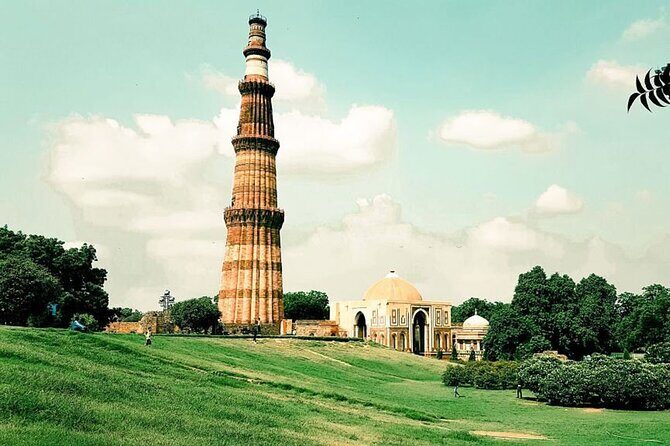
- Qutub Minar: 73 meters of stone and story
- Lotus Temple: modern faith in a flower shape
- Day 2 in Agra: Taj Mahal Timing and Agra Fort
- Taj Mahal: plan around the weekly closure
- Agra Fort: Mughal power after the big show
- Fatehpur Sikri and Panch Mahal: a big step back in time
- Day 3 in Jaipur: Hawa Mahal, Jal Mahal, City Palace, and Jantar Mantar
- Hawa Mahal: breeze-palace views for the curious
- Jal Mahal: a palace in the lake
- City Palace: where Mughal and Rajput meet
- Jantar Mantar: astronomy in stone instruments
- How Guides and Drivers Change Everything (Chaman, Vijay, Bobby, Aravind, Mantun)
- The Pace: Tickets, Walking, and the Day-Of Closure Reality
- Best Fit: Who This Tour Suits Most
- Should You Book This Golden Triangle Tour?
- FAQ
- How long is the Golden Triangle tour?
- Which cities are included?
- Is pickup and transfer included?
- Is the tour private?
- What’s included in the tour price besides transportation?
- Are hotel accommodation and meals included?
- Are monument entrance fees included?
- Which attractions are closed on specific days?
- What is the cancellation policy?
Key highlights worth planning around
- Private Delhi–Agra–Jaipur transport: you’re not stuck waiting on other groups.
- English-speaking guides: names you may meet include Chaman, Vijay, Bobby, Aravind, and drivers like Mantun.
- A mix of free and paid sights: India Gate and Lotus Temple can be quick wins; Qutub Minar and the Taj Mahal are ticketed.
- Clear closure notes: Taj Mahal is closed every Friday; several Delhi temples close Mondays.
- Breakfast included (3 days): handy when your days start early.
A 4-Day Private Golden Triangle That Fits Real Schedules
This Golden Triangle tour is built for people who want the headline sights of North India without turning the trip into a logistics puzzle. With private transportation and airport/hotel transfers, you can focus on seeing rather than negotiating rides, timetables, and meeting points.
The route makes sense for time. Delhi gives you a grand introduction to modern India alongside Mughal-era landmarks. Agra anchors the story with the Taj Mahal. Jaipur finishes the arc with Rajput architecture, especially the famous skyline drama of Hawa Mahal.
Because it’s private, your guide can usually adjust the order and pacing to match your group’s energy. If you want smoother sightseeing days and fewer “hurry up” moments, this format helps.
You can also read our reviews of more private tours in New Delhi



Price and Value: What $195 Covers (and What It Doesn’t)
At $195 per person, the value is in what’s included, not just what the price tag says. You get private transportation, water bottles, and an English-speaking guide for sightseeing. You also get fuel, toll plaza costs, and state taxes handled as part of the package, plus airport and hotel transfer.
What’s not included matters. Entrance tickets are listed at $50.00 per person, and meals and accommodation are not included. Tips aren’t included either, so you should plan a little extra for that.
A simple way to think about it: you’re paying for a guided, chauffeured route that hits major sites in a short window. If you already know you’ll be spending money on entrance tickets anyway, the package stays easier to manage. If you’re trying to keep costs extremely tight, the ticketed monuments will be the main variable.
Day 1 in Delhi: India Gate, Parliament Views, Humayun’s Tomb, Qutub Minar, and Lotus Temple
Delhi on day one is a blend of monuments and meaning. Some stops are quick and symbolic, while others bring you into the Mughal story with gardens and towering architecture.
India Gate and the Delhi Memorial feeling
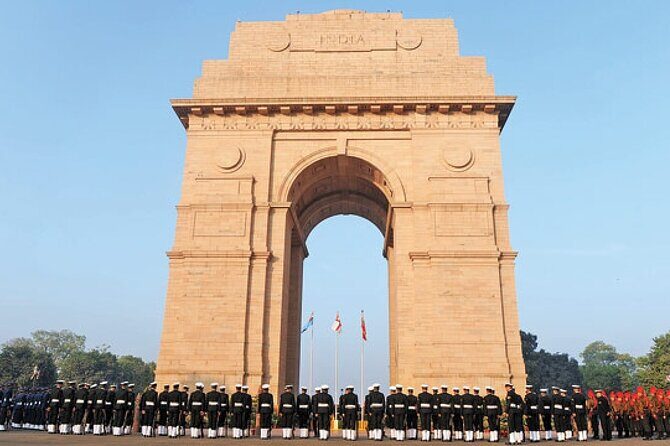
You start at India Gate (officially the Delhi Memorial). It’s a monumental sandstone arch dedicated to troops of British India who died in wars fought between 1914 and 1919. It’s free, so it’s also a low-pressure opener where you can get your bearings fast.
I like this kind of first stop. It helps you shift gears from travel-mode to sightseeing-mode without paying admission or committing to a long museum-style block.
Parliament House and Rashtrapati Bhavan: power on display
Next come Parliament House and Rashtrapati Bhavan. You’ll spend only a few minutes, but the details are striking: Parliament is India’s supreme legislative body with the President and two houses, Rajya Sabha and Lok Sabha. Rashtrapati Bhavan covers about 5 acres and is described with 340 rooms across four floors, plus Mughal Gardens with 159 varieties.
These are mostly exterior views and short looks. If you like architecture and governance history in one sweep, this works. If you’re expecting deep interior access, the time here will feel brief.
You can also read our reviews of more tours and experiences in New Delhi





Humayun’s Tomb: the garden-tomb that started something
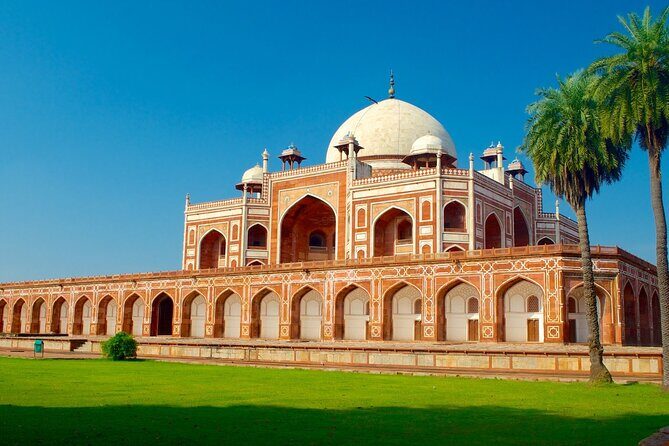
Then you head to Humayun’s Tomb, the first garden-tomb on the Indian subcontinent. It’s located in Nizamuddin East, near the Dina-panah Citadel, also associated with Purana Qila. This stop runs about an hour, and it’s not included for admission.
Even if you’re not a “tomb person,” garden-tombs change how you read Mughal design. You’re seeing how symmetry, landscaping, and architecture combine to create a calm scene rather than only a grand facade.
Qutub Minar: 73 meters of stone and story
From there, Qutub Minar comes in at about an hour, but admission is not included. The tower is noted as 73 meters high and built in 1193 by Qutub-ud-Din Aibak. It’s described as India’s highest tower, with five storeys and projecting balconies.
This is one of those places where timing matters. The earlier you get there, the more comfortable the light tends to be for photos. It also helps you avoid the midday “everything feels far away” fatigue.
Lotus Temple: modern faith in a flower shape
To close the day, you visit the Lotus Temple, a Bahá’í House of Worship dedicated in December 1986. It’s famous for its flowerlike shape and has free admission. This is a solid finish because it’s visually calm and easy to enjoy without feeling like you need to “power through” another ticketed site.
Day 2 in Agra: Taj Mahal Timing and Agra Fort
Agra is the emotional center of the Golden Triangle. The pace is still efficient, but the day is more about two anchors: the Taj Mahal and Agra Fort, with Fatehpur Sikri (Panch Mahal) added for scale.
Taj Mahal: plan around the weekly closure
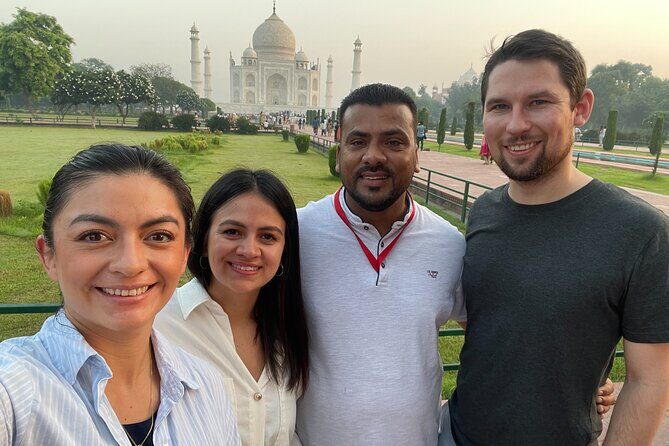
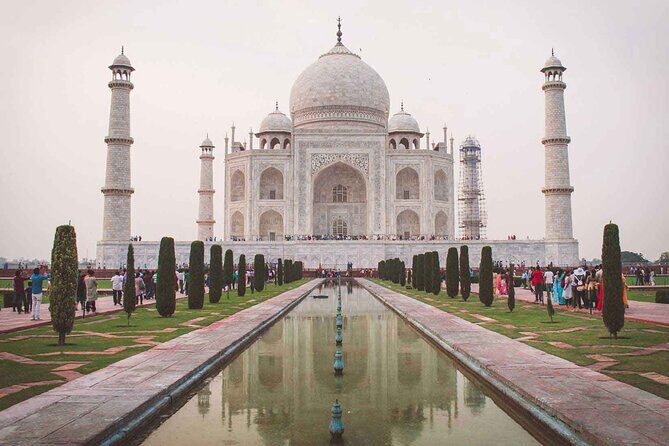
The Taj Mahal is scheduled for about three hours. It’s not included for admission, and there’s an important note: it’s closed every Friday. If your dates fall on Friday, you’ll either need to adjust your plan or accept that this signature stop won’t be on the schedule.
The Taj Mahal is an ivory-white marble mausoleum on the south bank of the Yamuna River. It was commissioned in 1632 by Shah Jahan. You don’t need to know every detail to appreciate the effect—this is one of those sights where symmetry, marble work, and atmosphere do the storytelling.
Agra Fort: Mughal power after the big show
After the Taj, you visit Agra Fort for about 45 minutes. Admission isn’t included, and the fort is described as the main residence of Mughal emperors until 1638, when the capital shifted to Delhi. It’s also identified as a UNESCO World Heritage site.
Agra Fort often feels less “picture-perfect” than the Taj, but that’s part of the value. It gives you the power structure behind the romance story, and it helps you understand how rulers lived, governed, and protected themselves.
Fatehpur Sikri and Panch Mahal: a big step back in time
The last stop of the day is Panch Mahal – Fatehpur Sikri (about one hour). Fatehpur Sikri is described as being constructed southeast of an artificial lake, on sloping levels of the Vindhyan hill ranges. The stop name includes Panch Mahal, pointing to palace structures within the broader Fatehpur Sikri complex.
This is a good way to keep day two from feeling like only one landmark. It adds variety: different building shapes, different scale, and a different kind of historical setting.
Day 3 in Jaipur: Hawa Mahal, Jal Mahal, City Palace, and Jantar Mantar
Jaipur is where the Golden Triangle turns theatrical. The architecture is made for views, angles, and photo stops—but it’s also genuinely interesting once you look closer than just the postcard.
Hawa Mahal: breeze-palace views for the curious
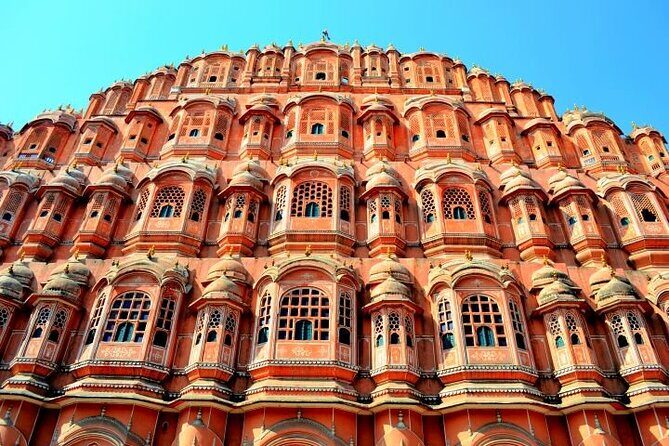
You start with Hawa Mahal (Palace of Breeze) for about 15 minutes. It’s described as a five-storey building and the tallest building in the world that was built without a foundation. The architecture is noted as curved, leaning at an 87-degree angle, with a pyramidal shape.
This stop is quick, but it pays off because it’s so distinct. If you like noticing design quirks—how the building shape drives the whole look of the neighborhood—this is one of the highlights.
Jal Mahal: a palace in the lake
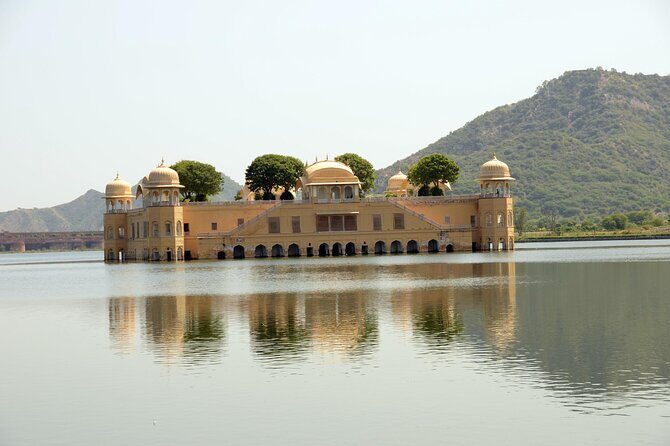
Next is Jal Mahal on Man Sagar Lake, scheduled for about 15 minutes. It’s a palace in the middle of the lake, constructed in 1699 and later renovated and enlarged in the 18th century by a Maharaja (the details are cut off, but the renovation timing is clear). This one is free.
Even if you can’t spend long here, the setting changes the feel of your day. You’re not just looking at stone walls—you’re seeing architecture paired with water, and it offers different light and different photo vibes than Hawa Mahal.
City Palace: where Mughal and Rajput meet
Then comes City Palace, about an hour, with admission not included. The complex is described as conceived and built by Maharaja Sawai Jai Singh II and as a fusion of Mughal and Rajput architecture.
This is the stop that tends to reward slower attention. If you’ve enjoyed Delhi’s tomb and tower contrasts, City Palace gives you a new kind of contrast: two architectural languages in one complex.
Jantar Mantar: astronomy in stone instruments
Finally you visit Jantar Mantar for about an hour. It’s an astronomical observation site built in the early 18th century, with about twenty main fixed instruments made of masonry. Admission isn’t included.
This is a great choice for travelers who enjoy science as culture. You’re looking at the physical tools used to measure the sky, which makes “time and space” feel real rather than abstract.
How Guides and Drivers Change Everything (Chaman, Vijay, Bobby, Aravind, Mantun)
A private tour shines when the team understands people, not just landmarks. I love when guides explain what you’re looking at and also give context that makes it click without turning it into a lecture.
In the stories shared during these trips, Chaman stands out for mixing India knowledge with personal stories that kept rides interesting. Vijay is described as accommodating and safety-focused. Bobby is praised for patience, good humor, and flexibility, including pointing out interesting sights along the way.
On the driver side, names like ARAVIND and Mantun come up with consistent themes: humble service, smooth coordination, and handling real-world issues like weather. One account even mentions unexpected rains, with Mantun working with guides to keep things on track.
If you value a calm, confident guide more than a speedrun itinerary, you’ll likely feel this difference immediately.
The Pace: Tickets, Walking, and the Day-Of Closure Reality
Golden Triangle trips can feel long because there are many major stops, not because the itinerary is messy. Plan for walking around monuments, moving between sites, and spending time waiting for the right light or the right entry window.
There are also schedule rules you should treat seriously:
- Taj Mahal is closed every Friday
- Delhi Red Fort, Lotus Temple, and Akshardham temple close every Monday
Those closure notes matter because they can shift your day’s order or replace a big stop. If you’re trying to see everything no matter what, pick dates carefully.
The good news is that some stops are marked as free, like India Gate and Lotus Temple on the day they appear in the schedule, plus Hawa Mahal and Jal Mahal. Those free stops are helpful when ticket lines or weather slow you down.
Best Fit: Who This Tour Suits Most

This private Golden Triangle works best for you if:
- you have limited time and want Delhi–Agra–Jaipur in one shot
- you prefer private transport over joining mixed groups
- you like learning from guides who can connect the architecture to everyday understanding
It’s also a strong fit for couples and small groups who want flexible pacing. When the driver and guide are described as patient and accommodating, that usually means fewer stress spikes when plans need adjustment.
If you’re the kind of traveler who wants slow museum hours every day, you might find three cities in four days feels intense. That doesn’t mean it’s wrong—it just means you should expect a lot of moving and a lot of “main sights” in limited time.
Should You Book This Golden Triangle Tour?
I’d book this if your priority is a well-run, private route that covers the headlines and doesn’t leave you wrestling with transport and basic timing. The biggest value is the mix of private transportation, transfers, guide support, and breakfast, paired with free quick-hit stops that keep you from feeling nickel-and-dimed all day.
I’d hesitate if you’re going on a date that hits the key closures, especially Taj Mahal on Friday, or if you want a trip built around included entrances and fully catered meals. The package is clear that accommodation, meals, and monument entrances are separate, so your final cost will depend on how you plan for that.
If you want, tell me your travel dates and your interests (architecture, photography, food, history). I can help you sanity-check the closure days and map which stops will feel most worth your time.
FAQ
How long is the Golden Triangle tour?
It runs about 4 days and includes 3 nights.
Which cities are included?
The route covers Delhi, Agra, and Jaipur.
Is pickup and transfer included?
Yes. Airport and hotel transfer is included, and pickup is offered.
Is the tour private?
Yes. It’s a private tour/activity, with only your group participating.
What’s included in the tour price besides transportation?
The included items listed are private transportation, water bottles, an English-speaking guide for sightseeing day, fuel/toll/state tax, airport and hotel transfer, and breakfast (3).
Are hotel accommodation and meals included?
No. Accommodation and meals are not included.
Are monument entrance fees included?
No. Entrance tickets are not included and are listed as $50.00 per person.
Which attractions are closed on specific days?
Taj Mahal is closed every Friday. In Delhi, Red Fort, Lotus Temple, and Akshardham temple close every Monday.
What is the cancellation policy?
You can cancel for free up to 24 hours in advance for a full refund. If you cancel less than 24 hours before the start time, the amount paid is not refunded.