REVIEW · NEW DELHI
Delhi City Tour: Heritage and Cultural Gateways
Book on Viator →Operated by India Voyages · Bookable on Viator
Nine hours, and Delhi feels mapped.
This Delhi City Tour: Heritage and Cultural Gateways is a full-day private circuit that strings together Old Delhi and New Delhi in an air-conditioned, chauffeur-driven vehicle. You start at 8:00 am and cover iconic Mughal sites plus modern landmarks like India Gate and the Lotus Temple—without haggling for taxis or losing time to confusing directions. It is built for people who want a focused snapshot of Delhi’s big story, fast and comfortable.
I especially like the private pace—only your group, so you can actually pause, look up close, and keep moving at a sensible rhythm. And I also like the way the driver experience shows up in real service: guides like Sumit are repeatedly described as punctual and professional, which matters when Delhi traffic is unpredictable.
One caution: several major monuments require separate entry tickets, including Red Fort, Humayun’s Tomb, and Qutub Minar. That means your total spend can rise a bit depending on what you choose to enter fully, and some stops are short by design (like India Gate at about 20 minutes).
In This Review
- Key Takeaways Before You Go
- Why This Delhi Day Works So Well (Red Fort to Lotus Temple)
- The 8:00 AM Start and How the Schedule Stays Realistic
- What You’ll See in Old Delhi: Red Fort and Jama Masjid
- Raj Ghat and India Gate: Gandhi, Memory, and National Symbols
- Viceroy’s House Photo Stop: A Quick Look at Presidential Power
- Humayun’s Tomb and the Garden-Tomb Idea That Changed How We Think
- Lotus Temple: Modern Faith, Quiet Attention (Free Entry)
- Qutub Minar’s Monument Cluster: Big Names, One Hour
- Birla Mandir Temple: Gardens, Shrines, and a Calm Finish
- Price and Value: What $30 Actually Buys You
- Who This Tour Fits Best (and Who Might Want More Time)
- My Decision: Should You Book This Delhi City Tour?
- FAQ
- What time does the Delhi City Tour start?
- How long is the tour?
- Is pickup offered?
- Are admission tickets included for all monuments?
- What’s included in the price besides transportation?
- Are meals included?
- Is this tour private?
Key Takeaways Before You Go
- Private AC vehicle + hotel transfers so the day starts easy and stays comfortable
- Old Delhi to New Delhi in one run: Red Fort to India Gate to Humayun’s Tomb and beyond
- Real-life punctual service (Sumit gets highlighted for being on time and professional)
- Mix of paid and free entrances: plan for tickets at the big ticket sites
- Not just monuments: you also stop at Gandhi’s cremation site area, plus major temples and tomb gardens
Why This Delhi Day Works So Well (Red Fort to Lotus Temple)
If you only have one day in Delhi, the hardest part is getting your bearings. This tour is built to solve that problem with a tight route that covers both halves of the city—Old Delhi for Mughal-era power, and New Delhi for the modern city plan and national memorials.
What makes it practical is that it pairs famous stops with short travel gaps inside one private vehicle. You’re not constantly switching plans, negotiating rides, or guessing how long a segment might take. The goal here is simple: see the big, meaningful sights and still feel like you had time to look.
You can also read our reviews of more city tours in New Delhi


The 8:00 AM Start and How the Schedule Stays Realistic
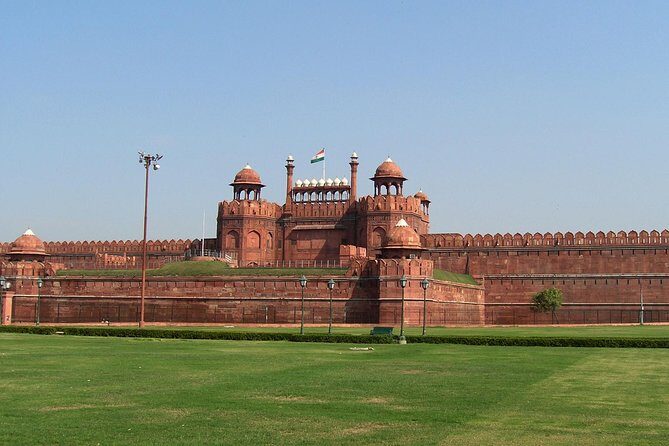
Starting at 8:00 am is a smart move in Delhi. The mornings tend to be easier for getting to key sites before the busiest crowds build, and you gain more usable sightseeing time for the paid-entry places.
The tour time is listed as about 9 hours, and the exact minutes can shift with the day’s traffic and the timing at each stop. That flexibility is normal in Delhi, so I recommend building in a calm mindset: you are not trying to cram every museum exhibit; you’re making sure you cover the major sights and understand what you’re looking at.
Also, this runs in all weather, so wear layers and keep a light rain option handy. Delhi can change mood fast.
What You’ll See in Old Delhi: Red Fort and Jama Masjid
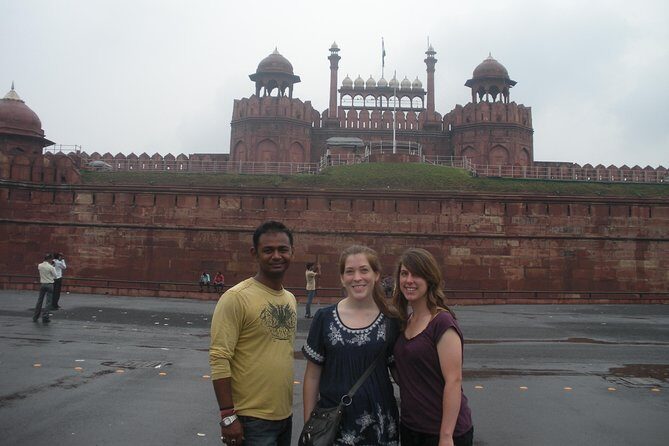
Old Delhi is where Delhi’s story feels most dramatic. The tour begins with Red Fort, a massive Mughal stronghold built starting in 1639 by the fifth Mughal Emperor Shah Jahan. It’s listed for about 2 hours, which is enough time to get oriented, walk key areas, and understand how the fort functions as both a historical monument and a site with multiple heritage spaces.
A practical tip: Red Fort is a big place, and you’ll get more out of it if you enter with a small plan. Aim to see the core courtyards and the main sights rather than trying to sprint through everything. Two hours sounds tight, but it is the right length for a first serious look.
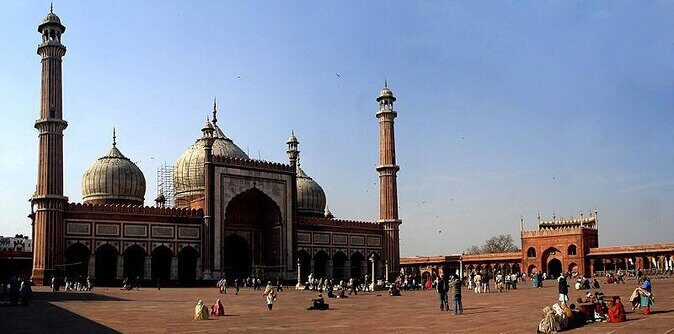
Next comes Jama Masjid, the Mughal-era mosque commissioned by Shah Jahan between 1644 and 1656. It’s scheduled for about 1 hour and noted as capable of accommodating more than 25,000 people for prayer. Even if you don’t go inside every section, the mosque’s scale hits you immediately—and it helps you understand how central religion and community were to the city’s design.
If you care about cultural context, this is one of the strongest pairings in the day: fort power first, then a place that shows how daily life and worship shaped the same era.
Raj Ghat and India Gate: Gandhi, Memory, and National Symbols
From Mughal Delhi, the route shifts into the quieter zone of reflection. Raj Ghat is the cremation site area for Mahatma Gandhi and several other major leaders (including Jawaharlal Nehru and Indira Gandhi among others). It’s planned for about 30 minutes, with free admission. In that short window, you get a strong sense of how Delhi functions as a national memory space, not just a sightseeing city.
Then you hit India Gate, the 42 m high war memorial arch on Rajpath. The stop is about 20 minutes and free to enter. India Gate is one of those places where even a short visit helps you connect Delhi’s layout: it sits in a designed ceremonial axis, so you’ll start seeing how New Delhi’s city plan works.
If your time is limited, this is a good section to keep moving. You’ll get the symbolism without draining the day.
Viceroy’s House Photo Stop: A Quick Look at Presidential Power
Between India Gate and the next major Mughal stop, you’ll pass the Viceroy’s House, now the official residence of the President of India. The tour includes this as a stop but doesn’t list a specific visit time.
In practice, this usually works as a short pause for orientation and photos from the right viewing areas. If you’re interested in how colonial-era architecture transitioned into today’s political roles, it’s a meaningful waypoint—even if it isn’t a long sit-down attraction.
You can also read our reviews of more historical tours in New Delhi






Humayun’s Tomb and the Garden-Tomb Idea That Changed How We Think
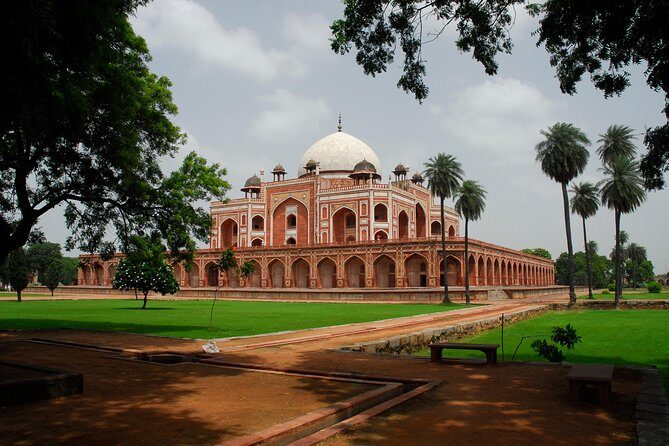
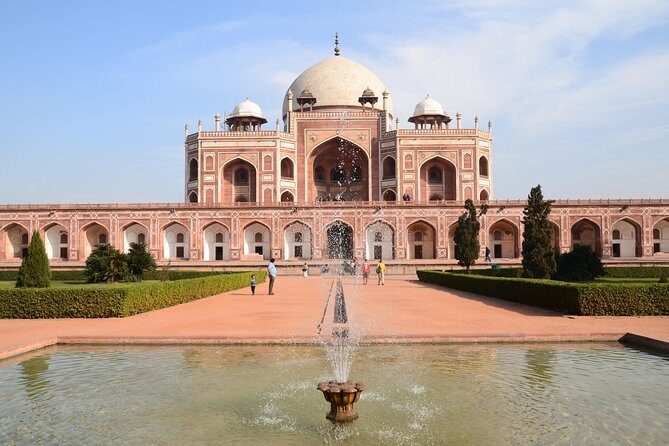
The tour then moves to one of the most “you can actually feel it” stops: Humayun’s Tomb. You get about 1 hour, and it is listed as not included for admission tickets.
The big reason this matters is that Humayun’s Tomb is described as the first garden-tomb in India, commissioned by Humayun’s first wife Bega Begum in 1569–70 and designed by Persian architects. That detail is worth remembering as you walk, because it explains why the site feels structured and intentional—more like an organized space of remembrance than just a single grave.
If you’re the type who likes architecture and planning, this is a highlight of the day. If you’re not, it still works, because the garden plan makes navigation easy and the atmosphere is calmer than many other major monuments.
Lotus Temple: Modern Faith, Quiet Attention (Free Entry)
After the Mughal tomb, you shift into something distinctly modern: Lotus Temple (Bahá’í House of Worship). It’s scheduled for about 1 hour and listed as free.
This stop is famous for its lotus-like shape, and it’s specifically mentioned as being one of Delhi’s most visited buildings in 2001 (reported by CNN). That popularity is part of why it’s such a good choice in a short itinerary: you don’t need to read a lot to recognize why it draws people in.
What I like about making time for Lotus Temple during a heritage-heavy day is balance. Red Fort and Humayun’s Tomb anchor the story in the past. Lotus Temple gives you a current look at how faith and design still shape Delhi.
Qutub Minar’s Monument Cluster: Big Names, One Hour
Next is the Qutub area, including Qutub Minar, the Quwwat-ul-Islam Mosque, the Iron Pillar of Delhi, and Smith’s Folly. The tour lists about 1 hour, with admission tickets not included.
The benefit of this tour is that it doesn’t force you to treat Qutub Minar as a long museum day. You get enough time to appreciate the main structures and their grouping, and you leave with a clear mental map of what Qutub Minar is and why the area matters.
The drawback is the same as with many high-profile heritage clusters: one hour can feel quick if you want to read every inscription or slow down in the details. If your priority is architecture photos and skyline views, the time works well. If your priority is deep historical study, you may want to return later for a longer visit.
Birla Mandir Temple: Gardens, Shrines, and a Calm Finish
To end strong, you’ll visit Birla Mandir Temple (Lakshmi Narayan). The stop is about 30 minutes and listed as free.
This temple is described as the first large Hindu temple built in Delhi, inaugurated by Mahatma Gandhi, and spread over 7.5 acres. The tour also notes fountains and a large garden with Hindu and nationalistic sculptures.
Even with a shorter time here, it’s a satisfying contrast to the earlier forts and tomb gardens. It feels more open and relaxed, and it’s a good place to slow your pace a notch before the drive back.
Price and Value: What $30 Actually Buys You
At $30.00 per person for a roughly 9-hour private day, this tour can be excellent value—mostly because of what is included.
On the “included” side, you get all taxes, parking fees, inter-state taxes, toll taxes, driver expenses, and handling charges. You also get an air-conditioned, chauffeur-driven vehicle and hotel transfers, plus a pickup start at 8:00 am. For many people, the real savings is not just money—it is stress. You skip the time and cost confusion of planning individual taxi rides between widely spaced monuments.
The biggest cost variable is admissions. Tickets are not included for Red Fort, Humayun’s Tomb, and Qutub Minar. Other major stops are listed as free, including Jama Masjid, Raj Ghat, India Gate, Lotus Temple, and Birla Mandir. So your final spend depends on how much you go inside at the paid sites.
Meals aren’t included, and the tour doesn’t list meals as part of the plan. Bring water, plan for a quick snack if needed, and don’t count on lunch being provided.
Who This Tour Fits Best (and Who Might Want More Time)
This is ideal for:
- First-time visitors trying to cover both Old and New Delhi without chaos
- People on a short schedule—like a business trip day or a stopover
- Anyone who values comfort, since the vehicle is air-conditioned and you get hotel transfers
- Solo visitors and mixed groups who want a private set-up rather than being rushed in a group
It may be less ideal if you want:
- Deep museum-style time at every major site (the paid attractions are time-limited)
- Unstructured wandering with no plan (the route is efficient on purpose)
If you like the idea of a driver like Sumit being punctual and able to keep the route moving, you’ll likely appreciate this style. Reviews also mention flexibility around what people wanted to see, including small extra sights, so you’re not locked into a rigid script.
My Decision: Should You Book This Delhi City Tour?
Yes, I’d book it if you want a clean, efficient “Delhi highlights” day with comfort and a clear route. The price looks strong for what you get—especially the private air-conditioned transport and the mix of Mughal, memorial, and modern landmarks.
I’d also book with one mindset tweak: treat it as a sightseeing framework. Use the morning and middle of the day to focus on the paid-entry monuments (Red Fort, Humayun’s Tomb, Qutub Minar), and treat the free stops as meaningful orientation points that still land emotionally—Gandhi at Raj Ghat, the national memorial at India Gate, and the calm at Lotus Temple.
FAQ
What time does the Delhi City Tour start?
The start time is 8:00 am.
How long is the tour?
The duration is approximately 9 hours, though exact timing can vary depending on traffic and the day’s schedule.
Is pickup offered?
Yes. Pickup is offered, and the tour includes hotel transfers.
Are admission tickets included for all monuments?
No. Admission tickets are not included for Red Fort, Humayun’s Tomb, and Qutub Minar. Other stops listed as free include Jama Masjid, Raj Ghat, India Gate, Lotus Temple, and Birla Mandir.
What’s included in the price besides transportation?
The price includes all taxes, parking fees, inter-state taxes, toll taxes, driver expenses, and handling charges.
Are meals included?
No. Meals are not included, and you’ll cover any personal expenses.
Is this tour private?
Yes. It is a private tour/activity, meaning only your group participates.