REVIEW · NEW DELHI
Delhi’s historical 7 hours experience tour
Book on Viator →Operated by SyN Travels · Bookable on Viator
Delhi makes sense in seven hours.
This is a fast, focused day that stitches together Old Delhi’s spice-market chaos with major Mughal-era landmarks and a few New Delhi classics. The format works well if you want real scale and context without spending your whole trip stuck in traffic. I like that it’s built around a tuk-tuk or rickshaw ride through narrow market streets, and I also like the comfort factor: you’re not doing it on foot all day thanks to an A/C vehicle and bottled water.
One thing to plan for: several big sights list admission as not included, and Lotus Temple is optional and can be closed on Mondays.
In This Review
- Quick hits before you go
- A 7-hour route that actually fits Delhi
- Jama Masjid, Humayun’s Tomb, and Qutub Minar: the Mughal spine
- Jama Masjid (about 30 minutes)
- Humayun’s Tomb (about 45 minutes, admission not included)
- Qutub Minar (about 40 minutes, admission not included)
- Old Delhi by tuk-tuk: Chandni/Khari Baoli, spice air, and street life
- The spice market rickshaw ride (about 45 minutes)
- Red Fort area stop (symbolic viewing)
- Raj Ghat and Agrasen Ki Baoli: reflection and an old water ritual
- Raj Ghat (about 30 minutes, free)
- Agrasen Ki Baoli (about 20 minutes, free)
- New Delhi breaks: India Gate plus two optional spiritual stops
- India Gate (about 30 minutes, free)
- Optional: Gurudwara Bangla Sahib (about 30 minutes, free)
- Optional: Lotus Temple (about 30 minutes, free, closed on Monday)
- Price, comfort, and what you may need to pay extra
- Should you book this Delhi historical tour?
- FAQ
- How long is the Delhi historical tour?
- Does the tour include hotel pickup and transportation?
- Is lunch included?
- Are entrance tickets included for all monuments?
- Is the Old Delhi rickshaw or tuk-tuk ride included?
- Is Lotus Temple part of the tour every day?
- What happens if the weather is bad?
- Can I cancel for a full refund?
Quick hits before you go
- Tuk-tuk/rickshaw through Old Delhi streets to experience the markets up close, not from behind a bus window
- Jama Masjid and Humayun’s Tomb anchor the Mughal story with big, iconic architecture
- Raj Ghat plus Agrasen Ki Baoli gives you a quieter, reflective break from the street-level motion
- India Gate and optional spiritual stops help you balance Old Delhi with New Delhi
- A/C car, parking fees, and bottled water keep the day comfortable for 7 hours
A 7-hour route that actually fits Delhi
Delhi is huge, and the distances can feel like a bad joke. This tour’s real strength is timing: it strings together the most important sights in a way that lets you see a lot without needing to be an expert navigator. You get about seven hours of structured sightseeing, with a mix of New Delhi landmarks and Old Delhi neighborhoods.
I also like that it’s set up as a private experience for your group only. That matters in Delhi, where even simple things like getting moving through busy areas can feel harder than expected. If your group wants to linger a bit, there’s room to do that. A strong guide helps a lot here, since the city can feel overwhelming fast.
One more practical note: this runs best with good weather. If rain or other conditions hit, the tour can be rescheduled or refunded, so you won’t be stuck with a wasted day.
You can also read our reviews of more historical tours in New Delhi



Jama Masjid, Humayun’s Tomb, and Qutub Minar: the Mughal spine
This tour gives you a clear line through Delhi’s Mughal architecture. It starts with Jama Masjid, then moves to the later Mughal mood at Humayun’s Tomb, and finishes with the older grand statement of the Qutub Minar area.
Jama Masjid (about 30 minutes)
Jama Masjid is the big opening act: built by Emperor Shah Jahan between 1650 and 1656, using red sandstone and white marble. It’s described as the largest mosque in India, and you can feel that scale when you’re standing in the space. This stop is listed at about 30 minutes, and admission is not included.
I like this as a starting point because it gives you a visual “rule set” for the rest of the day. Once you’ve seen how Mughal builders worked with symmetry, materials, and scale, everything else reads better.
Tip for your visit: wear clothing that fits mosque etiquette and be ready for indoor-to-outdoor shifts in temperature as you move between shaded and sun areas.
Humayun’s Tomb (about 45 minutes, admission not included)
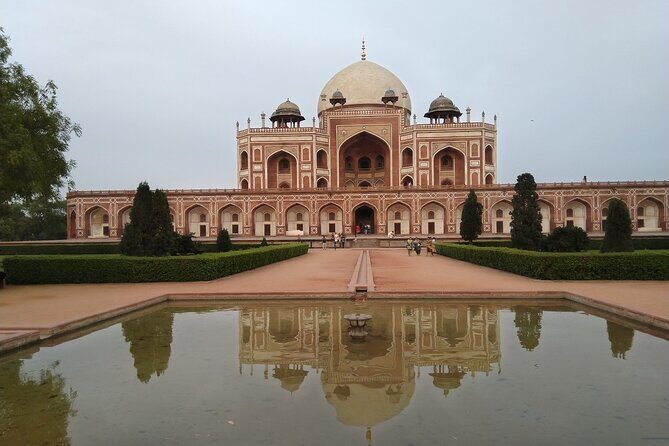
Humayun’s Tomb is the kind of place where you slow down a bit. It’s the last resting place of the Second Mughal Emperor of India, with the monument set in a landscaped garden. The description highlights pathways and water channels around the tomb, which is part of why this site feels calmer than the surrounding city.
This stop is about 45 minutes, but admission is not included, so check what you’re paying for before you arrive. Either way, the layout helps you understand Mughal tomb planning: the garden is not just decoration; it’s part of the experience.
Qutub Minar (about 40 minutes, admission not included)
Qutub Minar is an 800-years-old tower made from brick and red sandstone. It was built to commemorate the dominion of the Sultan dynasty in the 12th century, associated with Qutbuddin Aibak. Expect a strong “wow” factor here, especially if you’re used to flat city skylines back home.
Admission is not included, so budget for tickets if the entrance option isn’t selected.






Old Delhi by tuk-tuk: Chandni/Khari Baoli, spice air, and street life
If you come to Delhi and skip Old Delhi’s market energy, you miss a core part of why the city feels like a living museum. This tour includes an open tuk-tuk or rickshaw ride through narrow streets around the Old Bazaar area, with time spent at the spice market zone in Khari Baoli.
The spice market rickshaw ride (about 45 minutes)
This portion is built for the senses. You’ll ride through tight lanes, then you’ll also spend time around the market area where spices hang in the air and shop activity never really pauses. The ride is listed as including an admission ticket, so it’s one of the few segments where you should expect that the key access cost is handled.
This is also where you’ll feel Delhi’s daily rhythm: people moving goods, traders doing business, and the constant soundscape of a working market. It’s not a museum walkthrough. It’s a street scene.
Quick practical advice: keep water handy (you’ll have bottled water during the tour), go in with comfortable shoes, and don’t plan on a “perfect photo” moment every minute. The best payoff is the atmosphere and the contrast with the grand monuments later.
Red Fort area stop (symbolic viewing)
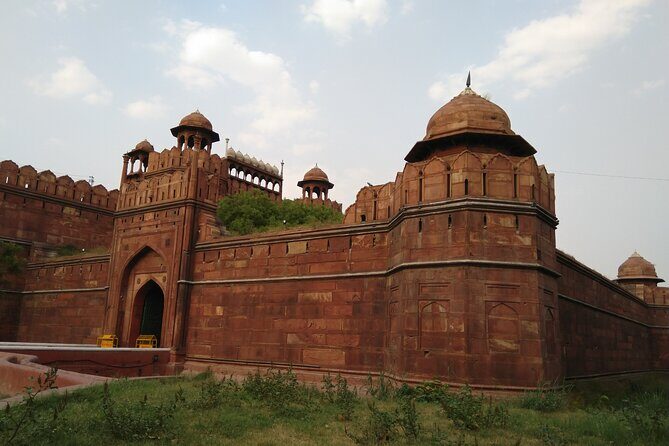
You also get a stop connected to the Red Fort, described as a massive citadel built by Shah Jahan in 1648 as part of his capital city, Shahjahan-Abad. In this tour, it’s framed as a big-picture look rather than a long, ticket-heavy deep visit.
That can be a plus if your goal is breadth. You’ll get the meaning and location of the fort in the day’s story, then shift into other stops without losing the clock.
Raj Ghat and Agrasen Ki Baoli: reflection and an old water ritual
The tour smartly breaks up the architecture with spaces that feel different. You get one very solemn stop connected to modern Indian history, and one older, more quietly interesting site tied to water and community.
Raj Ghat (about 30 minutes, free)
Raj Ghat is the cremation ground of Mahatma Gandhi. After his assassination, the last rituals were performed here, and the site is described as a beautiful garden that draws all kinds of visitors.
This is a short stop, about 30 minutes, but it lands well in a day like this. After the big visual scale of Old Delhi and Mughal sites, Raj Ghat gives you a chance to reset and remember the human story behind the names.
Agrasen Ki Baoli (about 20 minutes, free)
Agrasen Ki Baoli is an old reservoir-like structure often associated with a stepwell setup. It’s described as a 14th-century site, built by Lodhis or Tughlaqs, and used for harvesting rainwater for the local community. This is one of those Delhi stops that feels small on the map, but interesting when you’re there—especially if you like how cities managed water before modern plumbing.
This one is only about 20 minutes, so think of it as a “glance and absorb” moment. It’s free, which also makes it a good way to fill time without turning your day into a ticket-payathon.
New Delhi breaks: India Gate plus two optional spiritual stops
After Old Delhi and Mughal sites, the tour shifts toward New Delhi’s monumental, more open spaces. This part helps you understand the city’s layers: imperial, democratic, and spiritual.
India Gate (about 30 minutes, free)
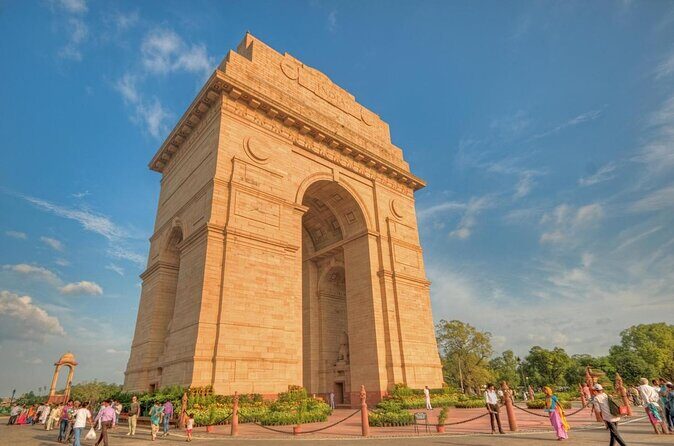
India Gate is a popular stop for both local and foreign visitors. It’s a 42-meter-high gate set in a garden area with views toward the President’s House to its west. This is a good “stretch your legs and breathe” pause after tighter areas earlier in the day.
Optional: Gurudwara Bangla Sahib (about 30 minutes, free)
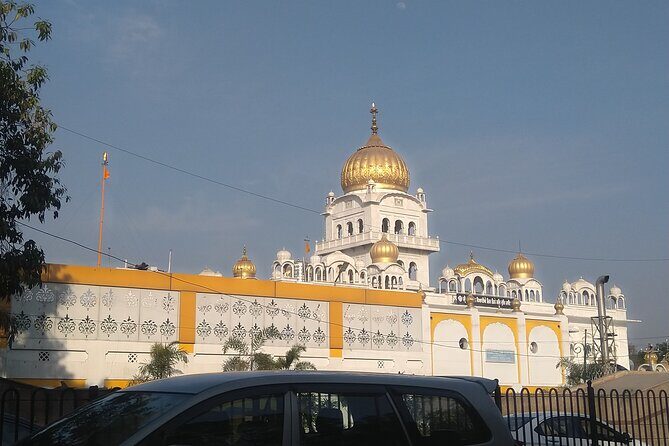
Bangla Sahib is described as the biggest Gurudwara in Delhi for Sikh religion among nine old Gurudwaras of Delhi. It’s listed as optional, so you can skip it if you want the day to stay tightly focused.
If you do go, this stop adds a spiritual and cultural tone that doesn’t compete with the architecture. It’s more about practice and atmosphere than big photo landmarks.
Optional: Lotus Temple (about 30 minutes, free, closed on Monday)
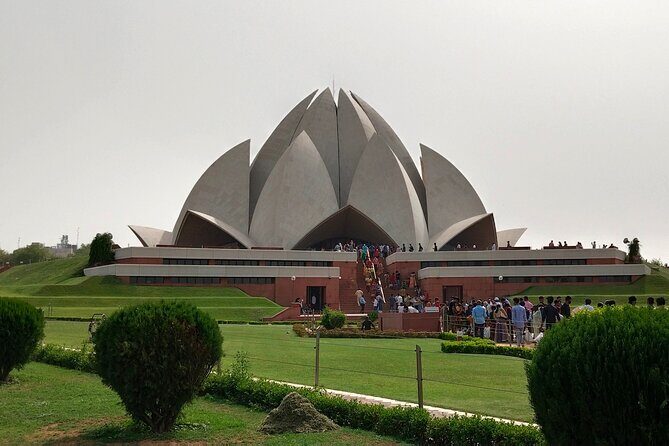
Lotus Temple is a marble lotus-shaped structure built for the Bahai religion. It’s located near the computer market of Nehru Place, and it’s listed as optional. The big heads-up: it’s closed on Monday.
This is the kind of stop where the design does most of the talking. If your trip includes a Monday, you’ll want to plan for an alternate route in your day’s logic.
Price, comfort, and what you may need to pay extra
The price is $29 per person, for an experience that runs around 7 hours. That’s a budget-friendly setup compared with the number of major landmarks packed in—especially since A/C vehicle, private transportation, parking fees, and bottled water are included.
That said, ticket details matter. The tour includes monument fees only if you select an option with entrances chosen by the guest. And in the itinerary notes, several stops list admission as not included, including Jama Masjid, Humayun’s Tomb, and Qutub Minar. Old Delhi’s rickshaw ride lists admission as included, and several other stops are free (Raj Ghat, Agrasen Ki Baoli, India Gate, Gurudwara Bangla Sahib, and Lotus Temple).
Lunch is not included, so you’ll need to budget time and money for food on your own. In a day this packed, having a simple plan helps: pick one low-effort meal option near where you end up, instead of trying to chase the perfect restaurant mid-tour.
Also, because this is a private tour for your group, you’re not sharing the day with strangers in a huge crowd. That usually improves your comfort and your pace.
Should you book this Delhi historical tour?
Book it if you want a smart sampler of Delhi in one day: Old Delhi market streets, major Mughal landmarks, plus a couple of New Delhi classics. It’s especially good for first-timers who don’t want to spend their vacation doing route math. The A/C transport and bottled water make the pace feel manageable.
Skip it or rethink if you’re strongly set on spending long hours inside ticketed monuments. Several major sites in this route list admission as not included, and your time at each stop is designed to be efficient rather than leisurely.
If you’re flexible, though, this tour is one of the cleanest ways to get oriented fast. You’ll leave with a stronger sense of how Delhi evolved—from Mughal grandeur to modern identity—without feeling like you tried to conquer the city alone.
FAQ
How long is the Delhi historical tour?
It runs for about 7 hours.
Does the tour include hotel pickup and transportation?
Yes. It includes pickup offered, plus an air-conditioned vehicle and private transportation.
Is lunch included?
No, lunch is not included.
Are entrance tickets included for all monuments?
No. Admission is listed as not included for Jama Masjid, Humayun’s Tomb, and Qutub Minar. Monument fees are included only if you choose the option with entrance.
Is the Old Delhi rickshaw or tuk-tuk ride included?
Yes. The Old Delhi rickshaw ride is listed as included, and its admission ticket is marked included.
Is Lotus Temple part of the tour every day?
Lotus Temple is optional, and it is closed on Monday.
What happens if the weather is bad?
The tour requires good weather. If it’s canceled due to poor weather, you’ll be offered a different date or a full refund.
Can I cancel for a full refund?
Yes. Free cancellation is available, and you can cancel up to 24 hours in advance for a full refund.