REVIEW · NEW DELHI
Private Golden Triangle Tour 5 Days Delhi Agra Jaipur
Book on Viator →Operated by Grand India Tours · Bookable on Viator
Three cities, one tightly run route.
The Private Golden Triangle Tour (Delhi–Agra–Jaipur) is built for people who want the big names without the stress of organizing trains, tickets, and transfers. You get a live English guide and a private vehicle, so the focus stays on the places themselves: Old Delhi’s Mughal monuments, Agra’s royal tomb-and-fort combo, then Jaipur’s palaces and observatory. In plain terms, it’s a fast way to get your bearings in North India.
Two things I like a lot: you’re not stuck with vague explanations, because you travel with a live English speaking tour guide at all destinations, and the guides get praised for clear, flexible guiding. Names that come up include Dr. Gopal Verma in Agra, and Mr. Jain and guide support that helps make the Taj Mahal day feel smooth. Second, the setup is practical: pickup is offered, you have private transportation throughout, and even small comforts like mineral water in the vehicle are included.
One consideration before you book: monument entry fees are not included. The package notes you’ll pay on the spot (listed at $95 per person), plus tipping is not included either. Also, this is a sights-heavy route, so expect longer days and plenty of standing and walking, especially around forts and historic complexes.
In This Review
- Key highlights to watch for
- Golden Triangle in five days: how the route really works
- Delhi day: Jama Masjid, Red Fort, Chandni Chowk, and the Mughal-era tour arc
- Old Delhi’s core landmarks
- Chandni Chowk: the market lesson
- Memorials and big-city landmarks
- Agra Fort, Itmad-ud-Daula, and Mehtab Bagh: a calmer day with strong payoff
- Agra Fort: power in stone
- Itmad-ud-Daula: the Baby Taj effect
- Mehtab Bagh: the view-building stop
- Taj Mahal and Fatehpur Sikri: the two-part culture punch
- Taj Mahal: more than a postcard
- Fatehpur Sikri: a historic city stop
- Jaipur highlights: City Palace, Jantar Mantar, Hawa Mahal, and Albert Hall
- City Palace: royal spaces plus museum context
- Jantar Mantar: science you can walk through
- Hawa Mahal: the quick wow
- Albert Hall Museum: a break with purpose
- Price and logistics: what you’re really paying for
- Guides and driving: why this tour can feel calmer
- Who this tour is best for (and who should think twice)
- Should you book the Private Golden Triangle Tour 5 Days?
- FAQ
- What cities are included in the 5-day Golden Triangle tour?
- Where does the tour start and end?
- How much does the tour cost per person?
- Is pickup included?
- Are the monuments included in the price?
- Is there an English-speaking guide?
- What about hotel and meals?
- What’s included in the tour besides guiding and transport?
- Is cancellation free?
Key highlights to watch for
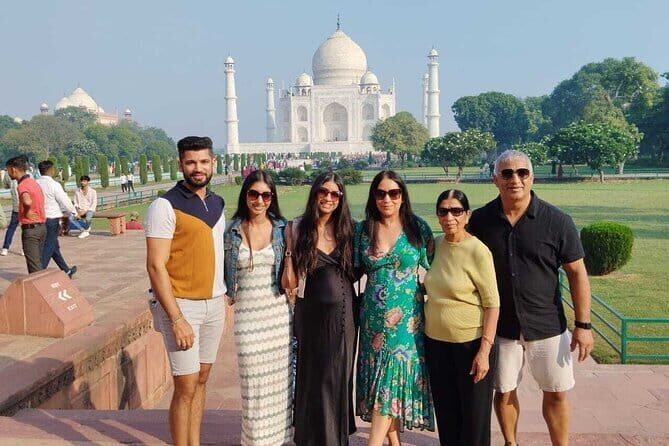
- A live English guide in every city so you’re not guessing at what you’re seeing
- Private car transfers that reduce time-wasting between stops
- Old Delhi on Day 1 with Jama Masjid, Red Fort, Chandni Chowk, and memorial sites
- Agra’s best mix of Agra Fort, Itmad-ud-Daula (the Baby Taj), and Mehtab Bagh views
- Jaipur’s royal + science combo with City Palace, Jantar Mantar, and Hawa Mahal
- Budget for on-site monument tickets (listed at $95 per person) and tips
Golden Triangle in five days: how the route really works

This tour’s strength is focus. Instead of spreading yourself thin across dozens of stops, you move in a clean loop: Delhi first, then Agra, then Jaipur, with return logistics back toward the Delhi starting point. The big monuments aren’t just “seen,” they’re sequenced in a way that keeps the days from turning into pure commuting.
You’ll also notice the pacing is built around landmark clusters. Day 1 concentrates on Old Delhi and nearby imperial monuments, Day 2 and Day 3 cover Agra and its surroundings, and Day 4 shifts fully into Jaipur’s sightseeing core. That matters because in North India, time is what you feel first—before you even notice the heat, you notice the wasted minutes in traffic and waiting. A private vehicle and a guide reduce that friction.
One more practical detail: breakfast is included four times. Since the tour runs about 5 days, that usually lines up with four hotel mornings, which helps you avoid having to plan meals during the most time-sensitive sightseeing stretches.
You can also read our reviews of more private tours in New Delhi



Delhi day: Jama Masjid, Red Fort, Chandni Chowk, and the Mughal-era tour arc
Delhi is two cities in one: Old Delhi’s Mughal-era lanes and New Delhi’s grand civic geometry. This day wisely covers both flavors without pretending they’re the same.
Old Delhi’s core landmarks
You start with Jama Masjid, one of India’s most iconic mosques. It’s a major Mughal-era statement, and it’s also the kind of place where architecture does more than look impressive—it helps you understand the scale of imperial Delhi. The stop is listed at about 30 minutes, so don’t expect a slow, museum-style visit. Instead, expect a short orientation plus time to take in the main views.
Next is the Red Fort, a UNESCO site that functioned as a symbol of Mughal power. The red sandstone walls and the fort’s enclosed layout give you an immediate sense of how authority was built into the city plan. With about 1 hour scheduled (and admission tickets noted as not included), you’ll want to use that hour to find the best exterior viewpoints and move with purpose inside.
Chandni Chowk: the market lesson
Then comes Chandni Chowk Market, around 30 minutes. This is where you get a real sense of everyday Delhi: narrow lanes, dense shopping streets, and food stalls. My tip here is simple: keep your expectations realistic. This isn’t a “browse leisurely for two hours” kind of stop. It’s a quick, sensory hit that helps you understand the living city that surrounds the monuments.
Memorials and big-city landmarks
After the old-city intensity, you pivot to more reflective stops:
- Raj Ghat (about 30 minutes), the memorial of Mahatma Gandhi
- India Gate (about 30 minutes), a war memorial designed by Sir Edwin Lutyens
- Rashtrapati Bhavan (about 15 minutes), the President’s residence and architectural landmark
- Humayun’s Tomb (about 1 hour), a UNESCO Mughal tomb complex
- Qutub Minar (about 1 hour), a UNESCO minaret site
This sequence is more than a sightseeing checklist. It gives you a timeline of Delhi—Mughal imperial architecture, colonial-era civic monuments, then a broader national story in memorial form. The one drawback is you’ll feel the day’s length. If you’re sensitive to long days, you’ll want comfortable shoes and a water plan.
You can also read our reviews of more tours and experiences in New Delhi




Agra Fort, Itmad-ud-Daula, and Mehtab Bagh: a calmer day with strong payoff
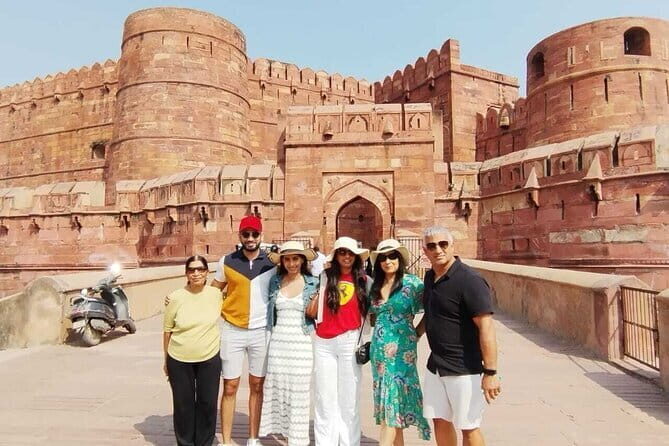
Agra isn’t only about the Taj Mahal. This tour builds credibility into the Agra portion by including two major “support” sights before the main white-marble moment.
Agra Fort: power in stone
Agra Fort (about 2 hours) is a UNESCO site made of heavy red sandstone and tied to the Mughal era. It’s described as the center of military and administrative life, and you’ll feel that immediately when you see how fortified the complex is. It’s also a good place to learn the idea that Agra’s monuments weren’t built as isolated attractions—they were part of how the empire functioned.
Itmad-ud-Daula: the Baby Taj effect
Then you go to Itmad-ud-Daula, often called the Baby Taj, with about 1 hour. Even if you’ve never heard that nickname before, you’ll get the message when you see the marble work and the careful detailing. If the Taj Mahal is the headline, Itmad-ud-Daula is the excellent supporting act that helps you appreciate workmanship and design choices.
Mehtab Bagh: the view-building stop
Next is Mehtab Bagh, a garden across the Yamuna River from the Taj Mahal (about 1 hour). The key idea here is that you’re not just visiting monuments; you’re stepping into the landscape of viewing. The tour notes the famous Taj view timing is especially good around sunset. Even if you don’t catch the exact moment, the location across the river still gives a different angle on the Taj Mahal’s mass and symmetry.
A practical note: gardens and river-adjacent areas can mean dust and wind. If you’re prone to allergies, bring what you need.
Taj Mahal and Fatehpur Sikri: the two-part culture punch

This is your headline day: Taj Mahal plus Fatehpur Sikri.
Taj Mahal: more than a postcard
You get about 3 hours at the Taj Mahal, with admission noted as not included. Three hours sounds generous, but in practice you’ll spend time entering, orienting, and then moving between key viewpoints. This is not a casual “quick look and go” stop.
What helps most is having a guide who can explain how the complex was designed and why it looks the way it does. The Taj Mahal is a lot of white marble, yes, but it’s also a geometry project—symmetry, gardens, and the way light changes the feel of the scene. The better your explanation, the less you just stare at the surface and the more you understand the intention behind it.
Fatehpur Sikri: a historic city stop
After Taj Mahal, you go to Fatehpur Sikri for about 2 hours. It’s described as a historic city near Agra built by Akbar, blending Persian, Mughal, and Indian architectural styles. That blending detail matters. It helps you see that Mughal India wasn’t working in isolation; it was absorbing and mixing design ideas.
One small caution: Fatehpur Sikri is a lot of walking across a large historic zone. If your legs get tired quickly, pace yourself, and don’t let photos turn into a sprint.
Jaipur highlights: City Palace, Jantar Mantar, Hawa Mahal, and Albert Hall

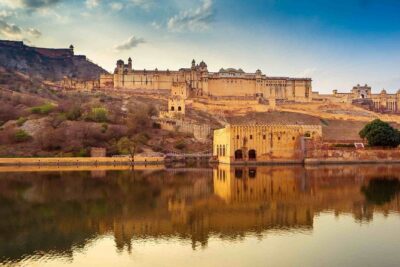
Jaipur is where the tour shifts from Mughal tombs and forts into Rajput and royal-city design. The stops are well chosen because they cover different kinds of “why this city matters.”
City Palace: royal spaces plus museum context
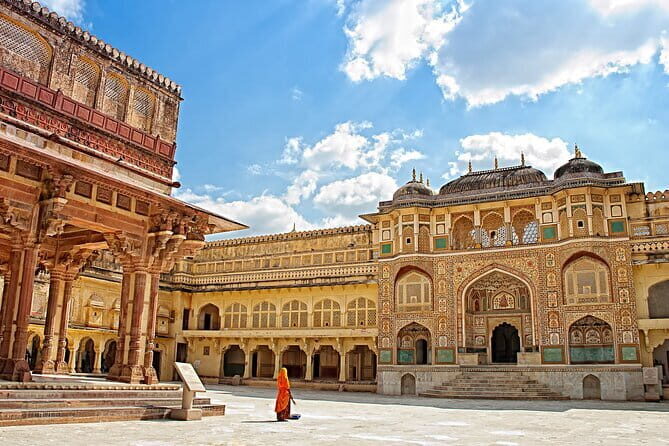
The City Palace of Jaipur takes about 3 hours. It’s described as a blend of Rajput and Mughal architecture with courtyards, museums, and intricate artwork. This is the time to slow down. Even if you’re not a museum person, the palace layout helps you understand how royal families lived and ruled—where public display met private structure.
Jantar Mantar: science you can walk through
Next is Jantar Mantar (about 1 hour). This observatory built in the 18th century has large instruments designed for measuring time and predicting celestial events. It’s one of those stops that becomes way more interesting once you realize it’s practical astronomy, built into monumental scale. If you like quirky facts, this is your Jaipur highlight.
Hawa Mahal: the quick wow
Hawa Mahal (Palace of Wind) is about 30 minutes and is listed as free admission. The key detail is the façade with 953 small windows (jharokhas). That number alone is a conversation starter. More importantly, the design shows how architecture can solve a climate problem while also turning into a visual brand of a city.
Albert Hall Museum: a break with purpose
Finally, there’s Albert Hall Museum for about 1 hour, described as the oldest museum in Rajasthan and built in Indo-Saracenic style. It’s a good “reset” after multiple open-air monuments, and it can help you connect the dots between royal design and regional art.
Price and logistics: what you’re really paying for

At $982 per person for a private 5-day Golden Triangle tour, you’re paying for three big buckets: private transport, a live English-speaking guide, and hotel accommodation. That combination is often what makes guided Golden Triangle trips feel easier than DIY.
What’s not included is the part people forget. Monument entry fees are not included, and the tour lists $95 per person for admission fees. That’s in addition to tipping for the driver, porter, tour guide, and representative. Since those are separate, I strongly recommend you assume the final cost will be higher than the base price and plan cash flow accordingly.
On the included side, I also like that the package calls out specifics that make travel smoother:
- Hotel accommodation with double/twin/single sharing options
- Breakfast (4)
- Mobile ticket
- Package mineral water bottle in the vehicle
- Traditional welcome by the representative at the airport in Delhi
Another practical point: this is a private tour. That usually means fewer compromises—less waiting around for strangers and more ability to match your group’s pace. Reviews tied to the company also mention safety and good driver behavior, which matters a lot on long intercity drives.
Guides and driving: why this tour can feel calmer
One of the strongest signals from real-world feedback is the value placed on guide explanations and driver care. In Agra, Dr. Gopal Verma is directly praised for explaining well and being flexible. Taj Mahal guiding is also credited to Mr. Jain in one account, and drivers are repeatedly described as friendly, punctual, and safety-minded, including names like Sanjeev, and other driver praise from other Golden Triangle and longer North India trips.
Even without focusing on names, the takeaway for you is clear: if you’re spending full days at big sites, the guide’s ability to explain quickly and adapt to your group matters. When that works, you spend less time wondering and more time enjoying.
Who this tour is best for (and who should think twice)
This tour makes the most sense if you:
- Want a high-impact route across Delhi, Agra, and Jaipur without organizing trains or day-by-day transport
- Prefer a private format with an English guide
- Like structured sightseeing that still includes real city texture (like Chandni Chowk)
You might want to reconsider if you:
- Hate long, packed days. The schedule is heavy, with multiple major sites each day
- Want fully included monument entry fees. You’ll pay on the spot for listed admissions
- Are looking for a slow, unhurried cultural journey. This is a “see the icons” package first
Should you book the Private Golden Triangle Tour 5 Days?
If your goal is to hit the headline monuments—Jama Masjid, Red Fort, Taj Mahal, City Palace, Jantar Mantar—while traveling with a guide who can make the history click, I think this is a strong value. The base price includes what you’d normally spend time and effort coordinating yourself: private transport, hotel stays, and an English-speaking guide across destinations.
My decision rule is simple:
- Book it if you want a smooth, guided route and don’t mind paying monument fees separately.
- Pass or negotiate on fees if you need every cost wrapped into one number.
If you do book, budget at least for the listed monument admission fees ($95 per person) and plan a bit for tips. Then pack comfortable shoes and expect a full five days of North India sights.
FAQ
What cities are included in the 5-day Golden Triangle tour?
The tour covers New Delhi, Agra, and Jaipur.
Where does the tour start and end?
It starts at Indira Gandhi International Airport in New Delhi and ends back at the meeting point area (airport/hotel in Delhi, as stated).
How much does the tour cost per person?
The price is $982.00 per person.
Is pickup included?
The tour includes pickup offered, and it also mentions a traditional welcome by a representative at the Delhi airport.
Are the monuments included in the price?
No. Admission fees are not included, and the package lists $95.00 per person to pay on the spot.
Is there an English-speaking guide?
Yes. The tour includes a live English speaking tour guide at all destinations.
What about hotel and meals?
Hotel accommodation is included, and breakfast is included 4 times.
What’s included in the tour besides guiding and transport?
Included items include private transportation, toll/parking/interstate tax and fuel charges, mineral water in the vehicle, and mobile ticket.
Is cancellation free?
Yes. The policy states free cancellation and that you can cancel up to 24 hours in advance for a full refund.