REVIEW · NEW DELHI
India eSIM (1 to 30 days. Up to 45GB of data)
Book on Viator →Operated by Xplori · Bookable on Viator
That first question is always: will my phone work?
This India eSIM is designed for one job—keeping your data on—so you can map routes, translate signs, and stay in touch without hunting for a local SIM. I like the email delivery (no waiting for a counter line), and I like that activation is QR-code based, so setup is quick once you’re ready.
The second thing I like is the practical coverage: it’s meant for use across India, including New Delhi and beyond, with 4G/5G where available for faster loading and smoother navigation. You also get a management layer (you can monitor usage and handle the plan from your phone), which matters when you’re traveling and don’t want surprises.
One thing to think about first: this is an eSIM, so you must have a compatible phone. The listing also notes that after you use the included high-speed data amount, your speed switches to 3G—fine for messaging and maps, but not ideal for heavy streaming.
In This Review
- Key things to know before you buy
- Why an India eSIM Beats Airport SIMs in Real Life
- Price, Data, and What 45GB Actually Buys You
- Setting It Up: eSIM Compatibility and QR Code Activation
- Using Your Connection in New Delhi and Across India
- Speed Limits, 3G Mode, and How to Plan Your Data
- Customer Service and Fixes When You Hit a Problem
- Who This eSIM Fits Best
- Should You Book This eSIM? My Decision Guide
- FAQ
- How do I receive the India eSIM?
- How long is the data plan valid?
- Does it work across India or only in New Delhi?
- What phone do I need for eSIM?
- What happens after I use the high-speed data?
- Can I cancel for a full refund?
Key things to know before you buy
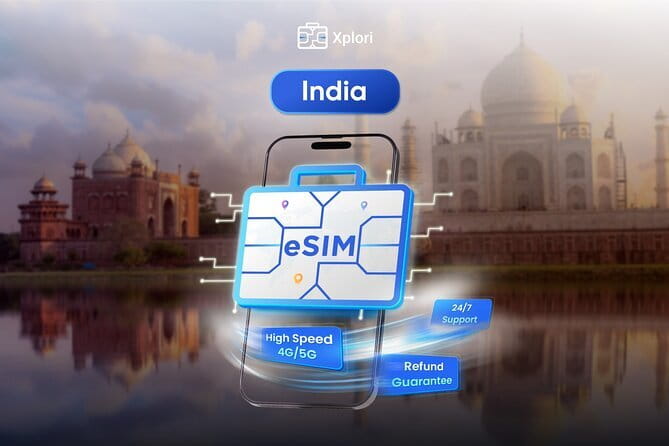
- Email delivery, quick activation: You receive the eSIM by email and activate by scanning a QR code.
- 4G/5G in India: You get 4G/5G where available for day-to-day travel needs.
- Data across India: The plan covers all Indian provinces, not just one city.
- Clear speed behavior after the cap: After the stated high-speed amount, speed drops to 3G.
- Works only with eSIM phones: The phone compatibility list matters—check before you order.
- No physical meetup: It’s a purely digital product, so there’s no pickup point in New Delhi.
Why an India eSIM Beats Airport SIMs in Real Life
India is one of those places where your phone is your trip co-pilot. Maps help, translation helps, and staying reachable helps—especially if your plans change or you’re meeting someone in a busy area. That’s what this eSIM is trying to solve: getting you online fast, without dealing with a physical SIM counter, paperwork, or language friction.
The big value is that you don’t need to stop your trip to get connected. This product sends the eSIM to your email, and once you scan the QR code, you can activate from your smartphone. No pickup. No meetup. No “wait until tomorrow to sort it out.” For me, that’s the core advantage: you handle connectivity before you’re stressed.
Also, the pricing is set up for short- to medium-length trips. At $5 per person, you’re not paying for a fancy add-on—you’re paying for reliable data access during your time in India. If you’re the kind of traveler who uses your phone constantly (routes, rides, messages, research), that cost can be cheaper than relying on roaming pricing from your home carrier.
One note to keep your expectations realistic: this is a data plan, not a replacement for voice service in every situation. The goal is internet access, not calling. But for most travel tasks, data is what you actually need most of the time.
You can also read our reviews of more tours and experiences in New Delhi.



Price, Data, and What 45GB Actually Buys You
The headline is simple: up to 45GB of data, depending on the duration you select. The listing says 1 to 30 days options, with another part mentioning options from 3 to 30 days depending on trip length. So you’ll want to match your choice to how many days you’ll be in India and how heavy your phone use is.
Here’s how I think about the value. Data costs are often most painful when you panic—when you get to the airport and realize your phone is the only way you can navigate the first day. With an eSIM, you usually remove that panic cost. You know the plan upfront, and you don’t have to gamble on airport pricing or immediate availability.
Now, the speed detail is important. The description says 4G/5G where available, then after the included high-speed amount, the plan switches to 3G. That means the plan is built for “travel internet,” not unlimited fast streaming forever. If you’re careful—using Wi-Fi when you can, downloading a few things before you go out—you’ll likely stay happy.
If you’re a heavy data user (constant video calls, lots of high-bitrate video, watching streamed shows on the move), you’ll hit the high-speed portion sooner. In that case, the price may still be good, but you should plan your media habits so the 3G phase doesn’t ruin your trip flow.
Bottom line: for most visitors, maps + messaging + normal browsing + translation are where this kind of data plan shines. It’s the smart “stay connected” choice for a set price, with a clear speed trade-off.
Setting It Up: eSIM Compatibility and QR Code Activation
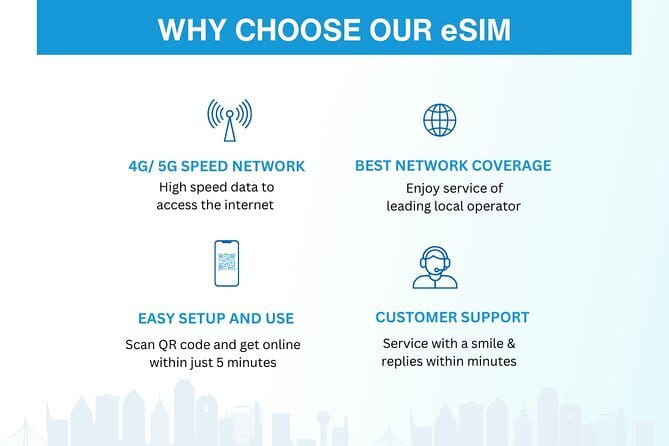
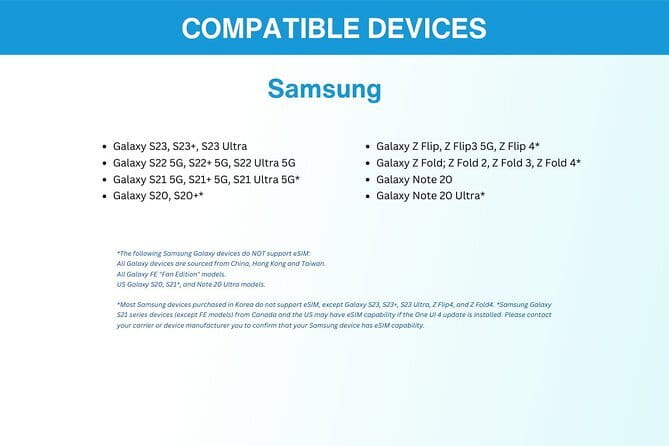
Before you buy, do the boring step that saves you from the annoying one: check phone support. The listing calls out several examples of eSIM-compatible phones, including:
- iPhone XS and later
- Pixel 3 and later
- Samsung S20/ S21/ Fold
If your phone model isn’t on the list, the instructions say to contact the provider in advance if you’re unsure. That’s worth doing. When connectivity matters, it’s better to confirm before you land.
The activation process is straightforward: you receive the eSIM by email, then scan the QR code to activate the eSIM profile. After that, you should be connected within minutes. This matters because the first hours in a new city are when you most want maps, directions, and the ability to quickly check ride options or message your contacts.
One more practical tip: eSIM activation can be easiest when you’re on Wi-Fi. You can do the QR scan on the spot, but if your settings are buried, having a stable connection helps you move faster. Also, take a minute to review your mobile data settings before you travel so you’re not digging for options mid-journey.
Finally, remember that this is digital. There’s no physical SIM to swap in, and there’s no pickup location in New Delhi. Your “meeting point” is basically your email inbox and your phone.
Using Your Connection in New Delhi and Across India

The start point is New Delhi, and that makes sense. It’s also where many travelers get their first taste of India’s scale and pace. When you’re in Delhi, data helps you do several small, important things that make the trip smoother:
- confirm routes and travel times
- find the right entrance or landmark when addresses are unclear
- message family or friends without relying on uncertain Wi-Fi
- look up current info on transit and local plans
The listing also says the data plan covers all Indian provinces. That’s a big deal if you’re bouncing between cities or doing day trips. You’re not paying for “Delhi-only internet.” You’re buying a single plan to keep you connected across India.
You’ll get 4G/5G where available, which can make a noticeable difference in how quickly pages load and how stable mapping feels. In practical terms, faster data helps you make decisions on the fly. You’re less likely to feel stuck with a slow connection.
One thing to keep in mind: coverage and speeds can vary by area. That’s normal anywhere, not a special warning. The plan is designed around mobile data access, and the 4G/5G promise is “where available.” In real travel terms, expect city areas and main routes to be better, and more variable performance in quieter or more remote zones.
Still, for a trip anchored in New Delhi, having a functioning data connection from day one is one of those “small” benefits that turns into a big comfort. It reduces uncertainty.
Speed Limits, 3G Mode, and How to Plan Your Data
This is where you should set expectations. The plan includes high-speed data up to the amount stated for your selected duration. After that, the listing says data speed switches to 3G.
That doesn’t mean your connection stops. It means it slows down. For most travel tasks—emails, messaging, basic web use, and map checks—3G can still do the job. What it may struggle with is anything that needs high bandwidth, like:
- streaming video at high quality
- heavy photo uploads in the moment
- constant high-resolution browsing
So here’s how I’d handle it with zero stress: treat the high-speed portion as your “must-have speed” time. Use it for planning the day, booking rides, checking routes, and doing the things you need done quickly. Then when you’re in a slower phase, shift to lighter tasks and Wi-Fi when you can.
This kind of staged experience is common with prepaid data products. The value is that the connection remains usable, just not always fast. If you go in expecting “always blazing,” you’ll be disappointed. If you go in expecting “reliable travel data with a speed drop,” you’ll feel in control.
A small extra advantage: knowing there’s a speed change helps you avoid the worst-case scenario—accidentally burning your whole high-speed allowance early by streaming on day one.



Customer Service and Fixes When You Hit a Problem
This is a digital product, so your support channel matters. The listing includes remote customer service by email. That means if something isn’t working—like activation issues or confusion about how to manage the plan—you don’t have to solve it alone.
The product description also indicates you can manage the eSIM in a user-friendly way using a dedicated app, including monitoring data usage and switching networks. That’s useful for two reasons:
- You can see how much you’ve used without guessing.
- You’re not stuck if settings need adjustment.
Still, with eSIMs, the most common real-world problems usually come from simple stuff: phone compatibility, activation steps not completed, or the phone not set to use the eSIM for data. If that happens, the fastest route is to check your phone’s eSIM status and data settings, then email support.
One practical mindset: treat activation like you’d treat checking in for a flight. Do it before you need it most. If you activate the eSIM when you’re calm (and ideally near Wi-Fi), you reduce the chance of a last-minute scramble on the day you’re trying to get around.
Who This eSIM Fits Best

This eSIM is a strong match if you want data for trip planning, navigation, and staying connected with friends and family. It’s also a good fit when you want to avoid the airport SIM rush and the small stress of dealing with local activation—especially if your travel timing is tight.
It’s particularly useful for:
- first-time visitors to India who rely on maps
- travelers who don’t want their whole day affected by SIM logistics
- people doing short-to-medium trips where you still want dependable internet
- anyone who wants to compare costs versus roaming charges
Where you might want a backup plan:
- If you use a lot of video streaming, you’ll likely hit the high-speed cap earlier and spend more time in 3G mode.
- If your phone doesn’t support eSIM, you’ll need a different connectivity solution. The listing explicitly warns to double-check compatibility.
The price helps make it a low-risk purchase for most travelers because you’re paying for connectivity, not a guided tour day full of activities. Your “experience” here is staying online enough to enjoy the trip with fewer friction points.
Should You Book This eSIM? My Decision Guide
If you’re traveling to India and you want one less thing to worry about, this is easy to recommend. The setup is designed to be fast—email delivery, QR activation, and data that works in India—and the cost ($5 per person) is low enough that you’re not taking a big financial swing.
I’d book it if you’re the type who uses your phone constantly for maps and communication and you want that connected feeling from the start in New Delhi and beyond. The up to 45GB high-speed allowance (based on your selected duration) plus the shift to 3G afterward is a predictable structure for travel internet.
I’d think twice or choose carefully if you know you’ll be streaming lots of video on mobile data, or if your phone model isn’t clearly eSIM-compatible. In those cases, you should confirm compatibility first, and consider your data habits.
Overall: this is a simple, practical purchase that helps you move through India with fewer stops and fewer surprises—exactly the kind of travel upgrade that pays off quietly every day.
FAQ
How do I receive the India eSIM?
You receive the eSIM by email after you order. Then you scan the QR code to activate the eSIM profile.
How long is the data plan valid?
You can choose between options from 1 to 30 days. The information also notes choices such as 3 to 30 days depending on your trip length.
Does it work across India or only in New Delhi?
The data plan is listed as covering all Indian provinces, not just New Delhi.
What phone do I need for eSIM?
Your phone must support eSIM. The listing gives examples like iPhone XS and later, Pixel 3 and later, and Samsung S20/ S21/ Fold. If you’re unsure, you should contact the provider in advance.
What happens after I use the high-speed data?
After you use the included high-speed amount, data speed switches to 3G.
Can I cancel for a full refund?
Yes. The experience has free cancellation. You can cancel up to 24 hours in advance for a full refund, based on local time. Canceling later than that does not refund the amount paid.