REVIEW · NEW DELHI
Taj Mahal & Agra Fort With Mother Teresa’s Missionaries Of Charity From Delhi
Book on Viator →Operated by New India Vacations · Bookable on Viator
5 a.m. is early, but Agra rewards you fast. This private day run strings together three very different sights: the Taj Mahal at its most magical time of day, the red-sandstone Agra Fort with Mughal-era power, and a stop at Mother Teresa’s Missionaries of Charity to see how care for children and elderly actually looks on the ground. I especially like the private AC car (you’ll appreciate it after a long drive) and the fact that your entrance fees and a professional guide are handled, so you’re not hunting around while jet-lagged. One real consideration: it’s a long day (about 12 to 14 hours), and the schedule starts very early.
You’ll also be happy with the practical add-ons that make the trip easier: breakfast or lunch at a 5-star hotel is included depending on the option, plus bottled water and WiFi on board. The only drawback I’d flag is the tour timing itself: if you’re sensitive to early starts or long hours in transit, this may feel like a lot in one gulp—especially since Taj Mahal is closed every Friday, which can affect your day.
In This Review
- The Early Delhi Pickup That Makes the Taj Mahal Worth It
- Taj Mahal: White Marble, Mughal Love Story, and Two Hours That Fly
- Agra Fort: What Red Sandstone Tells You About Mughal Power
- Mother Teresa’s Missionaries of Charity: A Direct, Human-Scale Stop
- Breakfast, Lunch, and the 12–14 Hour Rhythm
- Private Guide and Private AC Car: Less Hassle, Better Flow
- Optional Agra Souvenirs: Where to Spend If You Have the Time
- Price and Value: What $100.24 Buys You (and What It Doesn’t)
- Who This Tour Fits Best (and Who Should Think Twice)
- Should You Book This Delhi-to-Agra Day Trip?
- FAQ
- FAQ
- What time does pickup happen in Delhi?
- How long is the tour?
- Are the Taj Mahal and Agra Fort tickets included?
- Is breakfast or lunch included?
- How long do you spend at each main stop?
- Is admission required for the Missionaries of Charity visit?
- Is Taj Mahal open every day?
- What documents do I need to bring for entry?
- What’s included for comfort during the drive?
The Early Delhi Pickup That Makes the Taj Mahal Worth It

Your day starts with pickup from your Delhi hotel or the airport at 5:00 AM. Then it’s a drive to Agra in a private car with WiFi and bottled water, which is a nice comfort when you’re leaving home while most of the city is still asleep.
In Agra, the timing gives you breathing room before you step into the Taj Mahal experience. Instead of rushing straight into crowds, you get buffet breakfast on arrival, then you move into the main event. That order matters. Taj Mahal looks gorgeous anytime, but your focus stays better when you’re fed, hydrated, and not trying to do your first big tourist moment on an empty tank.
Also note the Taj Mahal closure detail: Taj Mahal is closed every Friday. If your dates land on a Friday, you’ll want to coordinate quickly with the tour operator so you don’t lose your anchor attraction.
Taj Mahal: White Marble, Mughal Love Story, and Two Hours That Fly
The Taj Mahal stop is built around one simple goal: getting you into the site at a pace that feels human. You’ll have about 2 hours at the Taj Mahal, with admission included.
This is the official kind of awe-in-a-stone-building. The Taj Mahal is an immense mausoleum of white marble, built in Agra between 1631 and 1648 by Mughal emperor Shah Jahan in memory of his wife—often described as a love story that inspired its creation. You don’t need a guidebook script to understand what you’re looking at. Even if you’re just there for great photos, the scale hits first: it’s big, balanced, and designed to draw your eyes from afar and keep pulling you inward.
What your guide helps with is the “why” behind the visuals. A good guide will point out how the design and placement create that iconic look you’ve probably seen a thousand times in pictures. It’s one thing to recognize the Taj Mahal from photos; it’s another to stand there and understand why the building has such strong symmetry and visual rhythm.
Practical tip: wear comfortable shoes and avoid anything too revealing, since dress rules can come up at major monuments. If your day starts at 5 AM, bring a light layer too. Morning air can feel cool even in seasons when midday warms up.
You can also read our reviews of more tours and experiences in New Delhi.



Agra Fort: What Red Sandstone Tells You About Mughal Power
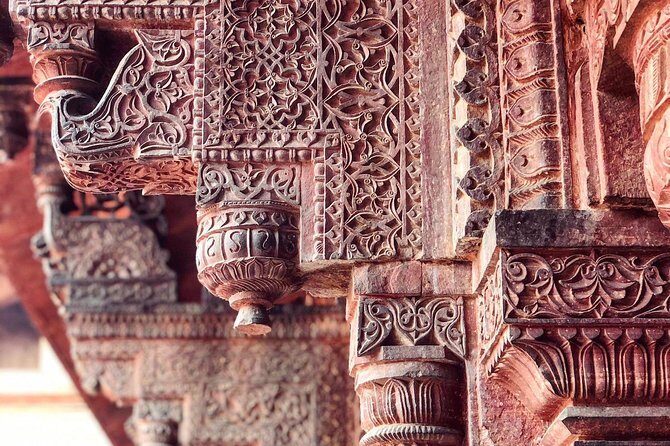
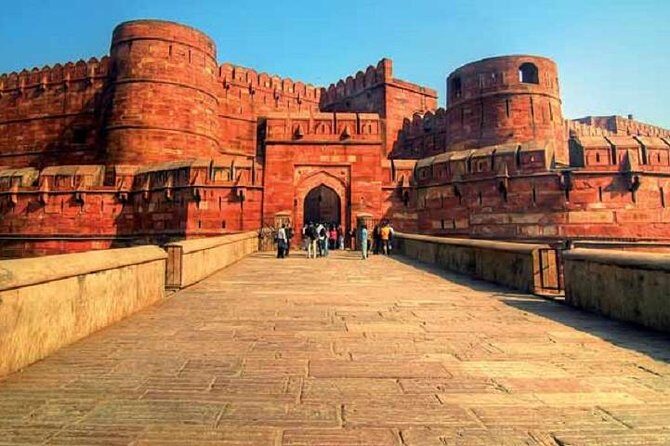
After the Taj Mahal, you head to Agra Fort (also called Lal-Qila, Fort Rouge, or Qilaa-i-Akbari—names you may see on signage and maps). This stop is about 1 hour, with admission included**.
Agra Fort is the opposite vibe from the Taj Mahal. Instead of delicate white marble and romantic symbolism, you get a fortress of red sandstone. It’s presented as a highlight of Agra and a key seat of power—once home to Mughal emperors and tied to the Mughal Sultanate era.
The best way to approach it is to treat it like a history machine. Even if you’re not a museum person, you can still read the fortress through simple cues: thick walls, strategic layout, and the sheer sense of control the fort was built to project. Your guide’s job here is to connect the architecture to how power worked during that period, rather than just reciting dates.
The main drawback is that you don’t get hours to wander freely—1 hour goes fast. If you love fortress details, you might want to spend a little extra time outside the core highlights (if your timing allows). If you’re happy with the big-picture experience, this is a reasonable amount of time.
Mother Teresa’s Missionaries of Charity: A Direct, Human-Scale Stop

Then you shift gears. The Mother Teresa’s Missionaries of Charity visit is about 30 minutes, and admission is listed as free.
This is the moment that changes the tone of the whole trip. Instead of monuments, you’re seeing real-life care and daily routines—nuns nurturing care for orphaned boys and girls, plus care for the elderly. The focus is on people, not sightseeing.
The setting also includes interaction time. The tour description notes that the children enjoy visitors and spending time chatting. That’s not a “performance” stop; it’s closer to a brief window into how this mission works as a community. It’s also why this part of the trip can stick with you longer than another photo-heavy landmark.
A practical consideration: this is not an “extreme touring” activity, but it is still a stop within a long day. Keep expectations realistic—30 minutes is short. If you want deeper involvement, you’d need a different kind of arrangement. For most people, though, it’s a meaningful counterbalance to the Taj and Fort.
Breakfast, Lunch, and the 12–14 Hour Rhythm

Food is handled in a very practical way. You’ll get buffet breakfast or buffet lunch in a 5-star hotel, depending on which tour option you choose. The day includes a local luxury air-conditioned multi-cuisine restaurant for lunch as part of the plan, so you’re not eating on the run.
Why this matters: Agra can be intense as a day trip. When you’re doing Taj Mahal plus Agra Fort plus a mission visit, the easiest way to feel cranky is to skip meals. Having food locked in means you spend energy on experiences instead of hunting for a decent table.
Also, the tour includes WiFi on board and bottled water. Small things, but they help when you’re dealing with an early start and long transfers. If you’re the kind of person who needs caffeine, plan for that either during the breakfast window or before you leave your hotel.
Private Guide and Private AC Car: Less Hassle, Better Flow
This is a private tour, meaning it’s just your group, with a private local professional guide and a private AC car. That setup is more than a comfort perk. It usually means:
- You can keep a steadier pace without waiting on other people.
- Your guide can adjust emphasis based on what you actually care about.
- You’re less likely to lose time to confusion over entrances and routes.
One thing I’d take seriously from the experience is the guide quality. In one account of the trip, the guide Manoj was singled out as exceptional for being informative and taking the group to Taj Mahal, Agra Fort, Mother Teresa’s Missionaries of Charity, and additional local sights in Agra. That kind of guiding matters on a day like this, because you’re juggling contrasts: romantic monument, fortress, and mission visit.
If your travel style is “I want to understand what I’m seeing without turning it into a lecture,” a good guide is the difference between a checklist day and a satisfying day.



Optional Agra Souvenirs: Where to Spend If You Have the Time
There’s an optional opportunity to stop for local art and craft in Agra. If you want to bring home items, the tour mentions specialties like:
- Stone-craft
- Zari embroidery
- Glassware
- Textile
- Jewelry
- Carpet weaving
This is helpful because it gives you a structured chance to shop without turning the day into a retail detour. The caution is simple: with a 12–14 hour itinerary, you don’t want to lose time by wandering too long. If shopping is on your list, it’s best to go with a quick mission: pick what you came for, ask questions, and keep your movement smooth.
Price and Value: What $100.24 Buys You (and What It Doesn’t)
At $100.24 per person, you’re paying for a very full package: private AC transport, a private local guide, Taj Mahal and Agra Fort entrance fees, WiFi on board, bottled water, and a buffet meal (breakfast or lunch) at a 5-star hotel depending on the option.
For value, I like how the big friction points are removed. Entrance tickets and a guide are included for the two major monuments. That means you can focus on seeing, not organizing. The Mother Teresa’s Missionaries of Charity visit is included too, with free admission, and it’s timeboxed so it doesn’t eat up your day.
What isn’t listed in the provided details is anything beyond the items shown as included. So you should budget for personal extras like tips, snacks outside the buffet, or any optional items you might buy while shopping.
Also, remember that this is positioned as a private tour, so you’re not getting the cheapest “share-a-van” price. You’re paying for structure, comfort, and guide attention.
Who This Tour Fits Best (and Who Should Think Twice)
This experience is a strong fit if you:
- Want a first-timer-friendly overview of Agra in one go
- Prefer private guiding and comfortable transport
- Appreciate having meals handled during a long day
- Like the idea of pairing major monuments with a mission visit that connects the trip to real people
It may not be the right match if you have physical concerns. The tour notes it is not recommended for participants with back problems, heart complaint or other serious medical conditions, and it is not recommended for pregnant woman. You should take that seriously. A day like this includes early pickup and long transfers, even with AC comfort.
One more “fit” check: you’ll want to be okay with modest dress rules. Avoid clothing that’s too revealing, since that can matter at major sites.
Finally, bring the right paperwork. You’ll need a current valid passport or ID with a photograph on the day of travel.
Should You Book This Delhi-to-Agra Day Trip?
I’d book it if you want a day that’s guided, structured, and meaningful—without the stress of managing tickets and timing yourself. The combination of Taj Mahal + Agra Fort + Missionaries of Charity, plus meal inclusion and a private AC car, is the core reason this works as a value choice.
I wouldn’t book it if your main priority is a slow, no-rush pace. This is an early-start, long-day experience. Also, if your dates are on a Friday, double-check what happens since Taj Mahal is closed that day.
If you’re a comfortable planner and you want your first Agra day to land the big moments with minimal fuss, this tour is a very practical pick.
FAQ
FAQ
What time does pickup happen in Delhi?
Pickup is scheduled for 5:00 AM from your hotel or the airport in Delhi.
How long is the tour?
The duration is about 12 to 14 hours, depending on traffic and weather.
Are the Taj Mahal and Agra Fort tickets included?
Yes. Entrance fees for Taj Mahal and Agra Fort are included as per the tour option.
Is breakfast or lunch included?
Yes. You get a buffet breakfast or buffet lunch in a 5-star hotel, depending on the tour option you select.
How long do you spend at each main stop?
The Taj Mahal visit is about 2 hours, Agra Fort is about 1 hour, and the Missionaries of Charity stop is about 30 minutes.
Is admission required for the Missionaries of Charity visit?
Admission is listed as free for the Missionaries of Charity center.
Is Taj Mahal open every day?
No. Taj Mahal remains closed every Friday.
What documents do I need to bring for entry?
You need a current valid passport or any ID that includes a photograph, and carry it on the day of travel.
What’s included for comfort during the drive?
The tour includes a private AC car, WiFi on board, and bottled water.