REVIEW · NEW DELHI
3 Days Private Luxury Golden Triangle Tour in Delhi, Agra, Jaipur
Book on Viator →Operated by TRAVELITE TAJ TOURS · Bookable on Viator
Golden Triangle can feel rushed. This 3-day private luxury loop keeps it organized, with private guides and easy transfers between major sights.
I especially like the way the day one pacing mixes Old Delhi classics with New Delhi landmarks, so you get contrast instead of the same vibe all day. I also like that the company builds in practical extras like a comfortable private A/C car and monument tickets, so you are not wasting time on logistics. One thing to watch: the program is packed, so you’ll want to be comfortable with early starts and steady walking between stops.
In This Review
- Key Points That Make This Tour Worth Your Time
- Three Days That Connect Delhi, Agra, and Jaipur Without the Daily Headaches
- Day 1 in Delhi: Tuk-Tuk Old Delhi, Jama Masjid, and the Quiet Big Gardens
- India Gate Area and New Delhi’s Planned Geometry
- Akshardham vs Humayun’s Tomb: Two Different Delhi Icons
- Qutub Minar: When Details Actually Matter
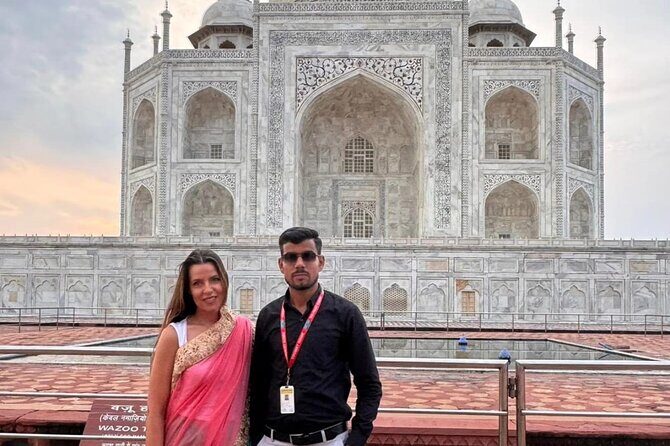
- Day 2 Starts With Taj Mahal Sunrise: The Marble Moment You Actually Remember
- Agra Fort and Itmad-ud-Daula: Mughal Power Up Close
- Fatehpur Sikri and Panch Mahal: A Stretch of Time Travel en Route to Jaipur
- Day 3 in Jaipur: Hawa Mahal Windows, City Palace Patterns, and Jal Mahal Calm
- Guides, Drivers, and the Little Things That Make It Feel Luxury
- Price and Value: What $120 Per Person Buys in Real Terms
- What to Pack and How to Survive the Tight Timing
- Should You Book This Private Golden Triangle Tour?
- FAQ
- How long is the 3 Days Private Luxury Golden Triangle Tour?
- What cities and major monuments are included?
- Where does pickup happen, and what time window is offered?
- Is transportation private or shared?
- Are monument entrance tickets included?
- What meals are included during the tour?
- What hotel options are available?
- Do I get a guide at the monuments?
- Can I choose where I finish the tour?
- Is free cancellation available?
Key Points That Make This Tour Worth Your Time
- Private pickup from Delhi-area: choose a start time between 9 AM and 11 AM, from Delhi, Noida, Gurugram, Ghaziabad, or Faridabad
- Old Delhi by tuk-tuk: ride past the colorful bazaars after meeting your guide near Sunheri Masjid
- Taj Mahal sunrise planning: early morning timing helps you see the marble monument at its most dramatic
- On-site live guides at monuments: you get explanations at each major stop instead of just passing by
- Meals and hotels included (3-star or 5-star): breakfast and dinners are built into the package
Three Days That Connect Delhi, Agra, and Jaipur Without the Daily Headaches
The Golden Triangle is famous for a reason: you hit big names in history, religion, and art across three cities. The trick is doing it in a way that does not turn your trip into a nonstop scramble. This tour is designed to keep you moving while still giving you time to actually look, ask questions, and take photos without the stress of public transit.
You start with pickup in the Delhi region and finish either back in Delhi or at Jaipur airport, so you can match the tour to your flight timing. The schedule also makes room for major highlights that people usually end up juggling on separate days, especially if you’re short on time.
The big value here is that you are paying for convenience plus interpretation. You get private transfers in an A/C car, monument tickets, and a live guide at the key sights, which means fewer gaps and fewer guesswork moments.
You can also read our reviews of more private tours in New Delhi



Day 1 in Delhi: Tuk-Tuk Old Delhi, Jama Masjid, and the Quiet Big Gardens
Day one is built around a smart contrast: chaotic markets, then monumental places, then a shift into planned urban design. You begin with pickup between 9 AM and 11 AM, then head to Old Delhi where you meet your guide near Sunheri Masjid. After that, you ride in a tuk-tuk past the bazaars while your guide explains how this neighborhood functions for locals, not just tourists.
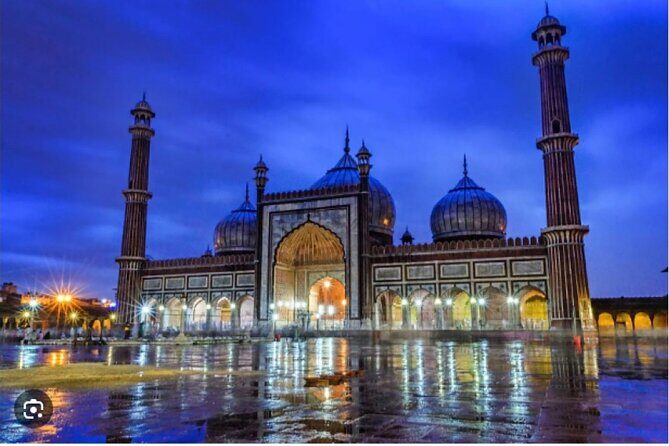
From there, Jama Masjid is the main anchor. It’s India’s largest mosque, built in 1656 with a workforce of 5,000 people. You’ll spend about an hour walking the red sandstone courtyard and getting a sense of how scale works in this space.
Next comes Gurudwara Bangla Sahib, where the story centers on the tank and healing legends tied to the 1664 visit by the eighth Sikh Guru. Even if you’re not deeply into religious sites, this is still a great “reset” stop after Old Delhi, and it usually feels calmer.
India Gate Area and New Delhi’s Planned Geometry
After the religious stops, the tour turns toward a different kind of history: memorial and design. You’ll visit the Tomb of the Unknown Soldier, built in 1921, with names of 13,300 Indian army servicemen carved into the wall who died during the First World War.
Then you move into the planned city story. The tour includes a view of the grand New Delhi layout built in 1929 by Sir Edwin Lutyens and Herbert Baker, who shaped much of the city’s core design. I like this part because it’s a break from Mughal and temple architecture and helps you understand why Delhi looks the way it does today.
If you’re the type who likes to connect dots, this half-day combo is useful. It ties together empire-era ambition, memorial remembrance, and urban planning in a way that feels like one continuous lesson instead of random stops.
Akshardham vs Humayun’s Tomb: Two Different Delhi Icons
Later in the day, you get a choice between Akshardham Temple and Humayun’s Tomb. Swaminarayan Akshardham is huge, with temple work created in 2005 that still looks like it belongs to a much older era because of the design style. This stop is short by design, so treat it like a first visual hit: see it, understand the concept, then move on.
Humayun’s Tomb is the UNESCO highlight if you choose it instead. It’s described as India’s first Garden Tomb, built after Humayun’s death at the request of his wife. The gardens and the tomb layout give you a more “slow-looking” experience, and it pairs well with the earlier contrast of Delhi’s dense Old City.
Either way, you get guided context without needing to figure things out yourself. That matters, because at both places, the architecture only starts making sense once someone points out what you’re supposed to notice.
Qutub Minar: When Details Actually Matter
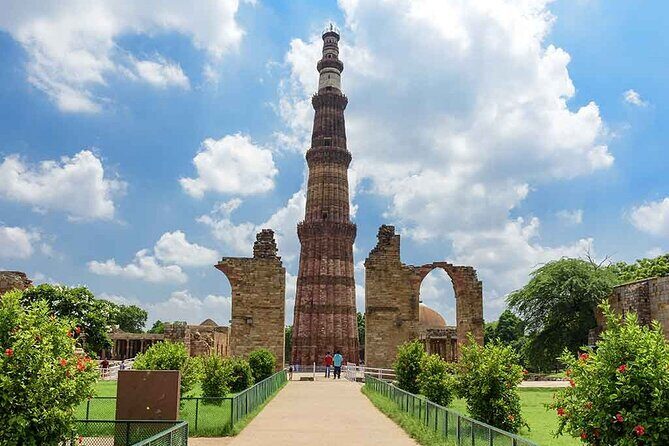
Qutub Minar is the final major Delhi monument before you head to Agra. The minaret is the tallest built with bricks, dating to 1192, and it sits within the UNESCO Qutub complex.
The reason this stop works on day one is timing. You’ve already seen multiple religious and cultural sites, so your brain is ready for an architectural landmark that has a clear shape and strong historical framing. Spend the time walking in and taking in the surrounding complex rather than treating it like a quick photo stop.
After Qutub Minar, you drive to Agra and drop at your hotel. The transfer is about 3 hours, so you’re unlikely to feel “still in Delhi” by the time you reach dinner. That’s good. You want your energy to reset for the Taj day.
You can also read our reviews of more tours and experiences in New Delhi






Day 2 Starts With Taj Mahal Sunrise: The Marble Moment You Actually Remember
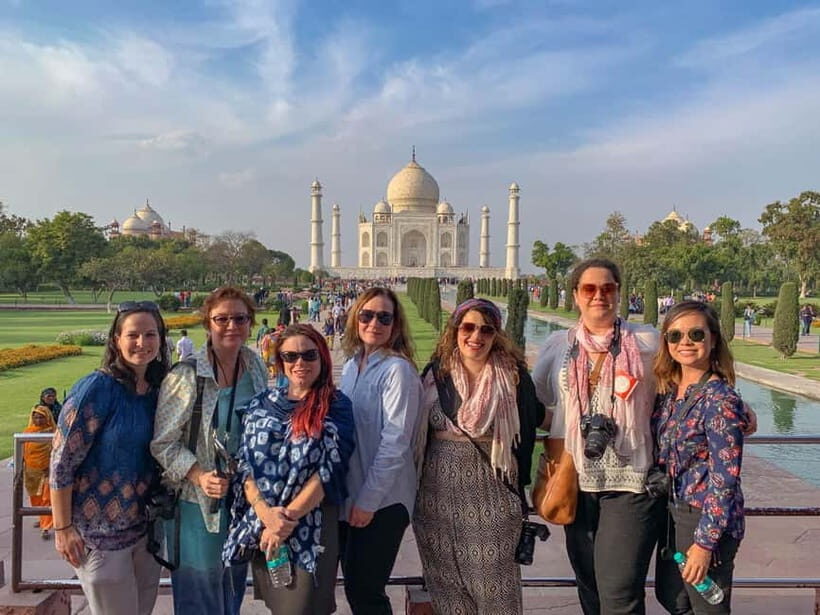
Day two begins early for the Taj Mahal sunrise view. The timing is the point. Taj Mahal looks stunning any time of day, but sunrise lighting is the part people tend to remember because it turns the marble into something softer and more cinematic.
You’ll spend about two hours at Taj Mahal, with time for the story behind it. The tour focuses on Emperor Shah Jahan building the mausoleum in 1630 for his favorite wife, and the tragic context that shaped the monument’s meaning.
You do not just stand there and hope you understand. A live guide helps connect the details: why this style, what the setting is doing, and how the monument fits into Mughal power and devotion.
Practical note: sunrise plans can be early enough to be uncomfortable if you are traveling from a late night. But it is one of the best ways to keep the Taj moment from feeling crowded and rushed.
Agra Fort and Itmad-ud-Daula: Mughal Power Up Close
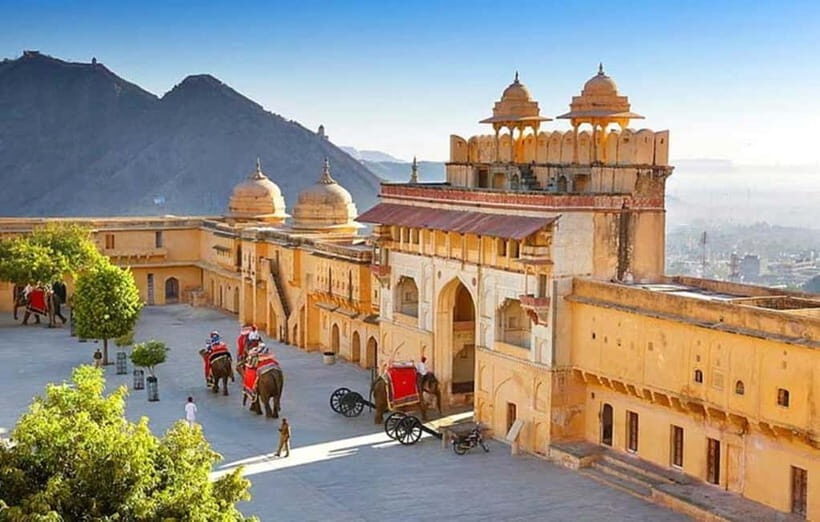
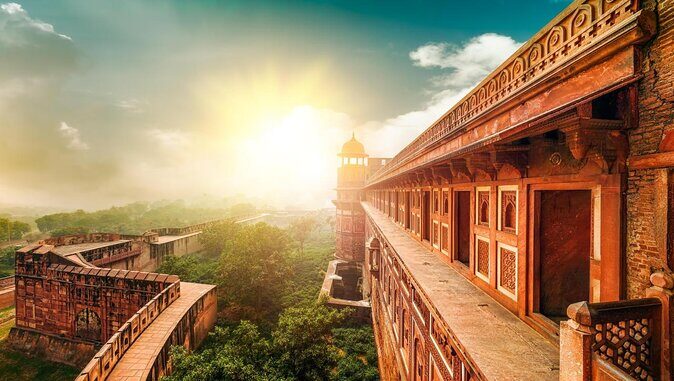
After the Taj, you go to Agra Fort, another UNESCO site and a major historical base. It’s described as a 17th-century fort blending Indian and Islamic art and architecture. This is a good contrast to Taj Mahal because it feels more fortress-and-rule than romance-and-memorial.
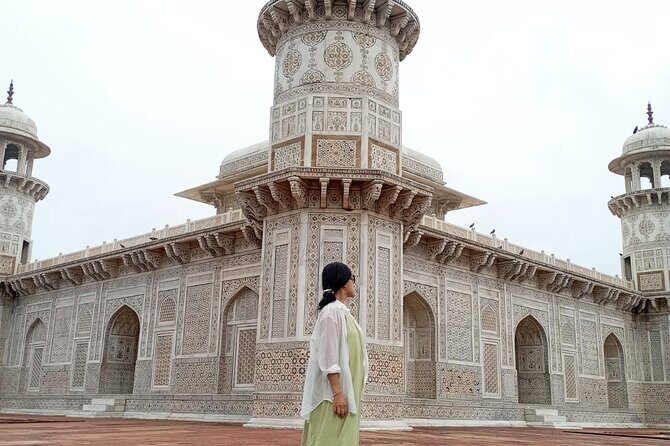
Next is Itmad-ud-Daula, sometimes called a major stepping stone in Mughal marble design. This stop is built on specifics the tour highlights: it’s said to be the first Mughal structure built completely from marble, among the first to use extensive pietra dura, and it’s a tomb on the banks of the Yamuna.
I like placing Itmad-ud-Daula here. It gives you a chance to see craftsmanship that feels close to your face, and it helps you notice how Mughal design evolves beyond one famous monument.
Fatehpur Sikri and Panch Mahal: A Stretch of Time Travel en Route to Jaipur
From Agra, the plan moves toward Jaipur with an added stop at Fatehpur Sikri, specifically the Panch Mahal area. It’s about 40 km west of Agra, and the tour frames it as a short-lived Mughal capital between 1572 and a later period.
Fatehpur Sikri works best when you don’t try to race every corner. Aim for the big shapes and the major spaces you pass, then linger where the guide points out the design ideas. Even with only about an hour, this stop can feel like a different chapter of Mughal ambition.
After that, you drive to Jaipur and drop at your hotel, around 3 hours. By the time you arrive, your mind has shifted from marble wonder to fort and city power, which sets you up nicely for day three’s Jaipur palaces.
Day 3 in Jaipur: Hawa Mahal Windows, City Palace Patterns, and Jal Mahal Calm
Jaipur on the last day is a celebration of design. It’s also a good way to end the trip because the city’s architecture is colorful and distinct without needing the same level of dramatic storytelling you get at the Taj.
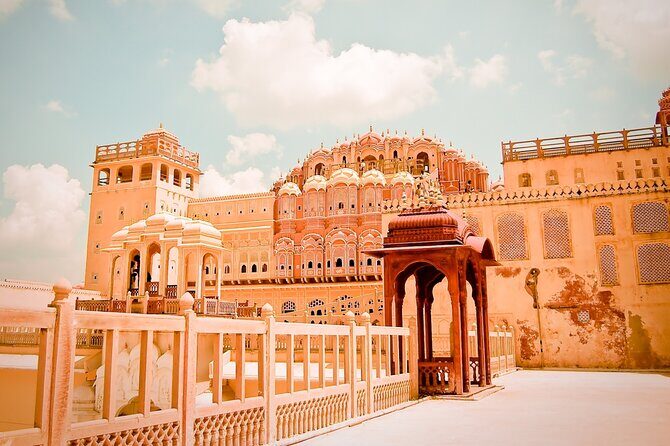
First stop is Hawa Mahal, the Palace of the Winds. The tour describes it as decorated with 953 windows and constructed in 1799 for royal ladies. The windows matter here because they’re not just a decoration. They connect the building to light, ventilation, and the way royal women could watch city life from a protected space.
Next is City Palace of Jaipur. You’ll explore patterned gardens and the palace architecture around the center of the city, with some reserved as a museum. The focus here is less about one single structure and more about how the palace complex functions as a living grid of spaces.
Then there’s Jal Mahal, which changes the tone again. It sits in Man Sagar Lake in Rajput-style architecture. The tour frames it as a 17th-century architectural beauty and a peaceful place for calm time. You get about 30 minutes here, so treat it like a breather rather than a long sit-down.
After Jal Mahal, you head back to the Jaipur hotel briefly, then continue to Delhi for the tour’s final transfer, about 4 hours. If your plans require it, you can choose drop-off at Jaipur airport instead.
Guides, Drivers, and the Little Things That Make It Feel Luxury
The “luxury” in this tour is not just the private A/C car. It’s the human layer: people who keep things moving while also making the sites make sense.
In past guest notes, the guide experience stands out again and again. Zaidy is specifically praised for extremely clear English and for being willing to answer questions, plus he’s noted as a strong photographer, which is handy if you want family shots without juggling your own camera while walking. Amir Khan is also mentioned as helpful, with clear explanations and good picture support.
On the driving side, Sonu gets praised for being on time and for driving safely. That matters on a multi-city schedule because any delays can cascade. A steady, professional driver makes the long stretches feel less stressful.
I also like the way coordination seems to work. One example in the feedback describes the company contacting the customer quickly after booking and staying in touch until the day of the tour. When you have early starts like sunrise Taj Mahal, that kind of communication is not a luxury. It’s sanity.
Price and Value: What $120 Per Person Buys in Real Terms
The price listed is $120 per person for a 3-day private luxury Golden Triangle package. What makes that number feel fair is what’s included: private A/C car transfers, monument tickets, live guides at the monuments, two breakfasts, and three dinners, plus two nights hotel stay with the option of 3-star or 5-star.
If you tried to build this yourself, you’d likely spend money on transport, entrance fees, and guide services anyway. The difference is that DIY often turns into a lot of small friction points: who meets you, where to go next, what time to depart, and how to understand what you’re looking at. Here, those friction points are reduced by design.
The main “value decision” you need to make is hotel level. Choose 3-star if you want to keep costs down and still get the same monument coverage. Choose 5-star if you want calmer evenings and a more comfortable base after long sightseeing days.
The tour is also private, so it’s often a better deal when you have a small group sharing the same car and guide attention. The tour description also mentions group discounts, which can make a real difference if your party size is right.
What to Pack and How to Survive the Tight Timing
Because the program is packed, your comfort choices matter. Wear shoes you can walk in for a few hours at a time. Bring a hat or something for sun protection, especially for the Taj sunrise plan and for Jaipur’s open viewpoints.
You also want some flexibility in your mindset. This is a highlights tour: you’re seeing a lot, not living slowly for each monument. If you treat each stop like a focused visit with a clear goal, you’ll enjoy it more than if you want to wander endlessly.
If you’re sensitive to early mornings, plan for that mentally the night before Taj day. The schedule starts early by design, and you’ll feel the difference in how the Taj visit goes when you arrive with energy.
Should You Book This Private Golden Triangle Tour?
Book this tour if you want a private, guided Golden Triangle with monument tickets handled and a tight route that still gives you time to see what matters. It’s a strong fit for first-time visitors who want the headline sights across Delhi, Agra, and Jaipur without getting stuck in transport hassles.
I’d skip it or adjust your expectations if you hate structured days and prefer a slow, unplanned travel pace. This route is meant to move, and you’ll be walking and transitioning between cities on a fixed timetable.
If you care about explanations and photos, the guide quality is a key reason to consider booking, especially with the kinds of praise attached to specific guides like Zaidy and Amir Khan, and driver support like Sonu. For many people, that guide-driver pairing is where the experience turns from sightseeing into a real trip.
FAQ
How long is the 3 Days Private Luxury Golden Triangle Tour?
It runs for 3 days, with timing described as approximate.
What cities and major monuments are included?
The tour covers Delhi, Agra, and Jaipur, including stops at places such as Chandni Chowk, Jama Masjid, Gurudwara Bangla Sahib, Humayun’s Tomb or Akshardham, Qutub Minar, Taj Mahal, Agra Fort, Itmad-ud-Daula, Fatehpur Sikri (Panch Mahal), Hawa Mahal, City Palace of Jaipur, and Jal Mahal.
Where does pickup happen, and what time window is offered?
Pickup is offered from anywhere in Delhi, Noida, Gurugram, Ghaziabad, or Faridabad, with a choice of pickup time between 9 AM and 11 AM.
Is transportation private or shared?
All transfers and sightseeing are done by a private A/C car with a driver, and the tour is private for your group.
Are monument entrance tickets included?
Yes. Monument tickets are included for the stops where tickets apply.
What meals are included during the tour?
Breakfast is included for 2 days, and dinner is included for 3 days. Lunch is not included.
What hotel options are available?
You can choose between 3-star accommodation or 5-star accommodation for the two nights, and both options include breakfast and dinner.
Do I get a guide at the monuments?
Yes. A private live tour guide is included at the monuments.
Can I choose where I finish the tour?
After sightseeing, you can return to Delhi, or you can choose drop-off at Jaipur airport.
Is free cancellation available?
Yes. You can cancel up to 24 hours in advance of the experience start time for a full refund.