Three days, three iconic cities, zero fuss. This route makes the big-name monuments feel manageable by pairing them with a private AC car and city guides, plus pre-included entry to several of the most famous stops. I especially like the way the plan stacks Mughal-era sites in Delhi, then saves its longest sightseeing block for the Taj Mahal.
One more reason I’m a fan: people often report that drivers like Husan or Shamsher Singh Bisht are punctual and drive safely, with guides such as Rashad Kumar helping you feel oriented and protected from the usual street-level chaos. The one drawback to consider is timing: a few attractions are only budgeted for about an hour, so you’ll need to move at a steady pace rather than linger.
In This Review
- Key highlights
- Golden Triangle in 3 Days: the pacing that keeps big sights doable
- Delhi Day 1: Jama Masjid, Red Fort, Humayun’s Tomb, and Qutub Minar
- Delhi drawback to keep in mind
- Agra Day 2: Taj Mahal and Agra Fort without rushing
- Agra drawback to keep in mind
- Jaipur Day 3: Jal Mahal, Hawa Mahal, and City Palace photos
- Jaipur drawback to keep in mind
- Private AC car, pickup, and guides: how you avoid the India-planning headache
- Price breakdown: what you pay and what you get
- What you’ll likely pay extra for
- Practical tips for a smoother Golden Triangle drive
- Should you book this 3-day Golden Triangle tour?
Key highlights
- Private AC car with pickup and drop-off so you’re not piecing together transport between cities
- Professional guide in each city to help you connect what you’re seeing with what it means
- Included monument entry for major stops like Taj Mahal, Agra Fort, Humayun’s Tomb, and Qutub Minar
- Taj Mahal gets the time (about 3 hours) instead of the usual quick-photo treatment
- Reliable driving is repeatedly praised, with named drivers such as KD, Husan, Kuldip, and Bisht mentioned for safety and punctuality
- Mobile ticket + mineral water bottle adds small, real-world convenience
Golden Triangle in 3 Days: the pacing that keeps big sights doable
This is the classic Golden Triangle shape for a reason. You’re covering three cities that most people treat as a once-in-a-lifetime combo, but doing it in a tight loop: Delhi first, then Agra, then Jaipur. What makes this plan workable is the balance between travel time and sight time, plus the fact that you’re not negotiating tickets, cash, and transport on your own.
The tour runs about 3 days with daily sightseeing blocks that mostly stay around an hour, except Taj Mahal. That approach is a practical trade-off. If you try to overstuff the day, you lose your attention. If you schedule too little, you end up staring at the same wall for photos only. Here, the schedule keeps your brain engaged.
Also, because it’s a private tour/activity with only your group, the day usually feels cleaner and more controlled than a shared-van style plan. You can keep a consistent pace without waiting for strangers to finish bargaining with a scarf vendor.
You can also read our reviews of more tours and experiences in New Delhi.



Delhi Day 1: Jama Masjid, Red Fort, Humayun’s Tomb, and Qutub Minar
Delhi on this route is built around Mughal-era architecture and the kind of landmark density that can overwhelm you if you’re doing it solo. The order matters: you start with Jama Masjid in Old Delhi, then move into Red Fort, and finish with UNESCO-listed monuments farther along the Mughal timeline.
Jama Masjid (about 30 minutes, entry included)
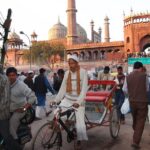
You get a focused introduction to one of India’s largest mosques, built by Mughal Emperor Shah Jahan. The time block is short, so use it like a first look. Prioritize the big visual cues: scale, the carved details, and the sense of being inside a grand complex. The upside of the short slot is that you’re not left rushing at the end of the day to find somewhere to eat or catch your driver.
Red Fort (about 1 hour, entry included)
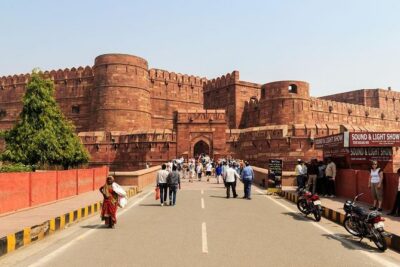
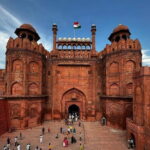
The Red Fort is a UNESCO site with stunning red sandstone walls and a long role in Mughal history. One hour is enough to appreciate structure and layout, especially if your guide helps you connect the dots. This is also a good stop for people who like architecture more than shopping, because there’s plenty to notice without needing extra add-ons.
Humayun’s Tomb (about 1 hour, entry included)
This one is a favorite on many itineraries because it’s specifically linked to later Mughal design. You’ll spend time at Humayun’s Tomb, a UNESCO World Heritage site built in 1570, and you’ll learn how it inspired the architectural language used in the Taj Mahal. If you enjoy seeing patterns across time, this stop gives you that payoff.
Qutub Minar (about 1 hour, entry included)
Qutub Minar adds a different flavor: Indo-Islamic architecture and inscriptions dating back to the 12th century. Plan to use your time intentionally here. Don’t treat it as just a tall photo object. Look for the details your guide points out, especially the inscriptions, since they’re one of the things this stop is specifically known for.
Delhi drawback to keep in mind
With three 1-hour blocks plus a 30-minute mosque, you’ll feel the schedule moving. If you’re the type who needs extra time to wander and people-watch, you may want to choose your favorite stop on Day 1 and really spend your attention there.
Agra Day 2: Taj Mahal and Agra Fort without rushing
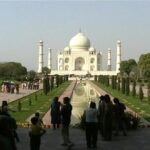
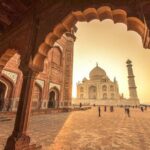
Agra is where this tour earns its name. The itinerary gives Taj Mahal the longest single sightseeing slot on the whole trip (about 3 hours), and that matters. When you have more time, you can do more than one thing: watch the light change, take in the marble inlay work, and slow down enough to notice proportions.
Taj Mahal (about 3 hours, entry included)
You’ll see it framed as a symbol of love, built in the Mughal tradition with intricate marble inlay work. The practical value of this time allocation is simple: it reduces the stress of rushing between photos. Instead, you can pace yourself and still cover the highlights your guide is likely to explain.
Agra Fort (about 2 hours, entry included)
Next comes Agra Fort, another UNESCO site with red sandstone architecture and sweeping views of the Taj Mahal. Two hours gives breathing room to look at the fort’s materials and structure, and to enjoy the viewpoint connections without turning everything into a stopwatch race.
Itmad-ud-Daula, often called the Baby Taj (about 1 hour, entry included)
This stop is short but meaningful. It’s a Mughal mausoleum built between 1622 and 1628, known for Persian-inspired architecture and intricate marble inlay work. If the Taj Mahal feels too large to absorb fully, Itmad-ud-Daula often works better for people who enjoy fine detail.
Agra drawback to keep in mind
Even with good scheduling, Agra’s big sights tend to draw crowds. The fix is mindset: treat your time like a structured walk with breaks, not a free-roam day. Guides help most when you follow their cues rather than chasing every angle yourself.


Jaipur Day 3: Jal Mahal, Hawa Mahal, and City Palace photos
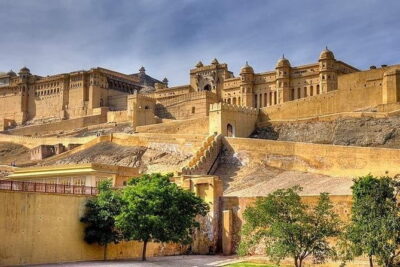
Jaipur is where the route shifts from Mughal grand scale to Rajput-and-Mughal visual mixing. Day 3 is designed as a sequence of recognizably “photo-able” landmarks, each with its own style language, so you keep feeling variety instead of repeating the same sightseeing mood.
Jal Mahal (about 1 hour, entry included)
Jal Mahal is described as the Water Palace, a five-story palace located in the center of Man Sagar Lake, mixing Mughal and Rajput styles. Spend your time thinking about perspective. This is the kind of landmark where your viewpoint matters as much as your camera.
Hawa Mahal, Palace of Breeze (about 1 hour, entry included)
Hawa Mahal is a five-story facade with intricately designed windows and a pink sandstone look. The best use of your hour is to notice how the windows shape the building’s personality. It’s easy to think of this stop as an exterior-only photo stop, but the architecture details are the whole point.
City Palace (about 1 hour, entry included)
You’ll visit the City Palace, described as a royal residence with majestic architecture, intricate carvings, and expansive courtyards. The design language here is built for appreciation on foot: carvings, patterns, and spatial layout. One hour is enough to feel the “royal residence” concept without burning your whole day on just one complex.
Jaipur drawback to keep in mind
Day 3 is dense with visually strong stops, which can make it feel like you’re moving from facade to facade. If you like museums or slower walks more than landmarks-with-angles, you might want to mentally prepare for a more “see it, appreciate it, move on” style day.
Private AC car, pickup, and guides: how you avoid the India-planning headache
The headline feature here isn’t any single monument. It’s the way you’re transported and guided across three cities.
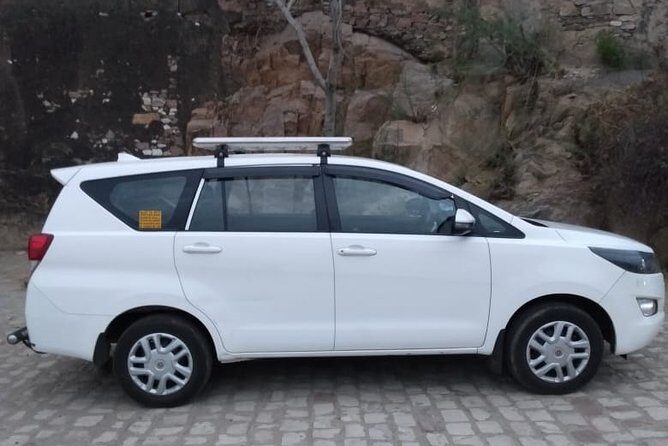
You get pickup and drop-off, a private AC car for the entire tour activity, and an included mineral water bottle. On top of that, toll taxes and parking are handled. That matters because the Golden Triangle is a logistics game as much as a sightseeing game. When transport is arranged cleanly, you lose less energy on navigation and waiting.
Equally important: there’s a professional tour guide in each city. That’s not a luxury add-on. It’s what turns a checklist of monuments into a story you can actually follow. In the feedback you provided, guides and drivers such as Rashad Kumar and drivers like Husan and Kuldip are specifically praised for English and for giving useful tips. That means you’re more likely to know what to look for when you arrive, instead of guessing.
A private setup also reduces the friction of coordinating with other people who may have different comfort levels. You keep a consistent rhythm, which makes the scheduled time blocks feel fair instead of rushed.
Price breakdown: what you pay and what you get
The tour price is listed as $198.44 per person. Whether that feels like a deal depends on what’s included—and here, quite a lot is.
You’re getting:
- A private AC car across the multi-city loop
- Pickup and drop-off
- Professional guide(s) in each city
- 3-star hotel accommodation with breakfast
- Mineral water bottle
- All toll taxes and parking
- A set of included entry tickets
For the tickets that are explicitly included, you’re covering major amounts (in INR) like:
- Taj Mahal: 1100
- Agra Fort: 650
- Itmad-ud-Daula: 350
- Humayun’s Tomb: 600
- Qutub Minar: 550
- City Palace: 700
Even without doing exact currency math, the included ticket list is a strong anchor. It reduces the chance you arrive at a gate and end up paying extra on the spot. It also makes budgeting easier, since the tour is built around those ticketed stops.
What you’ll likely pay extra for
The only clearly stated non-included cost is personal expenses. That’s a polite way of saying meals beyond what your hotel provides, shopping, and any extras you choose along the way. If you like full-day planned meals or guided tastings, you’ll probably spend more. If you keep it simple and eat where your guide recommends, you’ll stay closer to the base expectation.
Practical tips for a smoother Golden Triangle drive
Here are the things I think you’ll appreciate most, based on how this route is structured.
Use the time you have at Taj Mahal well
Because the schedule budgets about 3 hours, don’t spend all of it just circling. Build in small pauses: look first, then photos, then details. That pacing usually feels better than rushing to the next corner.
Trust the “tight block” approach on Day 1 and Day 3
You only have about an hour at each of several stops (except Taj Mahal). With that design, the best results come from staying focused on the key elements your guide explains rather than trying to do everything.
Lean on the safety reputation of the drivers
Your notes include repeated praise for reliable, punctual, safe driving, with named drivers like Husan, Shamsher Singh Bisht, Kuldip, and the operator name KD. If you value calm driving and clear coordination, this kind of consistency is worth paying attention to.
Plan for a phone-based workflow
Since there’s a mobile ticket, keep your ticket access handy and make sure your phone battery is charged before you leave the hotel. It sounds basic, but it prevents annoying late-day delays.
Should you book this 3-day Golden Triangle tour?
I think this tour is a strong match if you want three huge monuments-and-palaces cities in about 3 days, with the stress of planning minimized. The value is strongest when you care about: clear guiding, included entry for the biggest headline sites, and a private AC car that handles the between-city grind.
Book it if:
- You want Taj Mahal time that isn’t just a quick look
- You prefer a structured itinerary over freewheeling
- You like the idea of hotel + breakfast + major tickets rolled into one package
Skip it (or adjust expectations) if:
- You hate time limits and want long unplanned wandering at every stop
- You prefer cities with more time for neighborhoods and fewer landmark blocks
If your goal is a clean, well-paced Golden Triangle that gets you to the gates and keeps you moving smartly, this one is easy to recommend.