REVIEW · JAIPUR
Jaipur city tour
Book on Viator →Operated by Western India Nature Tours - Private Day Tours · Bookable on Viator
Jaipur rewards a well-paced day. I love the convenience of hotel/airport pickup and the fact that you get a private guide who helps you understand what you’re seeing, from palace exteriors to an active observatory. You also get built-in time for shopping, so you can trade sightseeing photos for real-life picks like textiles and jewelry. One catch to plan for: monument entrance fees are not included.
This is a private tour, so it’s only your group, driven in comfort with an A/C car and bottled water. That matters in Jaipur, where gaps between sights can eat up time if you’re not using a car.
At $25 per person, the value is pretty hard to beat because transfers, guiding, and taxes are included. Just remember tipping for the driver and guide is extra, and a couple of stops are intentionally short, so you’ll want to focus on the “what to look for” instead of expecting hours at every photo spot.
In This Review
- Key highlights worth knowing before you go
- How the Jaipur city tour flows (comfort first, sights second)
- Hawa Mahal: wind palace views without the long detour
- Amber Fort: 2 hours to understand the Hindu-Muslim mix
- Jal Mahal on the lake: a quick look that still feels special
- City Palace of Jaipur: where the royal family still shapes the space
- Jantar Mantar UNESCO observatory: why it’s not just statues and stones
- Shopping time in Jaipur: textiles, jewelry, and how to spend it well
- Price and what you really get for $25 per person
- Service quality: what the named support tells you
- Who this private Jaipur city tour suits best
- Should you book this Jaipur city tour?
- FAQ
- What’s included in the Jaipur city tour price?
- Are monument entrance tickets included?
- How long is the tour?
- Is this tour private or shared?
- Do I get hotel pickup and drop-off?
- Is there a cancellation option for a full refund?
Key highlights worth knowing before you go
- Hotel/airport pickup and drop-off to start and end your day without stress
- Amber Fort gets 2 full hours, enough time to see the main sights without rushing
- Jantar Mantar is UNESCO and still working, so it’s more than a museum label
- City Palace mixes public areas and the royal private side, which shapes how you tour the complex
- Hawa Mahal and Jal Mahal are mostly quick photo moments, ideal if your schedule is tight
- 2 hours for shopping focused on textiles, jewelry, carpets, handicrafts, and silk
How the Jaipur city tour flows (comfort first, sights second)
This tour is built around a logical loop through Jaipur’s key highlights: iconic palace views, Fort Amber, the lake-side Jal Mahal, the City Palace complex, and the UNESCO observatory at Jantar Mantar. Between stops, you’re in an A/C vehicle with bottled water, which helps a lot when Jaipur heat or crowds make walking feel slower than you want.
The time range is wide (about 1 to 8 hours), but the structure is still the same: you move efficiently, you get guidance at the major cultural stops, and you end with shopping time. If you hate “tour bus fatigue,” this is the kind of plan that feels calmer because you’re not stuck waiting for large group check-ins.
Because it’s private, the pacing is more flexible for things you actually care about—photos, quick rest breaks, or lingering a bit longer at one stop if it grabs you.
You can also read our reviews of more city tours in Jaipur


Hawa Mahal: wind palace views without the long detour
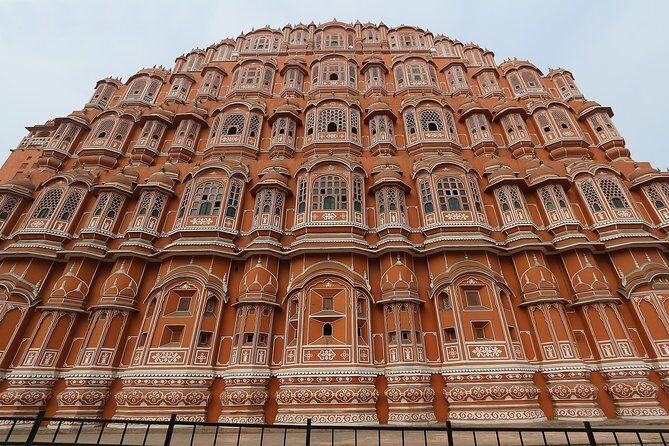
Hawa Mahal is one of those Jaipur sights you feel like you’ve already seen—until you’re standing near it in person. The key thing here is that you’re viewing it mainly from the outside. That’s good news if you want the classic photo moment without spending time locked into a ticket line.
What I like about this stop is the way the facade tells a story. Hawa Mahal is known as the Wind Palace, and the design is all about windows and airflow. Even if you only have a short window, you can still appreciate why it’s visually iconic: it’s made to be seen, and it’s made to breathe.
Practical tip: take your first photos quickly, then come back and look at patterns. The building rewards a second glance, especially if you like architecture details.
Amber Fort: 2 hours to understand the Hindu-Muslim mix
Amber Fort is the anchor of the day. You get about 2 hours here, which is a sweet spot: long enough to actually explore the main areas and short enough that you don’t feel like you left the rest of your day behind.
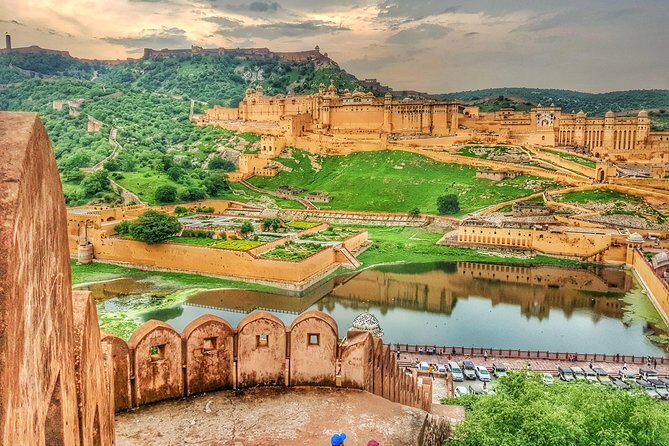
The fort is known for a blend of Hindu and Muslim architectural styles, built with marble and red sandstone. That combination shows up in the look and feel of the structures and gives the fort a layered identity. With a private guide, you’re not just walking through a big complex—you’re getting help connecting the visual details to how the place was designed and used.
One possible drawback: if you arrive needing a quick “one-and-done” photo stop, Amber Fort may feel like more effort than you expected. But if you like forts, details, and explanations, the time is worth it.
If your day is hot, plan for short breaks inside the fort areas when you can. The tour includes bottled water, but the fort itself can make you slow down, especially if you’re stopping to read or photograph.
Jal Mahal on the lake: a quick look that still feels special
Jal Mahal, the Water Palace, sits in the middle of the lake. It’s easy to understand why it’s photographed so often: from the shore, the building looks almost like it’s floating, with the water acting like a natural frame.
You only get about 10 minutes here, so this is not a “linger for hours” stop. Instead, think of it as a visual reset between bigger sites: you arrive, you get the signature view(s), and then you move on.
You’ll also hear that it was built in the 18th century by Maharaja Prithvi Singh (sometimes spelled Prthvi Singh in tour materials). Even in a short visit, that context helps you look at the structure differently—not just as a picture background, but as a historic choice tied to how the rulers shaped their environment.
City Palace of Jaipur: where the royal family still shapes the space
City Palace is one of those places where the boundaries matter. It’s not just a collection of old halls. Part of it is open to the public, while another part is private and tied to the present Prince of Jaipur’s residence.
This mix changes your experience. You’ll feel the space is both a heritage site and a living institution. For me, that makes the visit more grounded. You’re not imagining everything as “museum-only.” You’re seeing how power and tradition still occupy real rooms.
The tour gives you about 1 hour 30 minutes at City Palace, which is enough time to walk the main areas without feeling like you’re being chased out. With a guide, you’re also more likely to notice what’s public, what’s restricted, and why the layout feels the way it does.
If you care about how historic spaces function today, City Palace is one of the strongest stops on the route.





Jantar Mantar UNESCO observatory: why it’s not just statues and stones
Jantar Mantar is the UNESCO site that shifts the day from palace visuals to science-in-stone. The standout detail is that it’s the only observatory in India where the instruments are still working.
You get about 40 minutes here, which works well because the instruments are spread out but designed to be understood as a system. A good guide helps you interpret what you’re seeing—how the structures measure time, position, or other observations. Without that context, you can easily walk through and miss what makes the site special.
This is also a historic mind-bender: the observatory was built by Sawai Jai Singh II, who is described as a great astrologer and planner. Even if you don’t connect to astrology specifically, you can still appreciate the precision behind the built forms.
Practical tip: use your 40 minutes to look slowly. Pick a couple of instruments and give them time. You’ll get more satisfaction than trying to snap everything at once.
Shopping time in Jaipur: textiles, jewelry, and how to spend it well
The tour builds in about 2 hours for shopping, and it’s not random. Jaipur is known for textiles, jewelry, carpets, handicrafts, silk, and more, and that’s the shopping focus you’ll likely encounter during this block.
What I like about having a dedicated shopping window instead of “maybe sometime later” is that it protects your schedule. You’re not stuck searching for shops right after your last monument. You get a clearer block where you can compare, ask questions, and decide calmly.
Bring a simple approach:
- Decide what you want before you walk in (a scarf, a small craft, a jewelry piece, or a textile)
- Ask about materials and use (silk vs. blends, weave type if you’re buying textiles)
- Keep your budget in view because Jaipur shopping can scale fast once you find something you like
If you’re the type who loves buying local crafts but hates pressure sales, a private setting with your guide can help you stay focused. It’s also a good time to match what you bought to what you saw—like pairing Jaipur textiles with memories from the palaces and forts.
Price and what you really get for $25 per person
Here’s the value math that matters. The price is listed at $25 per person, and what you typically get included is more than just transportation: A/C car transfers, a professional private guide, bottled water, and all government taxes. The driver and guide allowances (food, accommodation, fuel) are also included in the package pricing.
That’s why this tour can feel like a solid deal, especially if you’re comparing it to a plan that only covers entrance tickets and basic driving.
The main variable is monument entry. Admission tickets are not included, so your final cost depends on what you decide to pay for at each stop. The tour notes that ticket details vary by site, and at least some areas are outside-photo focused, like Hawa Mahal.
Also add tipping for the driver and guide. Even if the base price is attractive, tipping is part of the real-world cost.
In short: the package is strong on logistics and guiding. Your total spending will come mostly from monument entries plus shopping.
Service quality: what the named support tells you
One thing I pay attention to is whether the service feels consistent. In past experiences shared with this tour provider, you can see real names tied to help—Nari from the agency is mentioned as being attentive, and drivers like Natu and Gampat are praised for care and professionalism.
That matters because in India, a day can go smoothly or become chaotic fast. A driver who knows the route, timing, and how to handle simple day-of issues can make the difference between a relaxed Jaipur day and a stressful one.
The tour is also described as well organized, with guides who are described as French in at least one case. If you care about language comfort, you’ll want to confirm what language support is available when you book, but the service approach is clearly built around real human guidance, not just transportation.
Who this private Jaipur city tour suits best
This tour fits best if you want a structured Jaipur highlight day without losing control of your pacing.
It’s a strong match for:
- Couples or small groups who want a private guide and clean timing
- First-time visitors who want the big hits in one day: Amber Fort, City Palace, Jantar Mantar
- People who want A/C comfort and hotel/airport pickup rather than managing local transport
- Shoppers who want a real block of time for textiles, jewelry, carpets, handicrafts, and silk
It may be less ideal if your dream day is “wandering only” with no fixed stops. The plan is purposeful, and the short photo moments at Hawa Mahal and Jal Mahal mean you’re not signing up for long free roaming at those specific locations.
Should you book this Jaipur city tour?
I’d book it if you want an easy, private way to hit Jaipur’s top sights in a single day and you value having a guide explain what you’re looking at. The price-to-inclusions ratio is the selling point here: A/C transfers, bottled water, a professional private guide, and taxes are included, which keeps your planning simpler.
I’d think twice if you hate paying extra for monument entrances, because admissions are not part of the package. Also, if you want deep time at every site, note the shorter stops like Hawa Mahal and Jal Mahal are built for quick views and photos.
If you’re trying to make the most of a limited schedule, this tour is a practical choice that still leaves room for shopping and personal pace.
FAQ
What’s included in the Jaipur city tour price?
The tour includes all sightseeing and transfers by an A/C car, a driver and guide allowances, a professional private guide, hotel pickup and drop-off, bottled water, and all government taxes.
Are monument entrance tickets included?
No. Monument entrances are not included, so you’ll need to pay admissions separately for sites that require tickets.
How long is the tour?
The duration is approximately 1 to 8 hours, depending on how your day is arranged.
Is this tour private or shared?
It’s a private tour/activity, so only your group participates.
Do I get hotel pickup and drop-off?
Yes. Hotel/airport pickup and drop-off are included.
Is there a cancellation option for a full refund?
Yes. You can cancel for a full refund up to 24 hours in advance of the experience start time.