REVIEW · NEW DELHI
Golden Triangle Tour – Delhi Agra Jaipur
Book on Viator →Operated by Indian Travel Tour - Private Day Tours · Bookable on Viator
Golden Triangle trips can feel like nonstop checklists, but this one runs with more breathing room. I like that you get priority queue access and real-time WhatsApp updates, so you’re not stuck guessing when to move or where to line up. The route also blends big icons with stops that help you understand how Delhi, Agra, and Jaipur actually work.
Two things I’d highlight for you right away: the small-group private setup (just your party) and the way the day-to-day logistics are handled with comfort. You’re traveling in an air-conditioned vehicle with WiFi, free water, snacks, and onboard first aid, plus an English-speaking local guide. That mix matters when you’re hopping between crowded lanes, fort courtyards, and long drives.
One possible drawback: monument entry fees are not included, so your final spend will depend on how many tickets you use. Also, the Taj Mahal timing is geared toward sunrise, which is fantastic for photos but means an early start.
In This Review
- Key things I’d plan around
- Why this Golden Triangle feels more controlled than rushed
- Delhi Day 1: from Qutub Minar to Lotus Temple, then onward
- Old Delhi essentials: Jama Masjid, stepwell time, and Chandni Chowk
- Transfers that keep your energy: lunch and the Delhi-to-Agra push
- Taj Mahal at sunrise: why this timing is worth the early alarm
- Agra beyond the Taj: Fort, Baby Taj, and a better sense of the city
- Abhaneri’s Chand Baori: the stepwell that steals the show
- Jaipur Day 2: Amber Fort first, then the royal map of the city
- Price and value: what $250 buys, and what to budget for tickets
- Should you book this Golden Triangle tour
- FAQ
- Is pickup included for this Delhi–Agra–Jaipur tour?
- Is this a private tour or a shared group?
- What is included in the tour price?
- Are monument entry tickets included?
- How long does the Golden Triangle tour take?
- What happens if weather is poor?
Key things I’d plan around
- Priority access and fewer waiting headaches at major sights, including the Taj Mahal
- Onboard comfort with WiFi, water, snacks, and first aid during transfers
- Real-time WhatsApp coordination that keeps the day moving smoothly
- Smart guide-led timing to reduce crowd pain and help you see more
- A mix of icons and local flavor with time in Old Delhi markets
Why this Golden Triangle feels more controlled than rushed
This is built like a private day tour model, so you’re not swallowed by a 50-person group. You get your own guide support and a dedicated vehicle, which changes everything when you’re trying to time Qutub Minar, Old Delhi mosques, and the Taj Mahal in the same trip.
I also like the operator’s emphasis on communication and pacing. Real-time WhatsApp updates sound small until you’re in Delhi traffic or trying to re-find a meeting spot after lunch. When your guide can keep you synced, you lose less time to confusion.
Finally, the value here is practical. The package includes the basics you usually end up paying for anyway—air-conditioned transport, breakfast with accommodation, and the guide’s services—so you can budget knowing what’s left: mostly monument tickets.
You can also read our reviews of more tours and experiences in New Delhi.



Delhi Day 1: from Qutub Minar to Lotus Temple, then onward
Your Delhi day starts with Qutub Minar, a UNESCO World Heritage tower that’s 73 meters tall and tied to the Delhi Sultanate era. This is one of those sights where a guide’s framing helps: you’re not just looking at height, you’re seeing how early Delhi power showed itself in stonework. Plan for about an hour here, and note that the entry ticket isn’t included.
Next comes the Lotus Temple, which is free to visit and moves at a different tempo than the fortress-and-tower sites. The flower-like design is the headline, but the real win is that you can often get a quieter moment to reset your brain before heading into Old Delhi later.
You then head to India Gate, where the visit is short but worth it. It’s a war memorial on Rajpath honoring soldiers of British India, and it also plays a modern role as a social gathering spot. If you’re thinking photo stops, this is an easy one to slot in without burning the whole morning.
A quick note on tone: Delhi goes from monumental to peaceful to urban life fast. That’s why this type of guided plan is helpful—you get context without needing to read an entire guidebook between stops.
Old Delhi essentials: Jama Masjid, stepwell time, and Chandni Chowk

After the major landmarks, you go into the Old Delhi layer that makes this city feel like a living machine. Jama Masjid (Masjid-i-Jehan-Numa) is one of the biggest mosques in India, built under Shah Jahan between 1650 and 1656. Your guide’s job here is important because Mughal architecture has patterns and purposes; without that framing, it can turn into just another big building photo.
Then there’s Agra sen Ki Baoli (Leamigo), a stepwell that people often walk past on their way to bigger Delhi targets. You get only about 15 minutes, but it’s a memorable contrast: water conservation architecture made for real daily needs long ago. If your group likes quiet, off-the-main-road corners, this stop is a good one to prioritize.
Humayun’s Tomb follows, and it’s more than a random add-on. It’s widely seen as a precursor to the Taj Mahal, so seeing it in Delhi helps your eyes later in Agra. It’s also a UNESCO site, and while the time is about an hour, it’s enough for meaningful wandering with a guide.
Chandni Chowk is the final Delhi-style experience in this plan: a market area where the lanes are narrow and the sales rhythm is intense. Expect around an hour here. If you’re shopping, go in with a strategy: set a budget, decide what you actually want, and don’t let the first stall set the tone.
Transfers that keep your energy: lunch and the Delhi-to-Agra push
Between Delhi and Agra you get a lunch break at a selected local restaurant, with food aimed at something more authentic than a tourist trap. You also spend about three hours traveling via the Yamuna Expressway link road, with your hotel arrival giving you time to check in and reset.
This matters because Golden Triangle routes can drain you just through movement. Having a scheduled transfer plus a meal plan reduces the risk of ending up hungry and cranky while you figure out where to eat.
One more thing: some travelers do best with a light evening. In Agra, you’ll likely have enough mental fuel for a short stroll, not a full second sightseeing day.
Taj Mahal at sunrise: why this timing is worth the early alarm
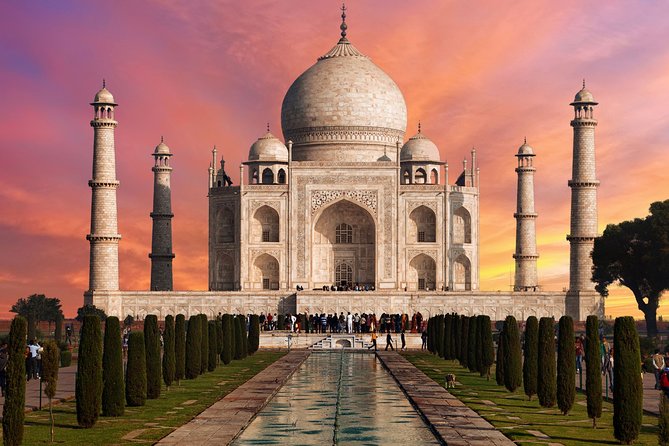
The Taj Mahal experience here is built around a sunrise approach, with the guide leading a detailed visit inside for about two hours. That early lighting is a real advantage because you get the golden hues while the crowds are still catching up.
Inside access is not included in the package price, so you’ll likely pay monument entry separately. Still, what you’re buying with the guide time is how to look: where to spend your focus, what details actually matter, and how the story connects to the building’s design.
If you’re tempted to skip the inside portion to save energy, don’t. The Taj is impressive from outside, but the interior is where the architecture and symbolism snap into clearer focus, especially when explained in plain language. Bring patience for waiting steps and security checks.
Weather matters here. The operator lists a good-weather requirement, and if conditions are poor they offer a different date or a full refund. For you, that means build flexibility into your expectations, especially if you’re traveling outside peak season.



Agra beyond the Taj: Fort, Baby Taj, and a better sense of the city
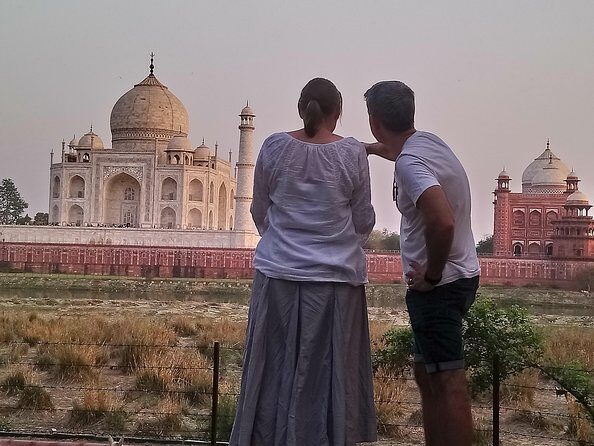
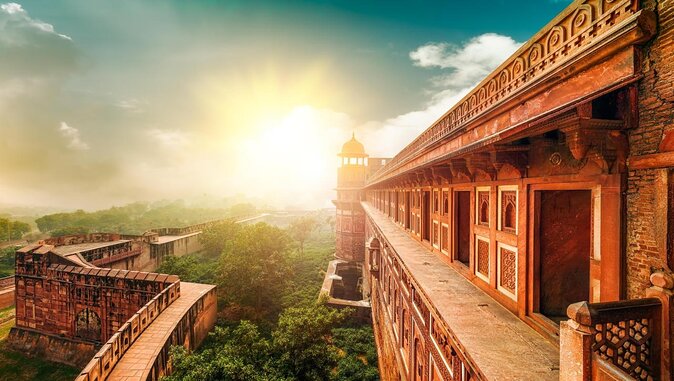
Once you’re done with the Taj, Agra doesn’t feel like a one-building town. You’ll visit Agra Fort, a UNESCO site with Mughal palaces, ornate balconies, and gardens inside a red sandstone fortress. The visit is about an hour, and while entry fees aren’t included, the guide helps you connect the fort layout to how rulers lived and moved through power spaces.
Then there’s Itmad-ud-Daula, often called the Baby Taj. This mausoleum, built between 1622 and 1628, shows the shift from red sandstone to white marble—one of those “watch how style changes over time” moments. You only get around 30 minutes, but it’s a strong stop if you care about details and evolution in architecture.
The best part of stacking Taj Mahal plus these two sites is that you stop seeing Agra as just a photo destination. You start understanding it as a place where rulers built legacies in stages.
Abhaneri’s Chand Baori: the stepwell that steals the show
Chand Baori in Abhaneri is a different kind of wow. It’s a massive stepwell, with thousands of steps descending toward water at the bottom, and it’s a UNESCO-listed historic site. You’ll have about 30 minutes there, and even with short time, you can appreciate the scale.
This is also a smart break from the Taj-and-fort pattern. Instead of marble and sandstone monuments, you’re looking at engineering and water logic. If your group likes photos, this is one where you’ll likely want a slow walk down and back up, watching the light change across the steps.
Jaipur Day 2: Amber Fort first, then the royal map of the city
Jaipur is where the trip turns from empire capitals into a living royal city. You arrive, check in, and the next day starts at Amber Fort, the hilltop fortress that was the former capital until 1728. Expect about two hours. Amber Fort is one of those places where a guide makes the difference because it’s not just walls—it’s courtyards, palace rooms, and the logic of power on a slope.
There’s also a photo stop at Jal Mahal, the palace that appears to float on Man Sagar Lake. Admission isn’t included, and the stop is short, but it’s a great way to break the heavier fort time with a different angle on Jaipur’s architecture.
Then you move to City Palace, the administrative and ceremonial seat of the Maharajas. You’ll spend about an hour. This stop works well if you want to connect what you’ve seen in forts to how governance and ceremony actually played out.
Next is Jantar Mantar, a UNESCO site built in 1734 with massive astronomical instruments built for naked-eye observation. The time is about an hour, and you’ll feel your brain working in a different way than it did at the tombs and forts.
Finally, you get Hawa Mahal, the Palace of Wind. The time is brief (around 15 minutes), but it’s the iconic Jaipur silhouette. If you’re photo-focused, this is one of the stops where it helps to arrive with a quick plan: one exterior angle, then move on.
Price and value: what $250 buys, and what to budget for tickets
At $250 per person, this tour is positioned as a midrange option with real structure. What you’re getting up front includes the big-ticket logistics: air-conditioned vehicle, breakfast with accommodation, an English-speaking local guide, plus state taxes, tolls, parking, fuel, and driver services. In a country where transport costs add up fast, that matters.
What’s not included is monument entry and ticket fees. That’s normal for India tours, but you should plan for it so you don’t get surprised at the payment stage. In particular, major sites like Qutub Minar and the Taj Mahal are clearly labeled as not included. Some stops are free (Lotus Temple and several market-style or outdoor areas), but you shouldn’t assume every highlight is.
So the value equation is: you’re paying for fewer headaches and stronger guided time, not for a fully ticketed pass. If you want flexibility on the day—more time at the Taj Mahal or skipping something—that ability is part of the pitch, and it’s the right kind of flexibility to look for in a Golden Triangle.
Should you book this Golden Triangle tour
Book it if you want a private-feeling Golden Triangle with priority access, real guide support, and fewer dead hours spent figuring things out. This is a good fit for couples, small families, and anyone who wants iconic sights without the stress of managing every timing detail in a packed itinerary.
Skip it or rethink it if you hate early starts, especially for sunrise Taj Mahal time. Also, if you’re trying to keep every penny tightly controlled, remember that monument entry fees are not included, so your final budget will grow.
If you do book: go in with a mindset that the guide’s job is to help you see, not just transport you. Ask questions at the important stops and use the shorter segments (like Chandni Chowk or Hawa Mahal) for what they’re best at: quick context, photos, and then moving on.
FAQ
Is pickup included for this Delhi–Agra–Jaipur tour?
Yes. Pickup is offered, and the tour description includes pickup availability.
Is this a private tour or a shared group?
This is private. Only your group participates.
What is included in the tour price?
The included items are air-conditioned vehicle, breakfast with accommodation, an English-speaking local guide, and state tax, toll, parking, fuel, and driver services.
Are monument entry tickets included?
No. Entry fees at monuments are not included. Some stops are listed as free, and others as included or not included, but you should plan on paying separate tickets for paid monuments.
How long does the Golden Triangle tour take?
It’s listed as about 4 days.
What happens if weather is poor?
The experience requires good weather. If it’s canceled due to poor weather, you’ll be offered a different date or a full refund.