REVIEW · NEW DELHI
Full Day Delhi Guided Group Tour
Book on Viator →Operated by Private India Guided Tours · Bookable on Viator
Delhi hits you fast, and this tour keeps up.
This day is built around big contrasts: Mughal-era landmarks in Old Delhi, then wide avenues and presidential grandeur in New Delhi. I like that you get a well-paced sweep of sights in 7 to 8 hours, with a guide riding along for context. I also like that the route mixes major monuments with places that feel more lived-in, so you’re not just checking boxes. One thing to consider: some major sites have entrance tickets not included, so your day can cost a bit more once you’re on the ground—and pick-up timing matters.
In practice, I think this works best when you want an efficient first look at Delhi without planning. Pickup is offered from your hotel at 9:00 am, and you’ll ride in an air-conditioned vehicle with a private guide for your group. The itinerary is busy by design, so you’ll be seeing plenty—just not lingering forever at any single stop.
In This Review
- Key highlights you’ll notice right away
- How this Delhi day works: a 9 am pickup and a real sightseeing rhythm
- Jama Masjid and the Red Fort exterior: Mughal scale in a short window
- Chandni Chowk lanes and Gurudwara Sis Ganj Sahib: trade energy plus Sikh remembrance
- Qutub Minar and Lodhi Garden: a Sultanate monument plus a needed pause
- India Gate to Rashtrapati Bhavan: from memorials to the presidency
- Agrasen Ki Baoli and lunch: a stepwell break that feels more local
- Birla Mandir, Lotus Temple, and Akshardham: three faith stops that change the mood
- What you pay for $75, and what costs extra once you’re there
- Best for who: first-timers who want contrasts, not slower deep dives
- Should you book this Full Day Delhi Guided Group Tour?
- FAQ
- What time does pickup happen?
- How long is the tour?
- Does the price include hotel pickup and drop-off?
- Is the tour guided?
- Are entrance tickets included for all monuments?
- Is lunch included?
- Are drinks included with lunch?
- Which sites are listed as free?
- Does the tour include viewing Red Fort inside?
- Is this tour private?
- What if the minimum number of travelers isn’t met?
Key highlights you’ll notice right away
- Old Delhi + New Delhi in one day: history, architecture, and city scale side-by-side
- Hotel pickup at 9:00 am with an air-conditioned bus for an easy start
- Most stops are free (including Gurudwara Sis Ganj Sahib, Lodhi Garden, India Gate, Rashtrapati Bhavan, Lotus Temple, Birla Mandir, and Akshardham)
- Several major monuments are “ticket extra” (Jama Masjid, Qutub Minar), so budget for a couple admissions
- A real lunch break with a 2-hour buffet lunch pause in the middle of the day
- Time is managed per stop (often 15 to 60 minutes), so you’ll cover a lot without feeling lost
How this Delhi day works: a 9 am pickup and a real sightseeing rhythm
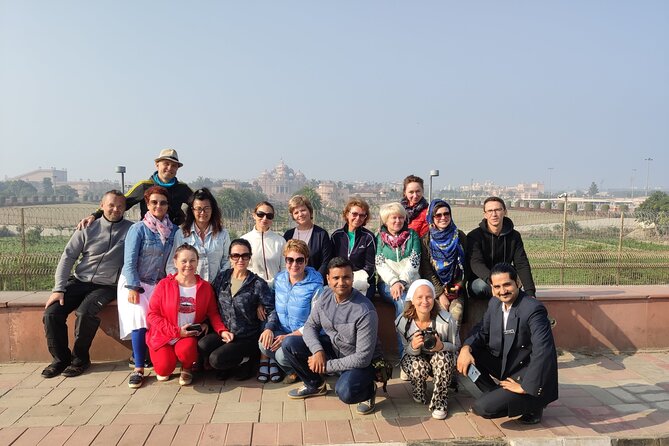
The tour is structured for a full day out, roughly 7 to 8 hours, with pickup from your hotel anywhere in Delhi at 9:00 am. You meet your guide and then switch to an air-conditioned private bus, which matters in a city where you can waste a lot of energy just moving around.
The route is a smart mix: you start with big Mughal landmarks, then shift into old-market Delhi, then hit a Sultanate monument, and later move to British-era and modern government architecture. That’s the core value for you: Delhi becomes more understandable when you see the “layers” in sequence rather than as separate browser tabs.
Because each stop has a set time window—anywhere from 15 minutes to 1 hour—you’ll get motion, orientation, and context. The tradeoff is simple: this isn’t a slow photo-walk tour. It’s more like guided momentum.
You can also read our reviews of more tours and experiences in New Delhi.



Jama Masjid and the Red Fort exterior: Mughal scale in a short window
Your morning centers on Old Delhi’s monumental Islamicate architecture.
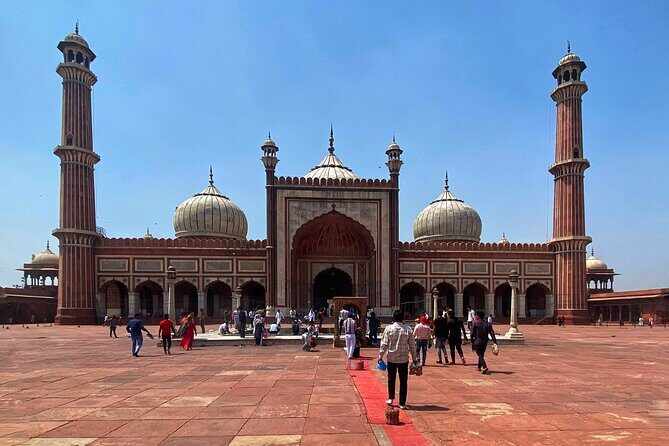
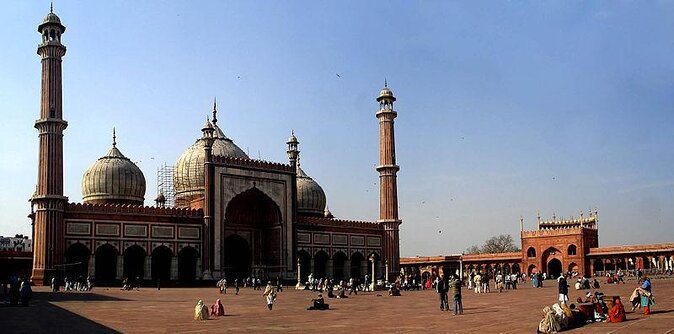
Jama Masjid is one of India’s largest mosques, built by order of the fifth Mughal Emperor Shah Jahan. You’ll have about 1 hour here, and entrance tickets are not included, so plan to pay on-site if you want to go in. This stop works even if you’re not an architecture nerd, because the scale hits immediately—think symmetry, courtyards, and the sense of an empire’s authority built in stone.
Then it’s Red Fort, completed in 1648 as Shah Jahan’s residence and power base. In this experience, you’ll see the fort from the outside (about 15 minutes) rather than going inside. That makes it easier on your schedule, but it also means you won’t get the palaces and pavilions described in the fort’s interior history. Still, the exterior view is a good “anchor moment” for understanding Mughal Delhi before you plunge into the older lanes around Chandni Chowk.
Chandni Chowk lanes and Gurudwara Sis Ganj Sahib: trade energy plus Sikh remembrance
After the fortress-wall viewpoint, you step into the human side of the city.
Chandni Chowk area (listed as Pasar Chandni Chowk) is tied to Shah Jahan’s family—Jahanara, his eldest daughter, is credited with planning this area to draw traders from different countries. You get about 1 hour here, and this is where Delhi feels less like a museum and more like a working city. You’ll see the pull of commerce, the rhythm of streets, and the way old bazaars survive next to newer development.
Then you switch religious settings at Gurudwara Sis Ganj Sahib, one of Delhi’s main Sikh temples. It’s built in 1783 to commemorate the martyrdom of the ninth Guru, Guru Tegh Bahadur. Admission is free, and you’ll have about 30 minutes. I like this pairing because it adds depth: you’re not only seeing places of worship, you’re seeing how Delhi holds multiple faith stories in the same urban space.
Qutub Minar and Lodhi Garden: a Sultanate monument plus a needed pause
Next comes a landmark that most first-time visitors remember for life, even if they don’t know the details yet.
Qutub Minar is described as the world’s tallest brick minaret, built over time by generations of rulers of the Delhi Sultanate. You’ll spend about 1 hour here, and entrance tickets are not included. This is one of those sights where you’ll feel the “power of repetition”—layers of construction effort across dynasties, all aiming at height and permanence. It’s also part of a larger complex, so even your quick visits feel layered.
Then you get a break at Lodhi Garden, a city park with tombs from the 15th century, including Muhammad Shah, Sikander Lodi, Shish Gumbad, and Bara Gumbad. Admission is free, and you’ll have about 30 minutes. For you, this stop is more than greenery. It’s a reset between heavy monuments and the later government-and-temple stretch. If you’re anything like me, you’ll appreciate having a calmer moment to regroup and breathe.
India Gate to Rashtrapati Bhavan: from memorials to the presidency
After the garden, the tour moves into New Delhi’s grand civic geometry.
India Gate is the famous gateway originally called the whole of India war memorial. You’ll spend about 15 minutes here. It’s a short stop, but it gives you a sense of how Delhi uses monumental architecture to frame national memory.
Then comes Rashtrapati Bhavan, the official residence of the President of India. Construction started in the 1910s under British architect Edwin Lutyens, continued intermittently until 1929, with minor improvements into 1930. You’ll have around 15 minutes. Even if you don’t have time to tour inside, the exterior view helps you understand why New Delhi looks planned in a way Old Delhi doesn’t—it’s a different design mindset, different era, different kind of authority on display.
This section is quick, so don’t expect a deep guide lecture at each curb. Do expect the guide to connect what you’re seeing to the city’s timeline.


Agrasen Ki Baoli and lunch: a stepwell break that feels more local

Lunch is built in as a real pause, not a rushed snack.
You’ll stop for buffet lunch, with about 2 hours allocated. Food and drinks aren’t included beyond the buffet lunch itself, so plan to spend only what you choose to add.
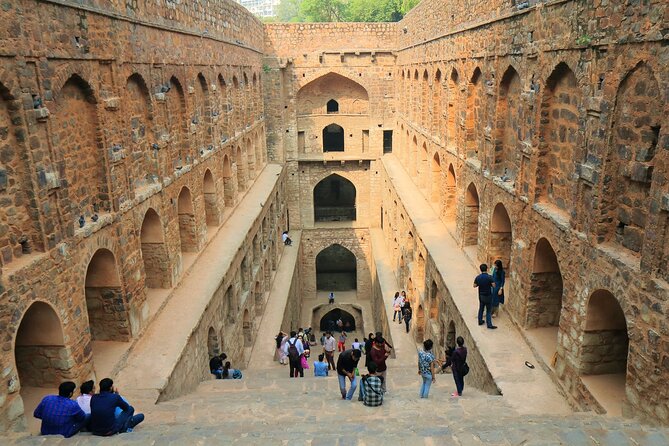
After lunch, you visit Agrasen Ki Baoli, a historical stepwell listed as about 60 meters long and 15 meters wide. It’s associated with the legendary king Agrasen and is said to have been rebuilt in the 14th century by the Agrawal community. This is one of those stops I personally like on a high-speed itinerary because it feels different from the big “everybody takes photos here” monuments. A stepwell isn’t just decoration; it’s a practical structure tied to water and daily life, which makes it easier to picture Delhi as a city that survives and functions.
And since this stop happens after lunch, you’re less likely to feel run down. That timing helps.
Birla Mandir, Lotus Temple, and Akshardham: three faith stops that change the mood
The final stretch shifts into spiritual architecture across multiple traditions. Admission is free for these sites as listed, and time is reasonable for each—so you get variety without rushing through everything.
First is Birla Mandir (Lakshmi Narayan), a Hindu temple also called Lakshmi Narayan Mandir. It’s dedicated to Lakshmi and Narayana, described as incarnations tied to Vishnu and worshipped for abundance and happiness. You’ll have about 30 minutes.
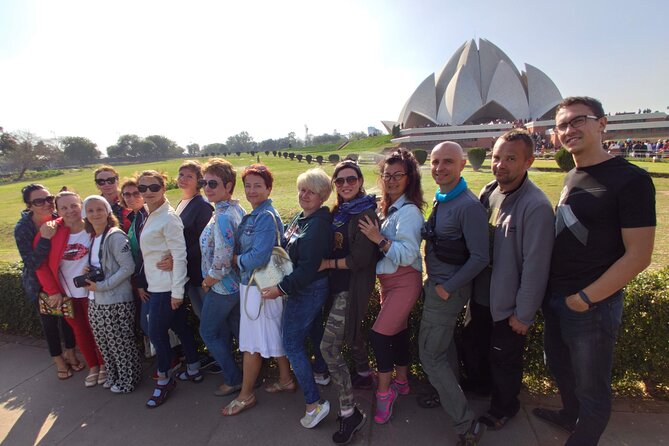
Then you’ll head to the Lotus Temple, the main Bahá’í temple in India and neighboring countries, built in 1986. You get around 30 minutes here. The name alone makes it memorable, but the value of stopping is more practical: it’s a clear change of pace from heavy fortress and government visuals.
Finally, you visit Swaminarayan Akshardham, described as the largest Hindu temple complex in the world and listed as entered in the Guinness Book of Records. You’ll have about 1 hour. Akshardham tends to be visually impressive, but for your trip it’s also a useful finishing act: the day ends with a huge, modern-feeling temple environment that helps Delhi’s religious diversity feel current rather than only historical.
What you pay for $75, and what costs extra once you’re there

At $75 per person, you’re paying for a lot of “moving parts” that add up in a big city: hotel pickup and drop via an air-conditioned private bus, a private tour guide fee, and coverage of taxes, parking fees, and fuel charges. That’s the real value. You’re not just paying for a guide; you’re paying for transport + guide + the logistics that keep your day from falling apart.
What’s not included is also clearly defined: monument entrance tickets and any personal expenses. Food and drinks are not included either, though lunch is a buffet lunch as part of the schedule.
In terms of planning your extra costs, the day lists entrance tickets as not included for Jama Masjid and Qutub Minar. Many other stops are free (including Red Fort from outside, Chandni Chowk, multiple temples, India Gate, Rashtrapati Bhavan, and Lodhi Garden). So your worst-case budget surprise is likely limited to just a couple of admissions, plus whatever you add during lunch.
Best for who: first-timers who want contrasts, not slower deep dives
This tour fits you well if:
- you’re on a tight schedule and want to see Old Delhi + New Delhi without planning each leg
- you like guided explanations that connect architecture to emperors, dynasties, and city design
- you want a day that includes major sights and also at least one more everyday-feeling neighborhood moment
It may not fit as well if you:
- hate crowds or prefer long, quiet visits (several stops are only 15 to 30 minutes)
- want to spend lots of time inside places rather than seeing some from outside (Red Fort is outside in this experience)
- are trying to avoid any added site costs (two key stops list entrance tickets as not included)
Group style is listed as a private tour activity with only your group participating. That’s helpful because you’re less likely to get stuck watching the slowest person in a huge crowd.
Should you book this Full Day Delhi Guided Group Tour?
If you want a solid first pass through Delhi’s highlights in one day, I think this is a good bet—especially because pickup, transport, and the guide are covered up front, and many stops are free. The biggest deciding factor for me would be whether you’re okay with a fast schedule and possible extra entrance tickets for Jama Masjid and Qutub Minar.
If your travel style is structured and you like getting orientation fast, book it. If you’re the type who wants to linger for hours inside one monument or temple, consider a longer, more focused day instead.
FAQ
What time does pickup happen?
Pickup starts at 9:00 am from your hotel anywhere in Delhi.
How long is the tour?
The tour runs about 7 to 8 hours.
Does the price include hotel pickup and drop-off?
Yes. Hotel pick up and drop are included, with an air-conditioned bus.
Is the tour guided?
Yes. The private tour guide fee is included.
Are entrance tickets included for all monuments?
No. Monuments entrance tickets are not included.
Is lunch included?
Yes. There’s a buffet lunch included, with about 2 hours allocated.
Are drinks included with lunch?
No. Food and drinks are listed as not included, aside from the buffet lunch itself.
Which sites are listed as free?
Stops listed as free include Chandni Chowk, Gurudwara Sis Ganj Sahib, Lodhi Garden, India Gate, Rashtrapati Bhavan, Birla Mandir, Lotus Temple, and Swaminarayan Akshardham.
Does the tour include viewing Red Fort inside?
No. You’ll see Red Fort from the outside.
Is this tour private?
It’s listed as a private tour/activity, and only your group participates.
What if the minimum number of travelers isn’t met?
If the experience is canceled because the minimum travelers requirement isn’t met, you’ll be offered a different date/experience or a full refund.