REVIEW · JODHPUR
Jodhpur Blue City Heritage Walking Guided Tour
Book on Viator →Operated by Blue City Adventures · Bookable on Viator
Jodhpur’s blue lanes leave a mark. This short guided walk threads together Mehrangarh Fort-area landmarks and the Blue City quarter, with stories about water, power, and daily life. You’ll end up seeing why Jodhpur’s indigo walls are more than a photo backdrop.
I like two things most. First, the tour is led by an English/Hindi speaking licensed guide, so you’re not just reading plaques. Second, stops like Toorji Ka Jhalra (the stepwell) and the lake features connect architecture with practical desert thinking, not just pretty scenery.
One consideration: this is a 1 hour 40 minutes to 2 hour walking route in the Old City, including hilly/uneven lanes. If you’re sensitive to steps or uneven ground, wear supportive shoes and go in with realistic expectations.
In This Review
- Key highlights you’ll feel fast
- Start at Sardar Market near Gulab Sagar (and find your feet)
- Fateh Pol Road: a victory gate with carved meaning
- Ranisar and Padamsar Lakes: desert water stored with purpose
- Navchowkiya: the Blue City lanes in real street form
- Toorji Ka Jhalra stepwell: carved stone and cool shade
- Gulab Sagar: a quiet lake that still matters
- Clock Tower Market (Sardar Market): shopping, snacks, and a familiar ending
- What the guide adds: licensed languages, real storytelling, and real-world quirks
- Pacing, group size, and what 1 hour 40 minutes feels like
- Why the price of about $13.39 can be good value
- Practical tips so you enjoy the Blue City, not fight it
- Should you book this Jodhpur Blue City heritage walking tour?
- FAQ
- How long is the Jodhpur Blue City Heritage Walking Guided Tour?
- What does the tour cost?
- Where does the tour meet and where does it end?
- What’s included in the tour?
- Is admission required for the stops?
- How big is the group?
- What kind of ticket do you get?
- Can I cancel for a refund?
- Is the tour suitable for most people?
Key highlights you’ll feel fast
- A small group (max 15) keeps the walk moving at a human pace.
- Toorji Ka Jhalra stepwell shows 18th-century engineering with carved detail.
- Ranisar and Padamsar Lakes explain how water was managed in an arid city.
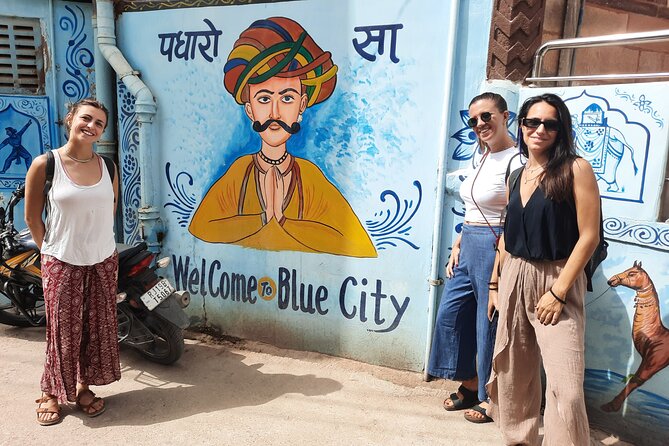
- Navchowkiya Blue City lanes give you a real sense of everyday streets and homes.
- Clock Tower Market (Sardar Market) anchors the tour in a central, practical meeting point.
Start at Sardar Market near Gulab Sagar (and find your feet)
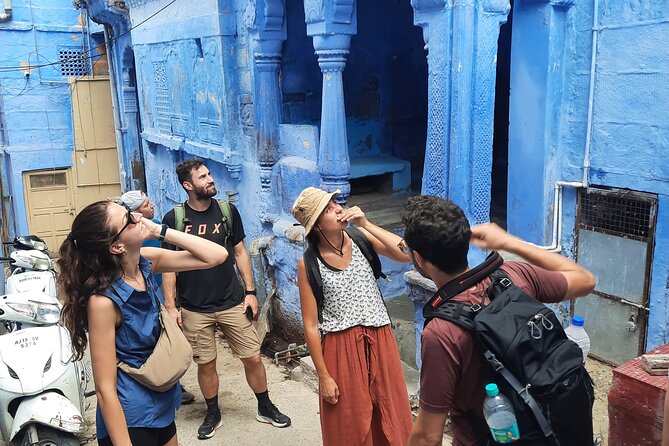
The tour starts at the Clock Tower area in Jodhpur’s Old City—near Makrana Mohalla, behind Pal Haveli, close to Gulab Sagar. The exact meeting reference given is 72XF+37C, which is handy if you’re using offline maps or Google Maps.
I love starting here because Sardar Market is the city’s “do things” center. It’s easy to orient yourself, and you’re already in the middle of the shopping and snack flow. You’re not walking out into nowhere—you’re walking through the parts of town people actually use.
Practical note: the Clock Tower is easy to spot, but the lanes around it can feel confusing at first. Give yourself a few extra minutes to confirm you’re with the right guide group.
You can also read our reviews of more tours and experiences in Jodhpur.


Fateh Pol Road: a victory gate with carved meaning
One of the first stops is Fateh Pol Road, tied to the Mehrangarh Fort complex. Fateh Pol is described as one of Mehrangarh’s majestic gates, commemorating a significant Mughal victory in 1707.
What I like about this kind of stop is that it sets the tone. Before you wander the Blue City lanes, you get a sense of who held power, what they built, and how they used stone and symbolism. Even if you’re not obsessed with military history, the gate gives you context for why Jodhpur’s architecture is so confident and detailed.
Look closely at the carvings and the way the gate is integrated into the larger fort presence. It’s a good warm-up: you start noticing details instead of just looking at buildings.
Ranisar and Padamsar Lakes: desert water stored with purpose
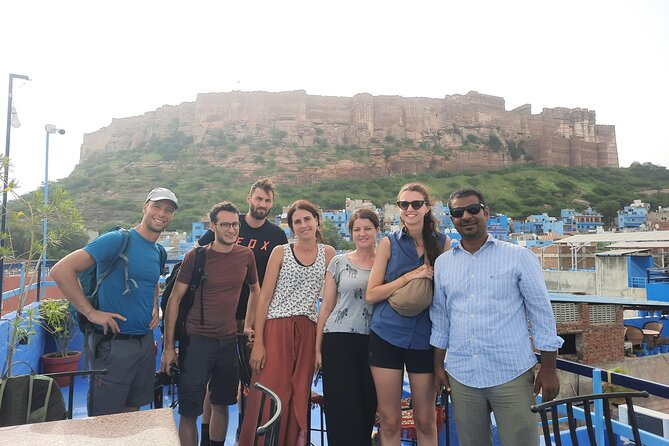
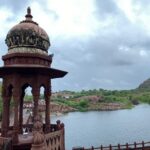
Next come Ranisar and Padamsar Lakes, right beside Mehrangarh Fort. These connected lakes were built in the 15th century to conserve water in an arid region, which makes them more than scenic pauses.
This is one of those stops where a guide can turn what looks like a calm water scene into something you understand. I like that the tour frames the lakes as city infrastructure—something designed for survival, not just decoration. If you’ve ever wondered how forts and cities functioned in Rajasthan’s dry conditions, this is a clear, visible answer.
Even in a short walk, you get a sensory break from the streets. You’ll also be learning at the same time, which helps the Blue City section feel more meaningful rather than random.
Navchowkiya: the Blue City lanes in real street form
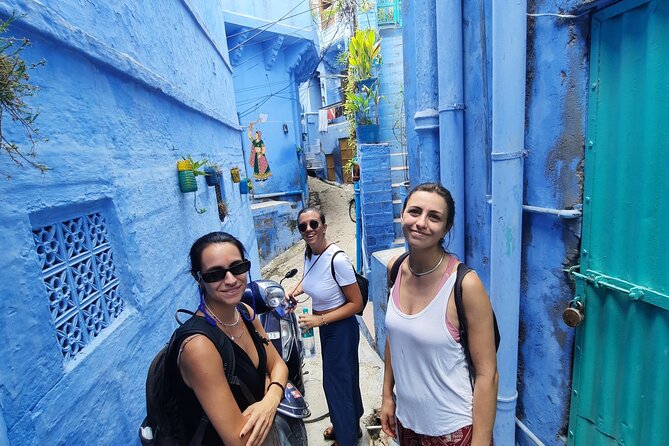
Then you head into Navchowkiya, described as a charming Blue City neighborhood with labyrinth-style lanes and indigo-hued homes. This is where the tour becomes more about texture: narrow passages, old walls, and the sense that you’re moving inside someone’s neighborhood—not inside a staged attraction.
I like this stop because it’s paced. You’re not rushing; you’re walking long enough to notice patterns—where people live, how lanes bend, and how the light hits the blue paint at different angles. If photography is your thing, this is the part where you’ll want to slow down without blocking foot traffic.
One tip: hold your phone camera with intention. In tight lanes, standing still too long can make the walk awkward for everyone. Move, shoot quickly, and keep walking—your guide will usually help you find spots to frame without turning into a traffic jam.
Toorji Ka Jhalra stepwell: carved stone and cool shade
Toorji Ka Jhalra (Toorji’s Step Well) is one of the tour’s centerpiece stops. It’s an 18th-century stepwell built by a queen consort, known for intricate carvings and the kind of scale-and-detail that makes you stop talking for a minute.
This is the stop I’d circle on any itinerary, even if you’ve seen stepwells elsewhere. Here’s why: it’s a bridge between art and daily survival. A stepwell is practical—water access in a dry climate—but the design is also expressive, with carved detail that suggests pride in craftsmanship.
When you’re there, take a slow look at the carvings and the shape of the steps. Notice how the architecture creates shade and makes the space usable. You’re not just looking at history; you’re understanding a system.




Gulab Sagar: a quiet lake that still matters
After the stepwell, the route includes Gulab Sagar, a picturesque lake in Jodhpur built in the 18th century. The lake serves as a vital water reservoir and is described as being encircled by heritage buildings.
I like that the tour keeps returning to water. It’s a consistent thread: fort gates, lake conservation, stepwell engineering, then a reservoir lake again. This pattern gives you a smarter way to see Jodhpur’s layout—blue painted walls aren’t the only story; water management shaped where people built and how they moved.
If you’re into views, this stop gives you a calmer horizon line compared with the tight lanes. It’s also a natural reset point before returning toward the busier Clock Tower market area.
Clock Tower Market (Sardar Market): shopping, snacks, and a familiar ending
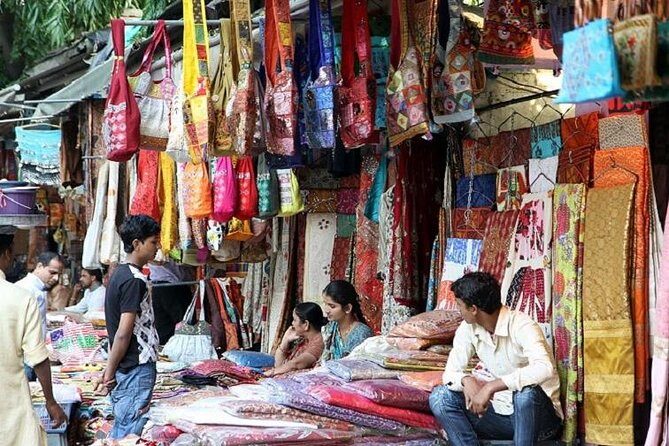
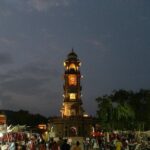
The Clock Tower Market, also called Sardar Market, is the tour’s lively hub. It centers around the late 19th-century clock tower built by Maharaja Sardar Singh. This is where the practical side of travel shows up: handicrafts, textiles, spices, and local delicacies.
I love ending near here because it makes the tour useful. You’re already in the place where you can turn ideas into purchases—like a spice that makes sense for your cooking, or a small handicraft you can pack. Even if you don’t plan to buy much, it helps to see where the city’s normal economy lives.
Since the start and end point are the same Clock Tower reference, you’ll feel less lost when the tour wraps. That matters when you’re juggling Old City lanes after a short walking session.
What the guide adds: licensed languages, real storytelling, and real-world quirks
This tour is led by an English/Hindi speaking licensed tour guide, and that bilingual element makes a difference. You can ask questions without playing charades, and you’re more likely to get explanations that connect the architecture to the people who built it.
In one example, a guide named Imtiaz was highlighted for being deeply informative and helping the group cover off-the-beaten spots and views. That kind of guidance is what turns a list of landmarks into a coherent walk.
Now, a fair warning based on the information you provided: there’s a real-world risk that a guide might contact you to adjust timing. One negative experience described a guide trying to get a participant to start earlier than booked. My advice is simple: confirm your meeting time and stick to your booked window.
Also, for comfort and safety, pay attention to your guide’s condition at the start of the tour. If anything feels off, speak up right away.
Pacing, group size, and what 1 hour 40 minutes feels like
This walk lasts about 1 hour 40 minutes to 2 hours, with a maximum of 15 people. That small cap is a big deal in Old City areas. Larger groups turn narrow lanes into a bottleneck. Here, you’re more likely to keep moving and still hear the guide.
The route also alternates between architecture-heavy stops and street-lane time. That rhythm helps. You’re not stuck in one kind of scene for the whole tour, and your eyes get breaks.
If you’re coming from a longer travel day, this duration is a sweet spot: enough time to get real context, not so long that you’re exhausted by the time you reach the market area.
Why the price of about $13.39 can be good value
At $13.39 per person, the price is attractive if you want guided context without paying high-ticket museum costs. A lot of the stops are marked as admission-free in the tour outline, which matters in a country where some sites can charge separate fees.
You’re paying mainly for:
- a licensed guide (language support + storytelling),
- a structured route through several key Blue City-linked locations,
- and a walk that saves you from piecing together directions on your own.
It’s also booked fairly ahead on average (about 23 days). That’s a clue that people value it as a compact orientation walk. If you’re traveling in peak season, snag a spot early so you’re not forced into a less convenient time slot.
Practical tips so you enjoy the Blue City, not fight it
Here’s how I’d set yourself up for an easy win:
Wear good shoes. Old City lanes and stepwell areas aren’t designed for flip-flops. Support matters.
Bring water and take small breaks. The tour is short, but the mix of walking and looking adds up quickly.
Plan for photo moments without blocking others. Navchowkiya lanes are narrow; take quick shots and keep moving.
Use the Clock Tower meeting point as your anchor. The start and end reference is the same, so you don’t need to stress about where you’ll end up.
Don’t be shy about questions. That’s one reason licensed guides in English/Hindi help. Ask about carvings, water systems, or why blue paint matters.
Should you book this Jodhpur Blue City heritage walking tour?
If you want a compact, well-organized way to connect Jodhpur’s indigo lanes with the city’s water-and-power story, I think this is an easy yes. It’s especially worth booking if you like architecture, want context beyond simple sightseeing, or want a short morning-style plan that keeps you oriented.
I’d hesitate only if you struggle with uneven ground or prefer long, slow museum-style time. This is a walk with specific stops, and it moves at a steady pace.
If you book, double-check your meeting time and confirm you’re aligned on the start. Then show up ready to look closely. The Blue City rewards attention, and a good guide turns attention into understanding.
FAQ
How long is the Jodhpur Blue City Heritage Walking Guided Tour?
It lasts about 1 hour 40 minutes to 2 hours.
What does the tour cost?
The price is listed as $13.39 per person.
Where does the tour meet and where does it end?
Both start and end are at the Clock Tower area (72XF+37C), near Makrana Mohalla, behind Pal Haveli in Jodhpur’s Old City near Gulab Sagar.
What’s included in the tour?
Included items are a licensed English/Hindi speaking tour guide, Clock Tower Market, Ranisar and Padamsar reservoirs, Toor Ji Ka Jhalra (step well), Blue City, and Gulab Sagar.
Is admission required for the stops?
The itinerary stops are marked as Admission Ticket Free in the tour outline.
How big is the group?
The tour has a maximum of 15 travelers.
What kind of ticket do you get?
You receive a mobile ticket.
Can I cancel for a refund?
Yes. Free cancellation is available up to 24 hours in advance for a full refund.
Is the tour suitable for most people?
The tour notes that most travelers can participate and that it’s near public transportation.