REVIEW · NEW DELHI
Delhi: Private Guided Full-Day Tour of New Delhi And Old Delhi
Book on Viator →Operated by Shadow Trips · Bookable on Viator
Delhi moves fast, even for locals. This full-day private tour is built for people who want to see the big names without spending the whole day figuring out routes. I like the mix of tuk-tuk in Old Delhi and a comfortable car for New Delhi, and I like that you get a professional English-speaking local guide doing the storytelling so you don’t miss what you’re looking at. One thing to consider: the itinerary is packed, so each stop is time-limited, which means you’ll want to accept quick photo breaks as part of the deal.
You also get practical support that matters in real Delhi time: hotel-area pickup options across Delhi and nearby NCR, a planned start window between 8 AM and 12 PM, plus water and even umbrellas in rainy or hot seasons. If you’re traveling solo, you’ll likely appreciate the guide being willing to help with photos, so you’re not stuck guessing how to frame yourself in front of major sights.
In This Review
- Key highlights at a glance
- Why this Old and New Delhi mix actually saves your day
- Pickup, timing, and how the private format works
- Old Delhi by tuk-tuk: Sunehri Masjid, bazaars, and getting your bearings
- Jama Masjid: your first major landmark, and what to notice
- The spice lanes: Khari Baoli and the Red Fort area
- Laxmi Narayan Temple: a calm pause with a clear theme
- Gurudwara Bangla Sahib: gold details and a simple reason to love it
- New Delhi monuments: India Gate and the story of the names
- Agrasen Ki Baoli: a stepwell for photos and a break from the big streets
- Gandhi Smriti: the short stop that hits hard
- Lotus Temple and Lodhi Garden: a softer ending to a packed day
- Price and value: what $5 gets you and where you might spend more
- Who this tour fits best (and who should pick a different day)
- Should you book this Delhi full-day tour?
- FAQ
- What is the tour duration?
- What time can I choose for pickup?
- Where does the tour start?
- Does the tour include a tuk-tuk ride?
- What transport is included during the day?
- Is the tour private?
- Is admission included for stops?
- Is the guide available in English?
- Can I cancel for free?
Key highlights at a glance
- Tuk-tuk ride through Old Delhi starting from Sunehri Masjid area, with guided commentary
- Jama Masjid as the anchor stop, with included admission listed for this stop
- Old Delhi to New Delhi transfer handled by private air-conditioned car and chauffeur
- Monuments plus quieter stops like Agrasen Ki Baoli and Gandhi Smriti on the same day
- Water, parking, tolls, and fuel handled, so your day runs without constant small payments
Why this Old and New Delhi mix actually saves your day
Delhi is two cities stacked together: Old Delhi with lanes and bazaars, and New Delhi with wide avenues and official buildings. Doing them separately means more transit, more planning, and more chances to waste time trying to “figure it out.” This tour connects both in one go, so you can switch gears: tuk-tuk for the older streets, then car for the larger sights that sit farther apart.
I like that it’s private. You aren’t being herded into a schedule designed for a big group. You’re also not juggling directions while you’re trying to enjoy things like the main mosque area or the spice markets.
The guide commentary is the other big piece. Without local context, it’s easy to treat Delhi’s sights like photo backdrops. With a guide, you get the why behind what you’re seeing, like the role marketplaces play for locals and what Jama Masjid’s scale means.
You can also read our reviews of more guided tours in New Delhi



Pickup, timing, and how the private format works
You can arrange pickup from anywhere in Delhi, Noida, Gurugram, Ghaziabad, or Faridabad. Your pickup time can be chosen between 8 AM and 12 PM, which is useful if you want to start early to beat heat or heavy traffic. The day is planned for about 6 to 7 hours, so it’s a long-but-manageable stretch.
Even though the tour starts at Sunehri Masjid (Nishad Raj Marg, Lal Qila area), the design is still built around pickup. The practical takeaway: you don’t need to transport yourself across Delhi before the tour begins.
Transport is two-part:
- You use a local tuk-tuk for the Old Delhi segment (listed as included in the tour option)
- You switch to a private air-conditioned car with chauffeur for the rest
That change matters. Tuk-tuks are perfect for short, crowded lanes and getting the feel of the neighborhood. The car takes the strain off for the longer New Delhi stretches and keeps the day more comfortable.
Old Delhi by tuk-tuk: Sunehri Masjid, bazaars, and getting your bearings

The tour begins at Sunehri Masjid. From there, you jump into the tuk-tuk for a guided ride past Old Delhi’s colorful, busy bazaars. The key word here is orientation. Old Delhi is the kind of place where you can walk 10 minutes and feel like you’ve entered a totally different neighborhood. The ride helps you get your bearings fast, so later, when you look at Jama Masjid or nearby areas, you understand the surrounding logic.
This is also the moment where the guide’s commentary starts paying off. You’ll hear why the bazaars matter for daily life, not just why they look interesting. It’s the difference between seeing storefronts and understanding how the area functions for locals.
Time-wise, don’t expect a long “wandering” session in this first segment. You’re getting an efficient route through the hardest-to-navigate part of the day, while still feeling connected to the place.
Jama Masjid: your first major landmark, and what to notice
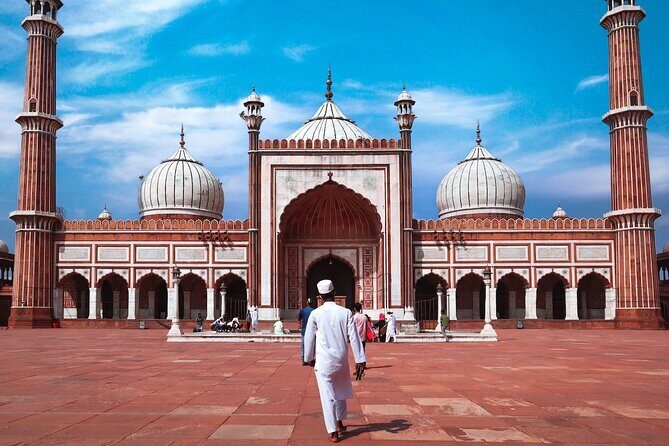
Next comes Jama Masjid, described as India’s largest mosque. The schedule notes it began in 1650 and was completed in 1656—a six-year build for a major religious site. That kind of timeline is useful because it gives you a scale of ambition: this wasn’t a quick local project.
Expect about one hour here. That’s enough to:
- Take in the main mosque area
- Walk slowly around key viewpoints
- Listen to the guide explain what you’re seeing
The admission is listed as included for this stop, which helps your budgeting. It also means the day keeps momentum—no searching for tickets or re-checking rules on the spot.
If you’re the type who likes photography, plan to move deliberately. With a mosque this large, you’ll find plenty of angles, but you’ll also see people flowing in and out. Your best results come from pausing long enough for the light and foot traffic to work in your favor.
The spice lanes: Khari Baoli and the Red Fort area
After the main mosque, you head toward Khari Baoli, famous as a spice market. The schedule frames it as Asia’s biggest spices market and notes that prices are fixed—handy because it sets expectations for how you’ll buy or browse. Even if you don’t purchase, this stop helps you understand Old Delhi’s economy at street level.
Time here is short (about 15 minutes), and it’s listed as pass-by style rather than a deep shopping session. Treat it as a sensory sampler: colors, smells, and the feel of a market street.
Right after this, the itinerary references the Red Fort area (built by Shah Jahan between 1639 and 1648 and serving as a Mughal residence). The note suggests you’ll see it as part of the routing rather than a full visit. That’s still valuable, because it ties the story of Old Delhi together: mosque, bazaars, then the Mughal power center.
You can also read our reviews of more private tours in New Delhi






Laxmi Narayan Temple: a calm pause with a clear theme
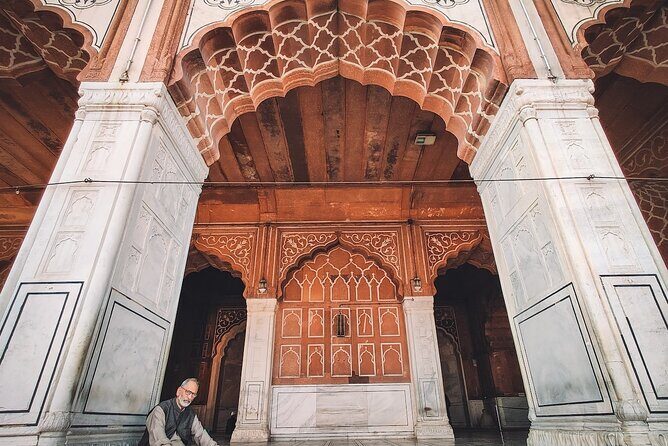
In the middle of Old-to-New transitions, you’ll stop at Laxmi Narayan Temple, dedicated to Vishnu and Lakshmi. You’ll get about one hour, and it’s marked as free admission.
This isn’t just a random “another temple” stop. It gives you a different religious and architectural flavor than Jama Masjid, and it breaks up the intensity of market streets. If you enjoy variety—different faith spaces, different design styles—this is one of the best “breather” moments in the schedule.
Gurudwara Bangla Sahib: gold details and a simple reason to love it
Next is Gurudwara Bangla Sahib, described as Delhi’s biggest gurudwara dedicated to Guru Har Krishan Ji. The schedule claims that parts inside are made with gold and that the site dates to the 17th century.
Time is about one hour, also listed as free admission. This stop works well because it’s easier to slow down here. You can step back, watch, and listen without the same kind of commercial noise you’ll encounter in spice lanes.
For solo travelers, this is also a good place to ask your guide for photo help. With the main sights, you often end up trying to solve the self-timer problem in a busy setting. The tour’s private setup makes it easier to get a usable picture without blocking anyone.
New Delhi monuments: India Gate and the story of the names
Once you’re in New Delhi mode, the vibe changes fast. The tour moves you to India Gate, described as a war memorial built in 1921 for the First World War, referencing the Indo-British army against Germany. There’s also mention that soldier names appear on the walls.
Your stop here is about 30 minutes. That’s enough time to see the memorial structure, take a few photos, and read a handful of names if you want. Don’t plan to read everything—just pick out a few and let the guide explain the context.
Then you pass Rashtrapati Bhavan and Parliament building for photography with a stop listed at about 15 minutes. This is a classic “see the big government landmarks” moment. Even if you’re not a politics person, it helps you understand why New Delhi looks the way it does: formal, symmetrical, and designed for large-scale public viewing.
Agrasen Ki Baoli: a stepwell for photos and a break from the big streets
Next comes Agrasen Ki Baoli, a stepwell made by King Agrasen in the 14th century. The details in the schedule are fun and very practical for photographers: about 60 meters deep and 15 meters wide.
Time is about 15 minutes, and that’s exactly right for this kind of stop. A stepwell can be hard to fully enjoy if you’re rushed, but it doesn’t require long visits like a full museum does. You’ll likely spend this time taking pictures of the structure and getting a sense of its scale.
Gandhi Smriti: the short stop that hits hard
Then you visit Gandhi Smriti, described as the Birla House, where Gandhi spent his last 144 days and where he was killed on 30 January 1948 by Nathuram Godse. The stop is listed at 30 minutes.
This is one of the more emotionally serious moments in the itinerary. It’s also one of the easiest to get right because you’re not trying to shop or compare designs. You’re learning what happened here, and then moving on with context in your head.
Because it’s a memorial site, keep your pacing respectful. If you want photos, take them during natural pauses rather than while people are entering or leaving areas.
Lotus Temple and Lodhi Garden: a softer ending to a packed day
The final major stretch includes Lotus Temple and Lodhi Garden.
Lotus Temple is described as a Bahai house of worship built in 1869, with a petal-like design. The schedule notes 27 petals outside and 9 inside, plus that it works like a meditation center. Time is about 30 minutes.
This is a great counterbalance after stronger political and religious stops. Even if you don’t do a formal meditation session, the space is designed to help you slow down. You’ll get pictures of the architecture too, but the real win is stepping out of constant historical narration for a moment of calm.
After that, you visit Lodhi Garden, described as Delhi’s largest garden and offering a heritage walk. Time is 30 minutes.
This isn’t the time to expect a long stroll through a giant botanical park. It’s a clean finish: a walkable end to a day that started with dense streets and ended with slower scenery.
Price and value: what $5 gets you and where you might spend more
At $5.00 per person, the tour price feels like an unusual deal—especially because you’re getting private air-conditioned car transport, a professional English-speaking local expert, and a tuk-tuk ride option for Old Delhi. Also included are water bottle, parking, tolls, fuel, and taxes, plus umbrellas during rainy and summer seasons.
That said, don’t skip the fine print mindset:
- Tips and gratuities are not included
- Meals are not included
- Some monument entrance fees are only covered if you pick the option where they’re included
- Jama Masjid is listed with admission included, and other stops are listed as admission free in the schedule, but always sanity-check what’s covered in your specific ticket option
My advice: budget for a bottle of water and a snack even if water is provided. A day like this can easily run longer than you expect, and Delhi heat can turn “one quick stop” into “I need a break now.”
The value is strongest if you hate planning. If you’re the kind of person who enjoys assembling routes, downloading maps, and bargaining through ticket counters, you might do it cheaper on your own. But if you want to maximize the day with less mental load, this setup is built for you.
Who this tour fits best (and who should pick a different day)
This tour is a strong match for:
- Solo travelers who want help with direction and photos
- First-time visitors who want a guided route through both Old Delhi and New Delhi
- People who prefer comfort for the long transfers but still want a real street experience via tuk-tuk
It may be less ideal if:
- You want long, slow visits at each sight
- You expect to do deep shopping in the spice market
- You dislike structured itineraries and prefer a fully flexible day with no time limits
Delhi heat is real, and this schedule is built for it with umbrellas and a water bottle. Still, plan on wearing breathable clothes and keeping a light mindset. You’re not on a “stay forever” tour. You’re on a “see the essentials with a guide” tour.
Should you book this Delhi full-day tour?
If you want to cover major highlights from Old Delhi and New Delhi in one day, with pickup support, private guiding, and the practical comfort of a chauffeur-driven car, I think this is an easy yes. The biggest reason to book is simple: you spend less time wrestling with logistics and more time understanding what you’re looking at.
If you’re the type who gets stressed by time limits, consider whether 6 to 7 hours with short stops is your style. For most first-timers, it’s a smart way to get an organized taste of Delhi without losing the day to getting lost.
FAQ
What is the tour duration?
The tour runs about 6 to 7 hours.
What time can I choose for pickup?
You can choose a pickup time between 8 AM and 12 PM.
Where does the tour start?
The meeting point is Sunehri Masjid (Nishad Raj Marg, Lal Qila, Old Delhi, New Delhi, Delhi 110006).
Does the tour include a tuk-tuk ride?
A local tuk-tuk ride is included in the Old Delhi portion only if you select the tickets option that includes it. The rest of the tour is by car.
What transport is included during the day?
You get sightseeing by a private air-conditioned car with chauffeur, plus the Old Delhi tuk-tuk ride as noted above.
Is the tour private?
Yes. It’s a private tour/activity, and only your group participates.
Is admission included for stops?
Jama Masjid is listed as having admission ticket included. Entrance fees for monuments are included only if you select the option where they are included.
Is the guide available in English?
Yes. The tour includes a professional English-speaking local expert.
Can I cancel for free?
Yes. You can cancel for a full refund if you cancel at least 24 hours before the experience starts.