REVIEW · AGRA
Agra To Jaipur Drop Via Fatehpur Sikri & Chand Baori, Step Well
Book on Viator →Operated by India saying namaste Trips · Bookable on Viator
Two big stops, one easy ride. This private transfer turns a long Agra-to-Jaipur day into a set of clear sights, with a comfortable A/C car and English-speaking guided tours at the main sites. I also like that entry tickets are handled as part of the plan, so you can spend your time watching stonework instead of lining up. One thing to keep in mind: the English level can vary at Chand Baori, depending on which guide you get.
You’ll be picked up in Agra from hotels or the station, then dropped anywhere in Jaipur when you’re done. The pace is steady (about 8 hours total), with guided time at Fatehpur Sikri and a shorter stop at the stepwell—perfect if you want “maximum monuments per day” without the stress of organizing transport and tickets.
In This Review
- Key Things I’d Plan Around
- Private A/C Transfer: The Real Value of This Agra-to-Jaipur Day
- Logistics you’ll actually feel
- Fatehpur Sikri Highlights: What You’ll See and Why It’s Worth the Time
- Mughal entrances and royal display
- Homes, leisure, and the “private life” angle
- Halls for people and for the emperor
- Religious landmarks and royal devotion
- Places tied to Akbar’s personal world
- Small circuit check: fort wall and “city scale”
- One “inside info” detail worth paying attention to
- A real guide name you might hear
- Chand Baori Stepwell at Abhaneri: The 30-Minute Geometry Fix
- What to do in those 30 minutes
- Guide expectations: where consistency may wobble
- Timing, Handoffs, and How the Day Usually Runs
- Heat and stamina: plan for it
- A practical note about luggage and car size
- Food, Shopping Stops, and What to Watch For
- Shopping pressure: keep your focus
- Is This Good Value for You? Best Fit and Tradeoffs
- Should You Book This Agra-to-Jaipur Route?
- FAQ
- How long is the Agra to Jaipur transfer with stops?
- What stops are included on the route?
- Are entry tickets included?
- Is there an English-speaking guide?
- Where are pickup and drop-off locations?
- What about food and drinks?
- Can I cancel for a refund?
Key Things I’d Plan Around
- Private pickup and drop anywhere in Agra and anywhere in Jaipur, so you avoid the hassle of meeting points.
- Fatehpur Sikri with an English guide across major monuments, including Buland Darwaza and multiple royal halls.
- A short, efficient Chand Baori visit focused on the stepwell’s geometry and depth.
- Safe, calm driving plus smooth handoffs between the car and site guides.
- Footwear matters on stepwell stairs and uneven temple-area paths.
- No food included, so your lunch stop is your call (and can be priced up).
Private A/C Transfer: The Real Value of This Agra-to-Jaipur Day
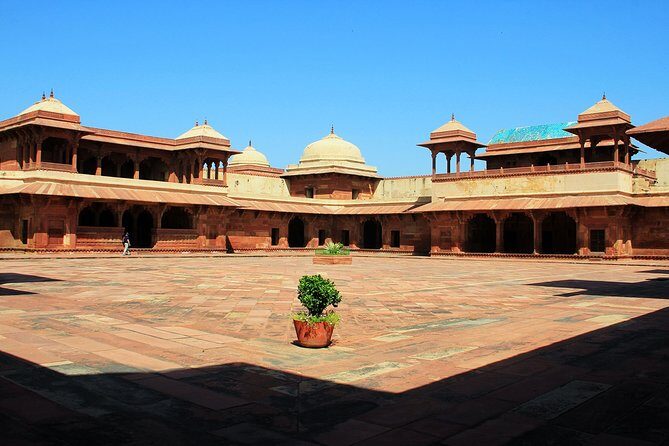
The best part of this tour is that the “travel day” stops feeling like travel. You’re in a private vehicle with a driver who stays with you while you tour each site. That means you don’t waste energy negotiating buses, taxis, or ticket counters between towns.
This also works well for short schedules. The total time is about 8 hours, with guided time carved out at Fatehpur Sikri and a focused visit to Chand Baori (Abhaneri). You’re not trying to race through too many places. Instead, the plan feels like a route with chapters: one Mughal capital stop, one stepwell stop, then you’re in Jaipur.
Price-wise, it’s priced per group (up to 2). At $146.06 total, your effective cost is about $73 per person if you’re traveling as a pair, and that number already includes entry tickets and guided touring. The value is strongest when you’d otherwise pay for a private car plus separate guides and plus tickets.
You can also read our reviews of more tours and experiences in Agra.



Logistics you’ll actually feel
You get pickup from any Agra location—hotel, railway station, airport, or a specific address. On the Jaipur end, you can choose a drop location like your hotel, a railway station, the airport, or a restaurant. That flexibility matters because Agra and Jaipur both have multiple busy areas, and you don’t want to end the day far from where you’ll sleep or eat.
And yes, you’ll get a mobile ticket. In plain terms: fewer surprises when you arrive.
Fatehpur Sikri Highlights: What You’ll See and Why It’s Worth the Time
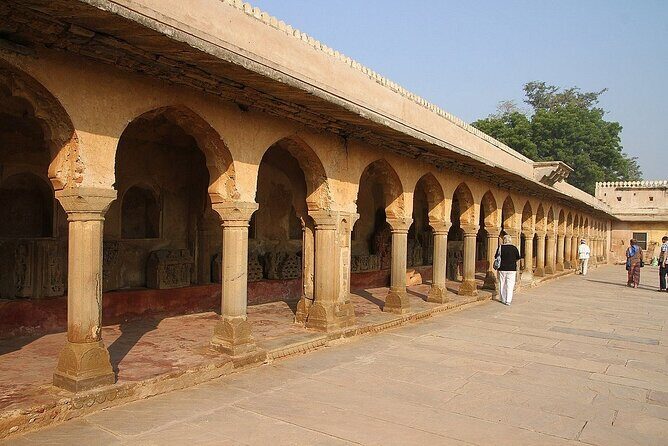
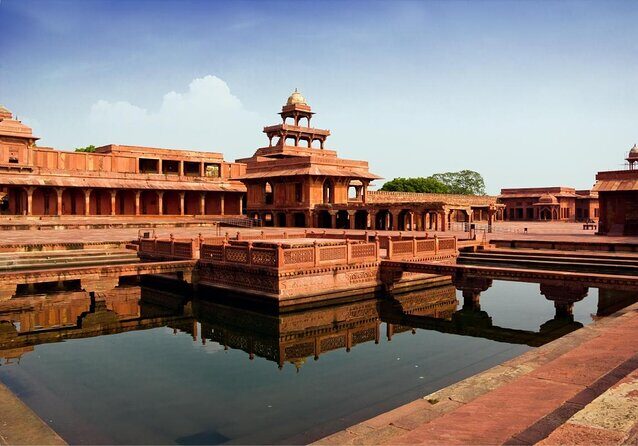
Fatehpur Sikri is one of those places where the details reward patience. The main stop here is about 2 hours with an English-speaking guide covering all areas included in the tour plan. If you like architecture, power, religion, and “how people lived inside the system,” this site gives you those threads in stone.
Here are the specific spots that make the circuit feel complete:
Mughal entrances and royal display
You start with Shahi Darwaza (the royal gateway)—a massive entrance meant for the emperor and his court. It’s built to project authority. Even if you’re not a design nerd, you’ll feel the intention fast: this is where power arrives.
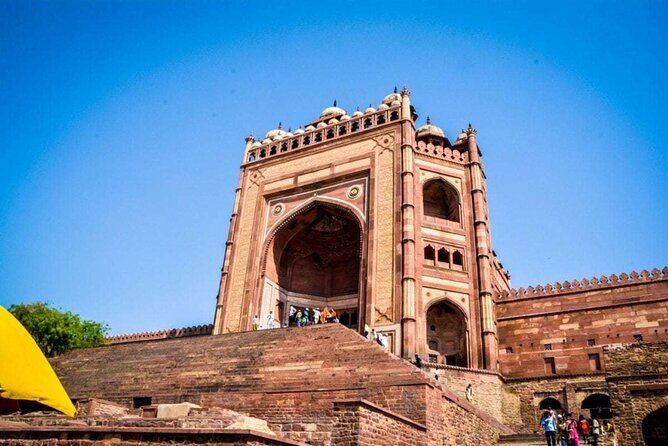
Next is the Buland Darwaza, built by Akbar in 1601 and described as standing 54 meters high. It’s a giant statement wall, tied to Akbar’s victory over Gujarat. Look at how the doorway works as a scale trick—standing at the base helps your brain understand how they wanted visitors to react.
Homes, leisure, and the “private life” angle
You’ll also see the Turkish Sultana’s House, built in an Indo-Turkish style with elegant arches and decorative details. It’s connected to the residence of the Sultan’s consort, so it’s not just military architecture. It’s court life in built form.
Then there’s the Panch Mahal, a five-story pavilion with open pillared spaces designed for leisure and for royal women’s use. The value here is the perspective shifts: each level gives a different “frame” of the complex, and the open structure makes the site feel airy despite its dense layout.



Halls for people and for the emperor
Fatehpur Sikri also explains how the empire spoke to different audiences. The Diwan-i-Aam is the public audience hall—Akbar addressing grievances. The scale and courtyard feel are designed for visibility and order.
A private-counsel angle comes with the Diwan-i-Khas. It’s known for a central intricately carved pillar with radiating stone bridges, meant to symbolize unity. This is where the site stops being “pretty” and starts being political.
Religious landmarks and royal devotion
You’ll visit the Tomb of Sheikh Salim Chishti, a white marble tomb associated with gems and stones. Next is the Jama Masjid, described as one of the largest mosques in India, built in 1571 with intricate Persian-inspired motifs.
If you want one practical tip: don’t rush the entry into these sacred spaces just for photos. The surfaces and motifs reward a slower look—especially when your guide can point out what to notice.
Places tied to Akbar’s personal world
Two stops often become favorites because they feel unusual. First, the Hathi Pol (Elephant Gate)—built wide enough for royal elephants to pass. It’s power made literal.
Second, Hiran Minar, the tall tower built by Akbar in memory of his favorite elephant. This is Mughal rule showing affection and symbolism, not just conquest.
You’ll also see the Jodha Bai’s Palace, which blends Rajput and Mughal styles, and Birbal Bhavan near Jodha Bai’s palace, known for symmetrical design and carved detail.
Small circuit check: fort wall and “city scale”
Fatehpur Sikri isn’t just a set of famous buildings. The Fort Wall stretches nearly 6 kilometers, enclosing the Mughal city. Seeing the perimeter concept in person helps you understand how big the capital was, not just how impressive a few monuments are.
There are also functional-feeling stops on the route like the Caravan Sarai near Hiran Minar, tied to merchants resting during travel. That adds a trade-and-movement layer beyond palace life.
One “inside info” detail worth paying attention to
The Khazana (Treasury) is described as thick-walled rooms likely used to store imperial valuables and documents, though it has a mistaken nickname sometimes called Ankh Michauli. Don’t treat that as trivia—this is how history gets wrapped in local naming.
A real guide name you might hear
One Fatehpur Sikri guide name that showed up in feedback is Abid (also called Tony). If you get him, it’s a sign you’re set up for a strong, story-based tour. If you don’t, don’t panic—the circuit still hits the main monuments you’d want.
Chand Baori Stepwell at Abhaneri: The 30-Minute Geometry Fix
Chand Baori is the kind of sight that feels designed for scale tricks. The stop is about 30 minutes, and that short time is intentional. It’s enough to appreciate the symmetrical steps and the sheer depth without turning it into a whole day.
You’re visiting one of the world’s deepest and largest stepwells, built over 1,000 years ago. The main thing to notice is the pattern. The steps don’t just go down—they create a repeating visual grid that makes your brain count levels even when the light changes.
What to do in those 30 minutes
Arrive ready to move slowly. You’ll be looking down the steps and back up at the surrounding edges, so plan to pause in a few key spots rather than rushing everywhere.
Wear proper footwear. Several people specifically called out this point because the stairs can be slippery or uneven, especially in heat or after shade.
And yes, watch for animals. I’d treat it like a gentle warning: goats can be around the area, and you don’t want to step awkwardly trying to dodge them while holding your phone.
Guide expectations: where consistency may wobble
This is the one drawback area I’d manage. Even with the tour including an English guide option, the stepwell area can be run with guides from a more remote background, and English can vary by person. The stepwell itself is still the star, so if the guide is lighter on English, you’ll still get value from the architecture and your own “look and interpret” time.
Also, you might notice nearby religious space such as the Harshad Mata Temple in the area if your guide takes you in that direction. Keep your eyes on what your guide suggests, but don’t expect a long extra detour here—your time is short.
Timing, Handoffs, and How the Day Usually Runs
The day is built around quick transitions between car time and guided time. In practice, it works like this:
- Pickup in Agra from where you’re staying (or a chosen address).
- Drive to Fatehpur Sikri with a guide meeting you at the site.
- About 2 hours of guided touring through multiple monuments.
- A lunch stop along the route, paid by you.
- Continue to Chand Baori (Abhaneri) with entry included and a short guided visit.
- Drive into Jaipur and drop you at your chosen location.
The handoff structure is a big deal. In feedback, people highlighted that guides meet you and the switching is stress-free, so you’re not stuck wondering where to go next.
Heat and stamina: plan for it
It’s often hot on this route. You’ll be walking on steps and uneven ground, then stepping in and out of open courtyards. Bring water with you even though food and drinks aren’t included. If you’re sensitive to heat, schedule your sightseeing pauses rather than pushing through every view at full speed.
A practical note about luggage and car size
This tour is private, and it’s typically a sedan sized for small groups. One concern that came up: if you travel with a lot of luggage (more than about 5+ bags), the car may feel tight. If you’re packing heavy, tell the operator in advance so they can size the vehicle to your reality.
Food, Shopping Stops, and What to Watch For
Food and drinks are not included. That means you’ll likely have a lunch stop along the way. In feedback, one person found the lunch stop overpriced and had to wait briefly afterward while the driver ate next door.
Here’s the simple way to protect yourself: treat lunch as your choice, not part of a fixed deal. If the driver suggests a place, you can still ask what options are available, and you can choose where you eat if there’s flexibility. The tour includes transportation and guided sites—not a restaurant package.
Shopping pressure: keep your focus
Sometimes drivers or guides may suggest stopping for souvenirs. If you want good value, the best approach is the same everywhere: say no politely, compare prices if you do stop, and remember the tour is paid for around heritage sites. You’re paying to see stone and stories, not to buy random items marked up on the roadside.
Is This Good Value for You? Best Fit and Tradeoffs
This tour is ideal if you want:
- A private, door-to-door Agra to Jaipur transfer.
- Two major stops: Fatehpur Sikri and Chand Baori.
- Entry tickets handled, plus guided time at the key sites.
- A day plan that’s structured enough to feel low stress.
It’s less ideal if you:
- Want a long time at Chand Baori. Your visit is about 30 minutes, so the stepwell won’t turn into a full hour-long photo session.
- Need consistently strong English at every minute of every stop. Fatehpur Sikri is more likely to feel dialed in; Chand Baori can be more variable by guide.
- Have very heavy luggage. If you’re bringing lots of bags, message the operator early so you don’t end up in a cramped sedan situation.
Should You Book This Agra-to-Jaipur Route?
I’d book it if you’re trying to make one transit day count. Fatehpur Sikri is the kind of place where a guided circuit saves you time and helps you spot what matters, and Chand Baori is so visually specific that even a shorter stop feels worthwhile.
Skip the booking only if you’re the type who needs long unhurried museum-style time at every site, or if your priority is shopping and food planning rather than architecture and sight circuits. For that style of travel, you’d do better with separate bookings and more flexible pacing.
If you do book, go in with two simple tactics: pack sturdy shoes, and bring water for the walking parts. Then focus on the monuments—Buland Darwaza’s scale, Diwan halls’ purpose, and Chand Baori’s step rhythm—and you’ll come away feeling like the day worked hard for you.
FAQ
How long is the Agra to Jaipur transfer with stops?
It’s about 8 hours total, including sightseeing stops.
What stops are included on the route?
You’ll visit Fatehpur Sikri, then Chand Baori (Abhaneri stepwell), and you’ll be dropped in Jaipur afterward.
Are entry tickets included?
Yes. Tickets are included for the visits, including Fatehpur Sikri and Chand Baori.
Is there an English-speaking guide?
The tour includes English speaking tour guidance for Fatehpur Sikri, and tickets are included for English guided touring at the stop.
Where are pickup and drop-off locations?
Pickup is available from any location in Agra (hotel, station, airport, or address). Drop-off can be any location in Jaipur (hotel, station, airport, restaurant, or address).
What about food and drinks?
Food and drinks are not included. Lunch is typically at your own expense during the journey.
Can I cancel for a refund?
Yes. Free cancellation is available up to 24 hours in advance for a full refund.