Delhi to Jaipur in five days. That’s the appeal.
This is a private Golden Triangle route by air-conditioned car that strings together the big-name sites fast: Delhi monuments, the Taj Mahal, and Jaipur’s royal forts and palaces. I like how the plan balances landmark sightseeing with short, focused stop times, so you’re not stuck in one place all day. You also get daily practical touches like a mineral water bottle and breakfast (4), which matters when you’re moving city to city.
Two things I particularly like: the mix of Mughal highlights (Humayun’s Tomb, Taj Mahal) with Rajput icons (Amer Fort/Amber Palace, Hawa Mahal), and the fact that you’re working with real people who guide you through the sites. The most common praise centers on smooth service from the driver and helpful city guides, with names like Sitaramji showing up in the feedback, plus strong organization led by Abhishek Faujdar. One consideration: the itinerary lists many places with admission tickets not included, and monument fees plus tips aren’t covered—so your total cost will be more than the base price once you add entries.
In This Review
- Key highlights that make this route worth your time
- How the Golden Triangle pace actually feels in five days
- Day 1 in Delhi: Parliament House and India Gate (plus why it works)
- Day 2 Delhi sweep: Qutub Minar, Lotus Temple, Humayun’s Tomb, and back
- Day 3 Agra: Taj Mahal first, then Agra Fort and Fatehpur Sikri
- Day 4 Jaipur: Amber Palace, City Palace, Hawa Mahal, Jantar Mantar, Galta Ji
- Day 5 in Jaipur: Ratnavali Arts and a shopping hour that’s actually practical
- Comfort, timing, and what to pack for a car tour
- Price and value: $50 base fare plus the real-world add-ons
- The service factor: punctual pickup and guides who adapt
- Should you book this Golden Triangle by car?
- FAQ
- Is this tour private?
- Does the tour offer pickup?
- How long is the tour?
- Which cities are included?
- Are meals included?
- Is the mineral water bottle included?
- Are monument tickets included?
- Is Taj Mahal included, and how much time is planned there?
- Is there a cancellation option if plans change?
Key highlights that make this route worth your time
- Private car + professional driver and guide: you’re not sharing the ride with strangers.
- Delhi’s standout mix: Qutub Minar, Lotus Temple, and Humayun’s Tomb in a single flow.
- One big Agra day: Taj Mahal gets the longest time slot, with Agra Fort and Fatehpur Sikri added.
- Jaipur by the royal route: Amer/Amber, City Palace, Hawa Mahal, Jantar Mantar, plus Galta Ji.
- Included essentials: AC vehicle, parking fees, daily mineral water, and 4 breakfasts.
- Luxury add-on mentioned: light-and-sound in Jaipur and an Amer Fort ride are included only with the luxury package.
How the Golden Triangle pace actually feels in five days
The Golden Triangle is famous because it’s efficient: Delhi, Agra, and Jaipur. In this format, you’re covering a lot of ground, and you should expect long stretches of car time between cities. The upside is clear: you don’t need to plan connections yourself, and the AC vehicle turns the travel time from a chore into something manageable.
The other reality check is intensity. The stops are stacked, and most of them are given tight visit windows (for example, 30–90 minutes each). That works well if you like seeing many highlights, but it’s less ideal if you want slow wandering or deep time in one monument area.
Also, you’re moving between eras on purpose. The route jumps from India’s modern political landmarks in Delhi to Mughal architecture in Agra and then into Rajput royal design in Jaipur. That shift can feel like a crash course, but it also makes the trip more rewarding because each city tells a different story.
Day 1 in Delhi: Parliament House and India Gate (plus why it works)
Day 1 keeps things straightforward with two major civic sights: Parliament House and India Gate, both with about a 30-minute block each.
Parliament House gives you a quick sense of modern India’s political center. Even if you’re not planning a deep architecture study, it helps to anchor your Delhi visit in how the country functions today.
Then comes India Gate, the war memorial along Rajpath. India Gate is easy to appreciate on a first night: you can get your bearings in the central ceremonial area and start connecting the names of places you’ve heard before. It’s also a good opening stop because it doesn’t demand a lot of ticket planning or long stair climbs.
Practical note: tickets aren’t included for both stops, so plan to pay monument fees if they apply in your visit timing.
Day 2 Delhi sweep: Qutub Minar, Lotus Temple, Humayun’s Tomb, and back
Day 2 is where Delhi starts to feel like a museum without walls. You get a more varied mix: Qutub Minar, Lotus Temple, and Humayun’s Tomb.
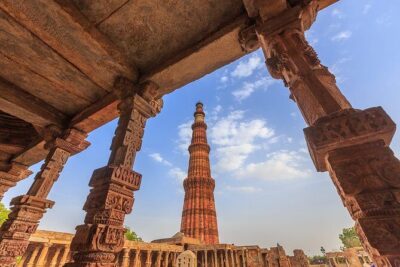
- Qutub Minar (about 40 minutes) is a UNESCO World Heritage Site and one of the most recognizable Delhi monuments. The minaret itself is the star, and the surrounding complex gives you a sense of how layered the area is.
- Lotus Temple (about 40 minutes) is a major contrast in style—Baháʼí worship space known for its flower-like shape. The design makes it a calm stop compared with more fortress-like monuments.
- Humayun’s Tomb (about 1 hour) brings in the Mughal layer. It’s an important stop for understanding the Mughal design language that later culminates at the Taj Mahal.
The day also includes India Gate again and revisits Parliament House. That repetition can feel odd on paper, but it can be useful on the ground—if the first day is more of an orientation pass, Day 2 becomes your fuller monument day while still revisiting the central axis area.
Ticket note: admission tickets are not included for these stops as listed, so keep some flexibility in your budget and time for entry.
Day 3 Agra: Taj Mahal first, then Agra Fort and Fatehpur Sikri
If your goal is the Taj Mahal, Day 3 is built around it. Taj Mahal gets about 3 hours, which is exactly what you want for something this big. This isn’t just a quick photo stop; the time block suggests you’ll be able to pace yourself, take in the symmetry from different angles, and sit with the scale for a while.
After the Taj, you head to:
- Agra Fort (about 1 hour): a historic Mughal fort and former power center. Even with a shorter visit window, it gives you a sense of how rulers controlled the city and landscape around the river.
- Fatehpur Sikri (about 1 hour): a 16th-century Mughal founded city with red sandstone buildings clustered at the center. You also get a small win here: Fatehpur Sikri lists admission as free in the itinerary.
This day is the emotional centerpiece of the whole trip for many people. The key is pacing. With the Taj Mahal as the main event, the rest of the day feels like you’re expanding your understanding rather than just checking boxes.
One more practical consideration: monument time windows can vary depending on day conditions and entry flow. Since admission isn’t included for many stops, bring a payment plan so you don’t lose momentum at the ticket counters.
Day 4 Jaipur: Amber Palace, City Palace, Hawa Mahal, Jantar Mantar, Galta Ji
Jaipur on Day 4 moves like a royal highlights route. You start at Amber Palace (Amer Fort area) for about 1 hour 30 minutes. This fort is elevated on a hill and works as your main fort stop of the day. If you’ve booked a luxury package, the tour notes a ride at Amer Fort and a light & sound show in Jaipur—details like that can be the difference between a standard visit and a more memorable day.
Then you transition into the city’s royal heart:
- City Palace of Jaipur (about 1 hour 30 minutes): a place that connects directly to the ruling court. Even in a short visit, you’ll get a sense of why the palace complex mattered.
- Hawa Mahal (about 40 minutes): the iconic Palace of Wind with its distinctive facade of windows. This stop is great for quick exterior-to-interior impressions.
- Jantar Mantar (about 40 minutes): built astronomical instruments. If you like hands-on thinking, this one tends to click because it’s a meeting point between art and science.
Finally, you close with Monkey Temple (Galta Ji) for about 30 minutes. This is a very different vibe from palaces and towers—think temple complex, hill setting, and a playful atmosphere thanks to the monkeys. If you want one stop that breaks up the palace-heavy rhythm, this is it.
Ticket note: the itinerary lists admission tickets as not included for the listed Jaipur stops, so budget for entry fees.
Day 5 in Jaipur: Ratnavali Arts and a shopping hour that’s actually practical
Day 5 keeps things lighter. You start with Ratnavali Arts (about 1 hour) and then you get time for shopping for clothes and jewelry (about 1 hour), both listed as free.
This is your buffer day. If you’re the type who wants a few tangible souvenirs—sarongs, scarves, maybe something for your collection—this scheduled shopping time helps. It’s also useful if you want to pace your shopping without trying to cram it between monuments.
One word of advice: set a spending range before you arrive. Jaipur shopping can go in many directions, and it’s easy to lose track when you’re tired from the big monument days.
Comfort, timing, and what to pack for a car tour
An AC vehicle is included, and in India’s heat, that’s not a luxury—it’s a sanity saver. Since the itinerary stacks several monuments per day, you’ll also want water on hand even though mineral water is provided daily.
Because monument tickets are not included for most stops, plan to carry what you’ll need for entry payments. I’d also recommend wearing shoes you can move in comfortably. Some sites involve uneven ground and lots of walking, and your time slots suggest you’ll be on your feet.
What I like about this tour format is that it’s structured: clear daily stop lists, short visit blocks, and a professional driver to handle the road. It’s not a slow retreat, but it’s a clean way to get a lot of India highlights without turning your trip into a logistics project.
Price and value: $50 base fare plus the real-world add-ons
The headline price is $50 per person, which is very affordable for a private 5-day car tour across Delhi, Agra, and Jaipur with guiding and daily essentials. But the fine print matters.
Not included:
- GST (Goods and Services Tax)
- Monument fees
- Tips to driver, guide, and hotel staff (hotel staff tipping is mentioned, so tipping is part of the expectation)
Also, hotels aren’t listed in the included items you provided. Breakfast is included (4), but you’ll want to confirm whether your hotel nights are part of your specific package option.
So here’s the practical way to think about value:
- The price covers the private movement, the core guided route, and basic inclusions like breakfast and water.
- You pay extra for entry and on-the-ground service costs that are normal for monument-heavy travel.
In other words, you’re buying convenience and structure at a low base rate, then topping up what you’d pay anyway once you enter famous sites.
The service factor: punctual pickup and guides who adapt
This is one of those tours where the people running it can make it feel smooth or stressful. In the feedback tied to this experience, one repeated theme is how helpful the team is day to day.
Names that show up with praise include Sitaramji as a van driver described as courteous and super helpful, plus Surendra credited with safe, punctual handling from the airport pick-up. On the organization side, Abhishek Faujdar is named as the owner who coordinated the trip well. For a car-based Golden Triangle, that matters because you’re spending hours together; small delays or misunderstandings can snowball quickly.
There’s also a note about flexibility—guides adjusting to what the group needed, rather than bulldozing you into a rigid checklist. That flexibility is a real value feature when you’re trying to cover many monuments on a tight schedule.
Should you book this Golden Triangle by car?
Book it if you want:
- A private Delhi–Agra–Jaipur route in about 5 days
- The Taj Mahal as the main event with a long enough time window to actually see it
- A plan that keeps going—without you planning transport between cities
I’d skip or rethink it if:
- You hate paying monument fees on top of the base price and don’t want that budgeting step
- You prefer slow travel, long museum time, and fewer stops per day
- You need your hotel details clearly included (since hotels aren’t listed in what’s explicitly included here)
Overall, this is a solid choice for people who want the highlights of the Golden Triangle with the comfort of an AC car and guided structure. Just budget for admissions and tips, and you’ll get a trip that feels efficient, not chaotic.
FAQ
Is this tour private?
Yes. It’s described as a private tour/activity, and only your group will participate.
Does the tour offer pickup?
Yes, pickup is offered.
How long is the tour?
The duration is listed as 5 days (approx.).
Which cities are included?
The tour covers Delhi, Agra, and Jaipur.
Are meals included?
Breakfast is included for 4 days.
Is the mineral water bottle included?
Yes. A mineral water bottle is provided to each guest daily.
Are monument tickets included?
No. Admission tickets are listed as not included for most stops, and monument fees are not included overall.
Is Taj Mahal included, and how much time is planned there?
Yes. The Taj Mahal stop is included with an about 3-hour visit time.
Is there a cancellation option if plans change?
Yes. You can cancel up to 6 days in advance for a full refund, and a 50% refund is available if you cancel 2–6 days before the experience starts.