REVIEW · 5-DAY EXPERIENCES
Five days Golden Triangle India Tour From Delhi
Book on Viator →Operated by Trek India Tours · Bookable on Viator
Five days, three UNESCO cities, one smooth plan. This Golden Triangle tour from Delhi is built for people who want structure without feeling rushed, with A/C transport and an English-speaking guide handling the moving parts. I especially like how the plan treats the Taj Mahal like a day-of-the-year event: sunrise for the real mood, plus a later sunset viewpoint across the river.
The second big win is the human touch. Guides associated with Trek India Tours, including Praveen, have a reputation for helping you get your entry tickets sorted and for explaining what you’re seeing in plain language (not museum-speech). One drawback to budget for: monument entrances aren’t included, so your final spending depends on how many paid sites you visit, and Swaminarayan Akshardham is closed on Mondays.
In This Review
- Key Highlights Worth Your Time
- Why This 5-Day Golden Triangle From Delhi Makes Sense
- Price and What $210 Really Buys You
- Day 1 in Delhi: Qutub Minar, Jama Masjid, Lotus Temple, and More
- Fast reality check for Day 1
- Day 2 to Agra: Yamuna Expressway, Itimad-ud-Daulah, and a Taj Viewpoint
- Day 3: Sunrise Taj Mahal, Agra Fort, then Chand Baori into Jaipur
- Day 4 in Jaipur: Amber Palace, City Palace, Jal Mahal, Jantar Mantar, Hawa Mahal
- Day 5 Return to Delhi: a 5-Hour Reset Day
- Guides, Tickets, and How to Keep the Day From Getting Irricky
- Who Should Book This Tour (and Who Might Not Love It)
- Should You Book This 5-Day Golden Triangle Tour?
- FAQ
- What cities are covered on this Golden Triangle tour?
- Is pickup included?
- Are monument entrance fees included in the price?
- How many nights and breakfasts are included?
- Is this tour private for my group?
- Is Swaminarayan Akshardham open every day?
Key Highlights Worth Your Time
- Sunrise Taj Mahal timing: you get the most atmospheric visit window, before crowds fully lock in.
- Viewpoints planned in: including a Taj Mahal sunset viewpoint across the Yamuna area for photos away from the densest areas.
- Private format for your group: only your party participates, which makes it easier to keep a comfortable pace.
- Old Delhi to the Pink City in one trip: you get Delhi landmarks, then Agra, then Jaipur without endless planning.
- Guide support with navigation and tickets: the operation’s guides are known for helping you sort entry logistics on the spot.
- Admission fees not included: several major sights require tickets, so plan ahead to avoid last-minute stress.
Why This 5-Day Golden Triangle From Delhi Makes Sense
If this is your first trip to India, this route hits the big cultural notes fast: Delhi for Mughal and imperial-era landmarks, Agra for the Taj Mahal and Mughal power, and Jaipur for fort and palace architecture. The charm here is not only the sightseeing list—it’s the way the days are sequenced so you’re not backtracking all over the map.
You also get a practical setup: an air-conditioned vehicle for travel between cities and for day drives, plus a professional English-speaking city tour guide. That matters in the Golden Triangle because a lot of the experience depends on timing—when you arrive, how long you spend, and how quickly you can get from gate to sight.
The pace is action-focused, with long-drive days balanced by sightseeing blocks. That can be great if you like momentum. If you prefer slow mornings and long, lazy museum hours, you’ll want to set expectations and focus on the highlights rather than trying to do everything at every stop.
Finally, this is priced as an organized package: you’re not just paying for transport and a map. You’re paying for someone to manage the schedule, coordinate your day, and keep you moving between the three cities.
Price and What $210 Really Buys You
At $210 per person, the headline cost looks low for a 5-day, three-city plan. The key is understanding what’s included and what is not.
Included:
- 4 nights accommodation
- Breakfast for 4 days
- Professional English-speaking guide
- Air-conditioned vehicle throughout
- All tolls and taxes
- Pickup offered, plus mobile ticket support
- Group discounts (when applicable)
Not included:
- Monument entrances (most major sites fall in this category)
So the value is strongest for people who want the “done-for-you” side: lodging secured for four nights, transport arranged, breakfast covered, and a guide to explain what you’re seeing. Your real variable cost will be admissions and any optional add-ons you choose.
One practical tip: before you go, check which paid stops matter most to you. If you’re more interested in the architectural details than shopping or smaller monuments, you can prioritize paid sites and skip anything you don’t care about—without wrecking the overall trip flow.
Day 1 in Delhi: Qutub Minar, Jama Masjid, Lotus Temple, and More
Day 1 is a concentrated Delhi hit, mostly in and around Old Delhi and central landmarks. It’s packed, but it’s also efficient. You start with Qutub Minar, a UNESCO World Heritage Site and one of the most recognizable minarets in the city. It’s tall, tapering, and visually dramatic even at a distance. Expect a good amount of walking and time to look up—this one rewards you for slowing down your gaze.
Next is Jama Masjid, the big Friday Mosque in Old Delhi. It sits above the surrounding hustle, and it’s built to hold a massive number of worshippers. Even if you’re not visiting for a religious service, the scale and the setting around the mosque are part of the experience.
Then you get a breather: Lotus Temple. It’s a Bahá’í House of Worship, open to everyone, and it’s free. The flowerlike shape makes it a calm counterpoint to the heavier Mughal-era stonework nearby. If you want a moment to reset before the later landmarks, this is where you do it.
After that you head to Raj Ghat, a peaceful park on the Yamuna where Gandhi was cremated. The black-marble platform is simple, and that quiet simplicity is the point. It’s also a good way to balance the architecture you’ve already seen.
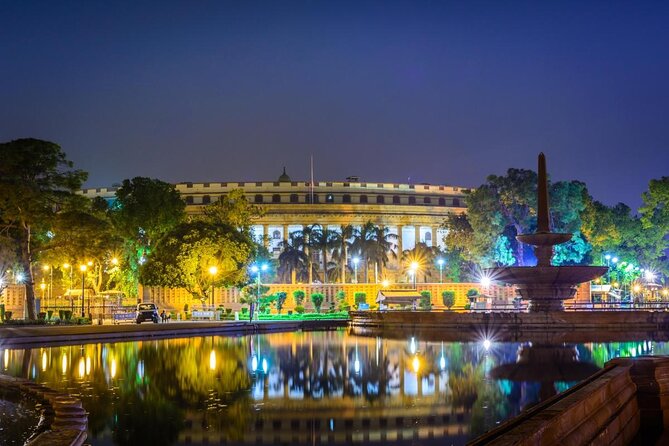
The tour also includes quick looks at Rashtrapati Bhavan (President House) and Parliament House, designed by Edwin Lutyens and Herbert Baker. These are more about the exterior presence and the historical context than about a long interior visit. You’ll also stop at India Gate, the 42-meter memorial arch. Even if you don’t read every name, you’ll feel the scale of what it commemorates.
The day ends at Swaminarayan Akshardham Temple, a showpiece built in 2005 with elaborate stone carvings and a gold statue centerpiece. It’s free on this tour, but keep the calendar in mind: it’s listed as Monday closed. If your trip starts on a Monday, ask your guide how they’ll handle it so the day doesn’t lose its shape.
Fast reality check for Day 1
This is a “many stops” day. Build a strategy: wear comfortable shoes, keep water handy, and don’t expect long, slow photo marathons at every site. The goal is to leave Delhi with the feeling that you understood the city’s layers.
Day 2 to Agra: Yamuna Expressway, Itimad-ud-Daulah, and a Taj Viewpoint
Day 2 shifts gears with a drive from Delhi to Agra. You’re looking at about 3 hours, and the route goes through the Yamuna Expressway area. That matters because it reduces the stress of constantly navigating traffic and getting stalled during transfers.
Once you arrive, you check into your pre-booked hotel and get settled. This isn’t a “no sleep, go go go” day. You have time to recharge before the sightseeing.
The first sight in Agra is the Tomb of Itimad-ud-Daulah. It’s often called the Baby Taj, and the nickname is fair—not because it’s a smaller Taj Mahal, but because it’s a jewel-box level of Mughal refinement. It’s a great warm-up before you see the full Taj Mahal later. You’ll likely notice the attention to detail and the craftsmanship style that the Taj Mahal later perfects.
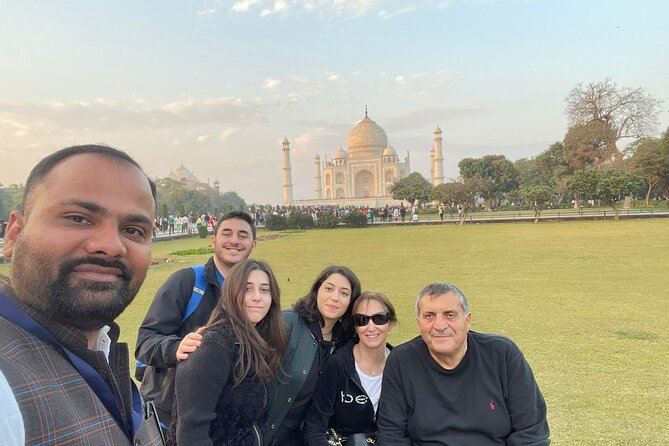
Next comes the Taj Mahal View Point for sunset. The value here is practical: viewing across the river can give you a different angle and sometimes a calmer feel than being right next to the main complex. It also gives you a softer light for photos without relying entirely on the main monument’s immediate surroundings.
Admissions are not included for these Agra stops in the tour price, so budget accordingly. If you want the Taj Mahal experience to stay smooth, it helps to keep your ticket plans ready so you’re not scrambling at the entry gate.
Day 3: Sunrise Taj Mahal, Agra Fort, then Chand Baori into Jaipur
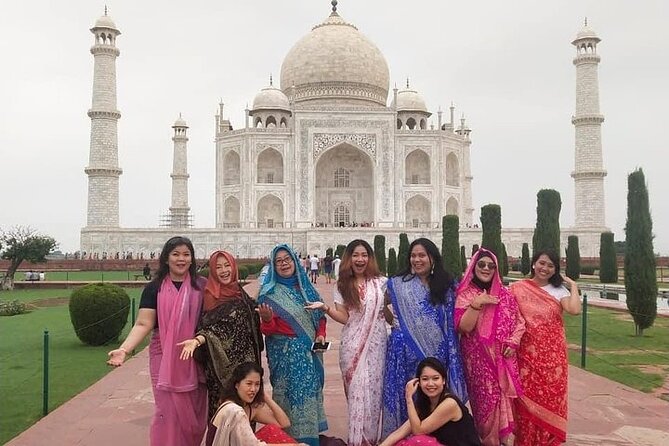
Day 3 is the big one: sunrise Taj Mahal. The itinerary schedules about a 2-hour visit in the early hours. Sunrise is the time when the monument’s mood changes fast with light. You get the classic white-marble glow and fewer crowds compared to later hours (and the guide timing helps you get there before the rush builds).
You’ll also get context during the visit: the Taj Mahal was built by Shah Jahan in memory of Mumtaz Mahal. Even if you’ve read about it before, the sunrise timing makes the story feel more immediate. Don’t just look at the building. Look at the symmetry and the way the grounds and reflections frame the whole scene.
After the Taj Mahal visit, the plan is to return for breakfast and then check out. That flow matters because it prevents Day 3 from turning into a long, exhausting stretch of waiting around. You then go to Agra Fort.
Agra Fort is another UNESCO World Heritage Site and was a main Mughal residence. Here, the experience is about palace walls, balconies, and gardens—architecture tied to power, not just decoration. Expect a more fortress-feeling atmosphere than you had at the Taj Mahal.
Then comes the travel day portion that makes this tour feel like a real “Golden Triangle” loop: you drive to Jaipur, with a stop in Abhaneri for Chand Baori, the step well. Chand Baori is one of Rajasthan’s most spectacular baoris, with carvings and a massive stepped structure that connects to old rainwater-harvesting logic. If you like unusual architecture, this stop can be the surprise favorite.
From Abhaneri, you continue to Jaipur—check in, then rest. Jaipur is where you shift from Mughal marble to Rajasthan’s forts, palaces, and pink-stone drama.
Day 4 in Jaipur: Amber Palace, City Palace, Jal Mahal, Jantar Mantar, Hawa Mahal
Jaipur on Day 4 is a classic lineup: forts, royal buildings, and the city’s famous visual icons. You start at Amber Palace (Amer Fort). It sits up on a hill, about 11 kilometers from Jaipur, and it’s the principal attraction for many first-timers. This is where the Golden Triangle really turns into “fort and palace” tourism, not just monument sightseeing.
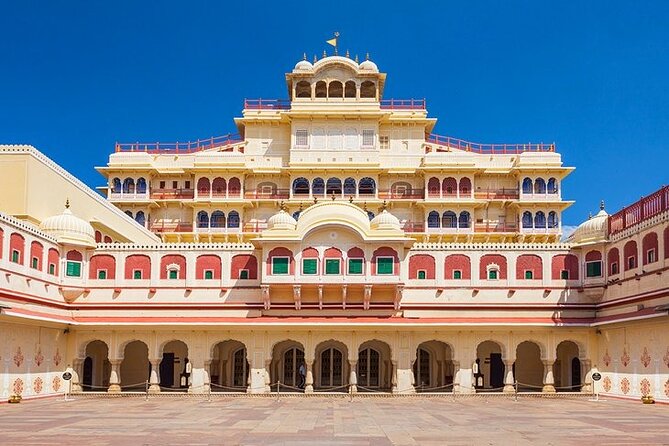
Then you visit City Palace of Jaipur, a palace complex that includes Chandra Mahal and Mubarak Mahal. The tour frames it as the seat of the Maharaja of Jaipur and the Kachwaha Rajput clan. What I like about City Palace in this kind of schedule is that it helps you understand Jaipur as a living power center, not just as a photo stop.
After that, you get a photo break at Jal Mahal. It’s a palace in the middle of Man Sagar Lake. The time here is shorter, so approach it as a view moment. You get the lake and the palace in one frame, which works well before the next heavy stop.
Next is Jantar Mantar, a UNESCO World Heritage Site built in 1734. It’s a set of nineteen architectural astronomical instruments created by Sawai Jai Singh II, designed to observe the sky with the naked eye. This is the kind of stop that makes you look twice: the instruments look like stone geometry, but they connect to how people studied time and movement centuries ago.
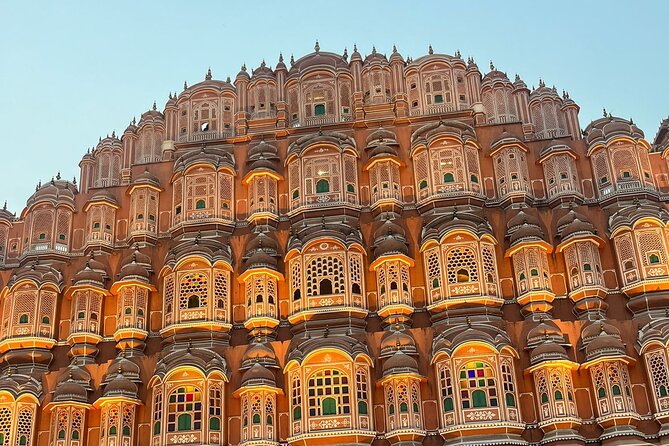
You finish with Hawa Mahal, the Palace of Wind. It’s five storeys, made from red and pink sandstone, built in 1799. Even if you only spend about an hour here, it’s one of Jaipur’s most recognizable shapes. Try to focus on the façade and the layered windows—this is the visual payoff.
Lunch is built into the day as time for a local restaurant. That’s one reason this plan works for most people: you aren’t stuck trying to hunt for food between sights while your group is tired.
Day 5 Return to Delhi: a 5-Hour Reset Day
Day 5 keeps it simple: breakfast, checkout, then the drive back to Delhi. The estimate is about 5 hours, and you’ll be dropped at Delhi Airport or your location.
This is a good way to end a trip like this. After four days of big monument days and lots of movement, having a direct return day reduces the risk of getting stranded in transit. It also keeps your last day from becoming a “bonus sightseeing scramble” that drains you right before you need to travel.
If you have a flight on the final day, you’ll want to plan buffer time based on your specific drop-off point. Traffic and airport flow can vary, and the tour timing is an estimate, not a guarantee.
Guides, Tickets, and How to Keep the Day From Getting Irricky
A lot of Golden Triangle tours rise and fall on one thing: how well your guide handles the small logistics. Here, the tour is designed around professional guidance and an English-speaking city tour guide, and the operation has shown strength in helping with entry tickets and navigation.
In past experiences tied to this service, names like Praveen, Rajiv Gupta, Umesh, and Suresh come up for different roles—guide and driver support. What you can take from that pattern is that you should expect real hands-on help, especially at the busiest entrances like Taj Mahal and major fort complexes.
Here are a few practical moves that will help you enjoy the trip more:
- Budget for entrances before you leave. Since monument entrances aren’t included, your spending will be biggest on the paid sites.
- Bring comfortable walking shoes. Even when stops are “only” 30–60 minutes, the ground is uneven and there’s usually a bit of moving between photo points.
- Think sunrise planning. Sunrise Taj Mahal is scheduled early, so treat that morning as a priority. Keep your evening packing simple so you’re not scrambling.
- Use the guide for timing. If crowds build, your guide can often steer you to the best viewing moments within your allotted time.
And don’t forget this is private for your group. That’s a real advantage if you’re traveling as a family, with people who prefer a calmer rhythm, or if you want a guide to adjust pace to your comfort.
Who Should Book This Tour (and Who Might Not Love It)
This tour is a strong match if:
- You’re seeing Delhi, Agra, and Jaipur for the first time and want a guided plan that ties the landmarks together
- You want the sunrise Taj Mahal experience
- You prefer having transport, hotels, and breakfast handled so you can focus on sightseeing
- You like history explained in a direct way rather than reading everything on your own
It may be less ideal if:
- You hate early mornings. Sunrise Taj Mahal is part of the structure.
- You dislike a schedule with many stops in one day. Day 1 and Day 4 are packed.
- You don’t want to think about additional spending for monument entrance fees.
Should You Book This 5-Day Golden Triangle Tour?
Yes—if you want the core Golden Triangle highlights with solid organization and guide support, this is a sensible way to do it. The value is best when you treat the $210 as covering transport, lodging, breakfast, and guidance, and you separately budget for paid entrances.
Before you book, do two quick checks:
- Your dates for Swaminarayan Akshardham: it’s listed as Monday closed.
- Your ticket budget: because monuments entrances aren’t included, your final total can add up faster than you expect.
If you’re the type of traveler who likes clear plans (but still wants flexibility from a private setup), this tour format will fit you well.
FAQ
What cities are covered on this Golden Triangle tour?
The tour covers New Delhi, Agra, and Jaipur.
Is pickup included?
The tour includes pickup offered in the tour details.
Are monument entrance fees included in the price?
No. Monuments entrances are not included.
How many nights and breakfasts are included?
You get 04 nights accommodation and Breakfast (4).
Is this tour private for my group?
Yes. It’s listed as private, meaning only your group participates.
Is Swaminarayan Akshardham open every day?
No. Swaminarayan Akshardham is Monday closed in the tour notes.