Delhi moves fast. In a good way.
This private 6-hour guided tour is built for seeing Old and New Delhi in one day without the stress of sorting transport or routing yourself. I like how it starts with pickup across Delhi-area cities and ends with drop-off where you want to be, so your day stays smooth even if traffic feels… ambitious.
Two things I really like: first, you get a private guide who can turn major stops into understandable stories (you’ll see the vibe in how guides like Aman and Nikhil G are praised for clear explanations). Second, the mix hits both sacred and iconic sights—Jama Masjid’s scale and the stop at Humayun’s Tomb are the kind of moments people single out as a favorite.
One thing to consider: the schedule is tight. You move through several major landmarks, and at least one big one is a photo stop outside only, so you’ll want to go in knowing this is a highlights-and-context day, not a slow, deep sit-down tour.
In This Review
- Quick hits
- Why this 6-hour Delhi mix works (Old + New without the chaos)
- Pickup and getting around: where the day starts matters
- Jama Masjid: a huge mosque and a smart first stop
- Red Fort from outside: a quick photo moment, not a full visit
- Chandni Chowk: market walking plus a rickshaw ride
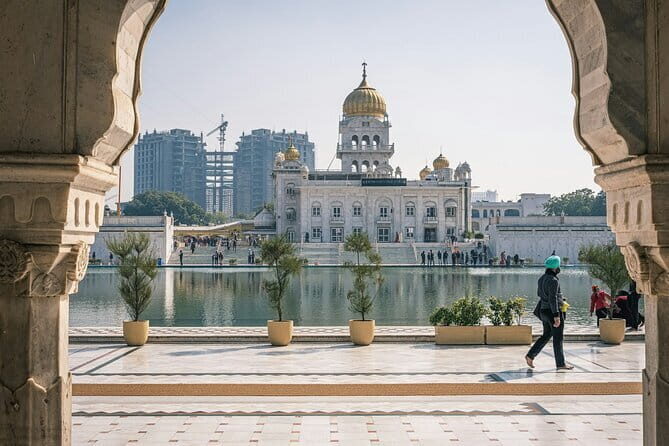
- Gurudwara Bangla Sahib: marble calm in the middle of the city
- Agrasen Ki Baoli: a small stop with big legend energy
- Humayun’s Tomb: the UNESCO stop many people call a favorite
- India Gate: a 1931 monument with a clear physical presence
- Parliament House, President’s House, and the view side of governance
- Lotus Temple: a modern worship space with a simple rule—no idols
- Price and value: what $15.40 per person actually covers
- Who should book this tour (and who might want something else)
- Should you book this 6-hour Old and New Delhi tour?
- FAQ
- What areas are included for pickup and drop-off?
- How long is the tour?
- Is this tour private?
- What monuments and sites are included?
- Is there lunch on this tour?
- Are monument entrance fees included?
- Do we get a rickshaw ride?
- What about Lotus Temple closures?
- What dress code should I follow?
- Do I need photo ID?
- Is cancellation free?
Quick hits
- Private pickup and drop across Delhi, Noida, Gurugram, Ghaziabad, and Faridabad
- AC vehicle + tolls/parking covered, so you don’t juggle logistics
- Jama Masjid admission included, plus a sense of Mughal scale (up to 25,000 for prayers)
- Chandni Chowk rickshaw ride and a full hour in the market area
- Humayun’s Tomb + India Gate for UNESCO and Independence-era monuments
- Lotus Temple visit included, with a Monday swap to Birla Temple
Why this 6-hour Delhi mix works (Old + New without the chaos)
Delhi has a way of feeling endless until you plan like a local. This tour is designed to do exactly that: start in Old Delhi with the Mughal-era icons and market energy, then shift to New Delhi’s broad government landmarks and famous modern worship space.
Because it’s private, you’re not stuck waiting behind other groups. Your guide sets the pace and timing as you go, and that matters when you’re trying to cover Jama Masjid, Chandni Chowk, Humayun’s Tomb, India Gate, and Lotus Temple (plus government buildings) inside roughly six hours.
The value is also in what’s bundled. You get a private vehicle with all the usual add-ons (tolls, fuel, parking, taxes) and a guide, plus mineral water bottles. If you choose the entrance fee and lunch options, you remove two more common trip annoyances: surprise payments and rushed meal decisions.
Pickup and getting around: where the day starts matters
One of the most practical parts is the pickup promise. You can be picked up from anywhere in Delhi, Noida, Gurugram, Ghaziabad, or Faridabad. That’s a big deal in Delhi because “nearby” often isn’t nearby.
The vehicle selection is also spelled out by group size:
- 1–2 people: four-seater sedan
- 3–5 people: six-seater car
- 6–8 people: ten-seater mini van
- 9–12 people: fifteen-seater van
So you’re not squeezed into something too small, and you still get the comfort of air conditioning. You’ll also have drop-off to your choice at the end of the tour across those same cities.
If you want a tip that feels boring but helps a lot: plan your pickup point so you can leave quickly. The tour is long enough that every delay matters, especially in Old Delhi where things can be crowded and slow.
Jama Masjid: a huge mosque and a smart first stop
You start at Jama Masjid, built in the 17th century by Shah Jahan. The tour gives you a focused 30 minutes, and admission is included.
What makes Jama Masjid special is scale. The mosque complex can accommodate up to 25,000 people for prayers, and you feel that immensity the moment you’re inside the space. It’s also a strong “anchor” stop for the day because it frames Old Delhi’s Mughal-era power and design in a way that makes later sights snap into place.
Practical note: mosques are places of worship. Your guide will expect you to follow the dress code. Shoulders and upper arms need coverage, and your lower wear needs to be at least below the knee. You’ll also want to bring a valid photo ID for monument checks.
Red Fort from outside: a quick photo moment, not a full visit
After Jama Masjid, you’ll stop for the Mughal-era Red Fort (the residential palace of the Mughal emperors, built by Shah Jahan in the 17th century). Here’s the catch: the tour does not go inside.
Instead, you get around 15 minutes for photos from outside. This can feel a little abrupt if Red Fort is your top priority, but it’s also a logical compromise for a tight 6-hour schedule. You still get the classic visual association of the day, and you save time for the market and the UNESCO-level tomb stop later.
If Red Fort is non-negotiable for you, consider booking a dedicated Red Fort plan on a separate day. This tour is about breadth, not lingering.
Chandni Chowk: market walking plus a rickshaw ride
Next is Chandni Chowk, Old Delhi’s famous and busy market area. You get about an hour here, with admission marked as free. Chandni Chowk dates to the 17th century, designed by Shah Jahan and laid out under the direction of his daughter Jahanara.
This is where your day gets human. The sights and sounds are part of the experience: shop fronts, crowds, and the feeling that you’re seeing the city’s daily rhythm rather than a staged monument.
What I like in this plan is the inclusion of a rickshaw ride. It helps you sample the motion of the neighborhood without exhausting yourself too early. You’ll still walk some, but the ride breaks it up and keeps the hour from turning into one long grind.
Simple advice: wear comfortable shoes. You’ll be standing and moving around in the market for at least part of that hour.
Gurudwara Bangla Sahib: marble calm in the middle of the city
Then it’s a change of pace: Gurudwara Bangla Sahib, built in the 17th century by Raja Jai Singh and known for its white marble look. The tour gives you about 30 minutes, and admission is included.
There’s a specific historical note that gives context: Guru Har Krishna stayed here in 1664 during his visit to Delhi, and the site is associated with help and service. Even if you don’t read every detail, the atmosphere helps you understand why people keep returning to Sikh gurdwaras in Delhi.
For a practical travel mindset, treat this as your reset moment. After Old Delhi market time, the symmetry and open space here makes it easier to breathe and re-focus before the next major stop.
Agrasen Ki Baoli: a small stop with big legend energy
The next stop is Agrasen Ki Baoli, known for urban legends, including haunted stories. You’ll spend about 30 minutes and admission is included.
This isn’t a monument you visit for grandeur alone. It’s a place where people come for the atmosphere and the story. Your guide may point out how the legends grew over time, but even without leaning into the supernatural angle, it’s still a distinctive Delhi setting—something different from the standard palace-and-temple circuit.
My take: if you like quirky local lore, you’ll enjoy the tonal shift. If you prefer only famous, well-explained sites, you might treat this as a quick palate cleanser rather than the main event.
Humayun’s Tomb: the UNESCO stop many people call a favorite
Humayun’s Tomb is one of the most important moments on the route. You get about an hour, and admission is included. It’s a UNESCO World Heritage Site and a major Mughal-era funerary complex.
The tour plan also seems to understand what works for most visitors: you spend enough time to look around without feeling rushed, and you get the kind of guided framing that helps you see why the architecture mattered.
From the feedback patterns tied to this stop, this is often the one people come away praising most—many call out Humayun’s Tomb as their absolute favorite. If you want one anchor reason to choose this specific tour, let it be this: it’s the stop that turns “I saw Delhi” into “I understood something about Delhi.”
India Gate: a 1931 monument with a clear physical presence
Next is India Gate, with a 30-minute stop. Admission is included. The monument is about 43 meters high and was designed by Sir Balen Shah in 1931.
This stop is less about intimate history and more about perspective. You’ll get a strong sense of the scale of New Delhi’s planning and the way Independence-era memory is built into the city’s public spaces.
Practical tip: this is a good place to take your time for photos because the setting tends to feel open compared to Old Delhi. If you’ve been walking all morning, India Gate can feel like a breather.
Parliament House, President’s House, and the view side of governance
You’ll also stop at Parliament House and President House (Rashtrapati Bhavan). The tour description focuses on what these institutions represent, and practically, this is where you see Delhi’s political identity from the outside.
Because no inside access is described, plan your expectations accordingly. Think of these stops as “understand the layout, see the symbols” moments. It pairs well with India Gate, since the day is moving from Mughal-era Delhi to the modern state’s ceremonial geometry.
Lotus Temple: a modern worship space with a simple rule—no idols
The last big stop is Lotus Temple, a Bahá’í place of worship near Delhi. You’ll spend about 30 minutes, and admission is included.
One of the tour notes that stands out is how it’s presented: there are no idols, and no religious rituals are performed. Instead, it’s described as a place of worship with quiet spiritual use.
If you’re visiting from a country where religious architecture often means statues and icon-heavy spaces, Lotus Temple can feel refreshing. The design language is calm and modern, and it gives your day a clean finish.
Important scheduling note: Lotus Temple is closed on every Monday. On Mondays, the tour visits Birla Temple instead.
Price and value: what $15.40 per person actually covers
At $15.40 per person, this tour can be a strong deal, mainly because Delhi distances add up fast. A private guide plus an air-conditioned vehicle with tolls, fuel, parking, and taxes included is exactly where groups start saving compared with cobbling things together yourself.
Here’s how to think about the price in plain terms:
- You’re paying for time saved (pickup/drop and car included).
- You’re paying for context (private guide).
- You’re paying for convenience items (mineral water bottles and a rickshaw ride).
- Some add-ons depend on your chosen option: monument entrance fees and lunch.
Lunch is included only if you select that option. The tour plan also makes room for a meal break between the Old Delhi segment and the New Delhi segment. If you’re picky about food timing, selecting lunch can reduce decision fatigue.
If you’re traveling in a group, the listing notes group discounts. Even without knowing the exact discount structure, that’s worth asking about when you book.
Who should book this tour (and who might want something else)
This tour fits best if you:
- want major Delhi landmarks in one day
- prefer a private guide instead of walking around with only maps
- appreciate a mix of sacred spaces, historic Mughal sites, and New Delhi monuments
- value a plan with pickup and drop, especially if you’re staying outside central Delhi
It may be less ideal if you:
- want deep time at one monument (this is more of a structured highlight route)
- expect Red Fort to be an inside visit (it’s described as outside photos only)
- are extremely strict about skipping religious sites (the route includes mosques and gurdwaras, and dress code applies)
Also, this is a private tour/activity, so only your group participates. That matters if you want quieter conversation and fewer interruptions.
Should you book this 6-hour Old and New Delhi tour?
Yes, I’d book it if your goal is to get your bearings and see the headline sites without losing hours to planning. With a 4.9 average rating from 11 reviews and consistently positive notes on friendly, clear guide explanations (including guides named Aman and Nikhil G), it’s the kind of tour that tends to work well for first-timers and time-strapped visitors.
My decision checklist for you:
- If Humayun’s Tomb is on your must-see list, this route supports it with real time (about an hour).
- If you like having someone handle logistics, pickup/drop plus AC transport does that heavy lifting.
- If you want slow wandering at one site, plan a separate day; this one is about covering a lot without feeling chaotic.
If you go in with that mindset—highlights with context—you’ll likely come away feeling like you truly mapped Delhi, not just collected photos.
FAQ
What areas are included for pickup and drop-off?
Pickup and drop-off are available in Delhi, Noida, Gurugram, Ghaziabad, and Faridabad.
How long is the tour?
The tour is about 6 hours.
Is this tour private?
Yes. It’s a private tour/activity, and only your group participates.
What monuments and sites are included?
You’ll visit Jama Masjid, Red Fort (outside photo stop), Chandni Chowk, Gurudwara Bangla Sahib, Agrasen Ki Baoli, Humayun’s Tomb, India Gate, Parliament House, President House, and Lotus Temple (or Birla Temple on Mondays).
Is there lunch on this tour?
Lunch is included only if you select the lunch option.
Are monument entrance fees included?
Monument entrance fees are included only if the option is selected. Some stops list admission included, but the package also notes entrance fees depend on the chosen option.
Do we get a rickshaw ride?
Yes. A rickshaw ride is included.
What about Lotus Temple closures?
Lotus Temple is closed every Monday, and on those days the tour visits Birla Temple instead.
What dress code should I follow?
For temples and mosques, you should cover shoulders, chest, navel, and upper arms. Lower wear should be at least below knee length.
Do I need photo ID?
Yes. You should carry a valid photo identity for checking at the monuments.
Is cancellation free?
Free cancellation is available. You can cancel up to 24 hours in advance for a full refund.