REVIEW · NEW DELHI
5-Day Private Golden Triangle Tour: Delhi, Agra, and Jaipur
Book on Viator →Bookable on Viator
Five days, three icons, zero stress. The Golden Triangle works best when someone else handles the moving parts, and this private setup does. You get private local guides (I’ve seen names like Himmat in Delhi, Mukesh in Agra, and Ashok in Jaipur) plus air-conditioned vehicle transfers so the day doesn’t turn into a taxi search.
My favorite part is the way it’s built for comfort without feeling fancy for the sake of it. I like that you travel with entrance fees included for the key sites and that you’re not constantly paying small extras. I also like the basics done right: unlimited bottled water during the tour, and even a battery bus/golf cart return ride from Taj Mahal parking to save your legs.
One thing to plan around: Monday closures affect a couple of major temple stops, and the Taj Mahal sunrise visit is weather-dependent. Add in a few optional extras like a bicycle rickshaw and you’ll want to keep a little cash handy for the choices you want to make.
In This Review
- Key highlights that make this tour tick
- Five Days in the Golden Triangle: A Logistics-Friendly Way to See the Big Names
- Day 1 Delhi Power Walk: Humayun’s Tomb, Qutub Minar, and Old Delhi Calm
- A practical tip for Day 1
- Day 2 Agra in the Right Mood: Agra Fort and a Taj Preview at Mehtab Bagh
- Consideration
- Day 3 Sunrise Taj Mahal and the Stepwells on the Road to Jaipur
- Day 4 Jaipur Icons: Amber Fort, City Palace, Jantar Mantar, and Galtaji
- A practical note
- Day 5 Easy Exit from Delhi (and Why a 5-Hour Transfer Helps)
- Price and Value: What You’re Really Paying For at About $465
- Who This Tour Fits Best
- Should You Book This Private Golden Triangle Tour?
- FAQ
- What time is the pick-up?
- Are hotel and breakfast included?
- Do I need to pay entrance fees separately?
- Is bottled water provided?
- Is the Taj Mahal visit definitely at sunrise?
- Which stops have Monday closures?
- What extra costs might come up?
- Where does the tour end?
Key highlights that make this tour tick
- Private guide in each city: strong, city-specific explanations help the monuments feel connected.
- Taj Mahal logistics handled: sunrise visit plus a battery bus return from parking.
- Old Delhi energy, without the navigation stress: you get a guided flow and can add the Chandni Chowk rickshaw ride for a small fee.
- Agra at dusk: the Mehtab Bagh photo-style stop helps you reset before the big sunrise.
- Jaipur’s big trio: Amber Fort, City Palace, and Jantar Mantar in one focused day.
- Hotel upgrades with breakfast: choose 4-star or 5-star and start each day fed, not hunting.
Five Days in the Golden Triangle: A Logistics-Friendly Way to See the Big Names
If you’re doing Delhi, Agra, and Jaipur for the first time, the hardest part is rarely the sights. It’s the timing: where you go first, how you get across town, and how early you need to wake up to see the best light.
This tour is designed to reduce that stress. You start with a morning pick-up on Day 1, then you move city to city in an air-conditioned car with a private guide in each stop cluster. That structure matters in India, where traffic and schedules can scramble your plans if you’re winging it.
It also helps that the essentials are wrapped in: monument entrance fees for the sites listed, a daily breakfast when you choose the hotel option, and bottled water included throughout. You can focus on what you came for—architecture, history, and those famous views—without constantly doing the math in your head.
Day 1 Delhi Power Walk: Humayun’s Tomb, Qutub Minar, and Old Delhi Calm
Day 1 is packed in a smart way: it starts with Mughal grandeur and medieval history, then shifts into the power and pace of Old Delhi.
You begin with Humayun’s Tomb, a UNESCO World Heritage site. This Mughal emperor’s tomb is famous for its red sandstone-and-white marble look—softening the “big monument” feel by using detail and symmetry. It’s also a good starting point because it gives you a visual key for what later Mughal design in Agra will do with space and reflection.
Next comes Qutub Minar, another UNESCO stop. This is one of those places where scale hits you fast: a tall minaret complex that dates back to 1193. The guide’s job here is important—if you’re only rushing for photos, you miss how this complex connects early Islamic rule to Delhi’s older layers.
Then you get a brief pause at Lotus Temple (free entry) if your timing works. It’s shaped like a lotus with white marble petals, and the calm contrast with the surrounding city is the whole point. Note the listing marks Monday closed for this temple, so if your trip lands on Monday you may see a different temple slot.
From there, the tour moves into iconic government and memorial landmarks, including India Gate. It’s not a war museum moment; it’s a memorial arch, 42 meters high, designed by Lutyens, tied to soldiers who died in multiple conflicts.
After that, you’ll pass major ceremonial architecture linked to modern India’s governance, then head into Old Delhi’s heartbeat with Jama Masjid. This mosque is built on an elevation and can hold around 25,000 people. It’s free entry, and it feels like a living place, not just a monument.
The Old Delhi stretch includes Chandni Chowk, and here’s where you can choose your own level of chaos. The plan includes an exhilarating bicycle rickshaw ride option through the lanes (at your own expense). If you enjoy street-level travel, this is where it all gets real—vendors, movement, and that sensory overload you came for.
You end with quieter spiritual context at Raj Ghat, the memorial site for Mahatma Gandhi’s cremation, then move to Swaminarayan Akshardham (included entry). It’s an effects-heavy temple complex built in 2005, known for craftsmanship and scale. Like Lotus Temple, it’s marked Monday closed, so your guide may adapt if needed.
A practical tip for Day 1
Wear shoes you’re willing to walk in for a while. Day 1 is a mix of grand sites and street segments, and your feet will tell you when you should’ve chosen better footwear.
Day 2 Agra in the Right Mood: Agra Fort and a Taj Preview at Mehtab Bagh
Day 2 is about travel rhythm and setting you up for the Taj Mahal moment on Day 3.
After breakfast, you drive roughly three hours to Agra. This part is where private transfers pay off: you avoid guessing schedules, wrestling with connections, and losing time to random stops.
When you arrive, you check into your pre-booked hotel. That matters because you get a reset period instead of jumping straight into another long walk.
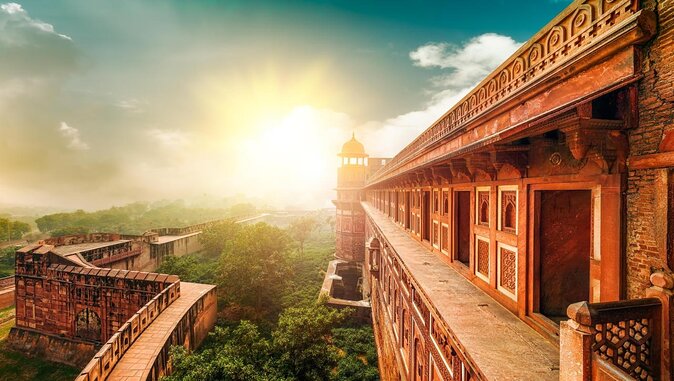
In the afternoon, you visit Agra Fort, a UNESCO World Heritage site on the Yamuna River. Historically, it was tied to Mughal emperors and served as a major residence area. The fort is a great counterpoint to the Taj: it’s not a single postcard building. It’s a fortress complex, full of spaces that help you understand how power worked.
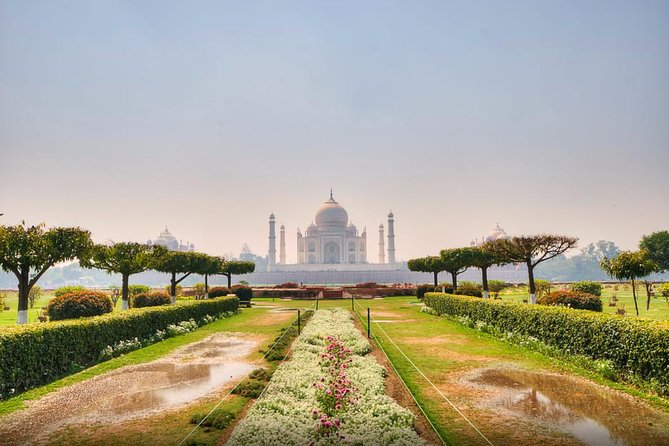
Then comes one of the tour’s smarter choices: you go to Mehtab Bagh for a photo-oriented stop in the evening. This “moonlit garden” viewpoint is designed for Taj views from across the river—often with fewer crowds than the main monument areas. Even if your photos aren’t perfect, you’re getting the bigger idea: the Taj wasn’t built to be looked at only from one angle.
Consideration
This day doesn’t revolve around the Taj itself, which can feel different if you’re expecting nonstop Taj time. But that’s the point. You’re pacing the experience so you’re not Taj-saturated before sunrise.
Day 3 Sunrise Taj Mahal and the Stepwells on the Road to Jaipur
If you’re going to do the Golden Triangle, the Taj Mahal day is the centerpiece. This tour schedules it for a sunrise visit, which gives you softer light and a calmer start compared with midday heat and crowds.
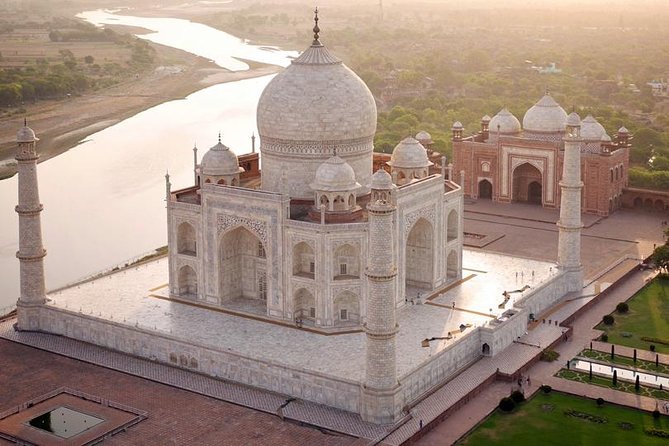
At the start, you visit the Taj Mahal at sunrise (UNESCO World Heritage). This is the monument Shah Jahan built as a memorial for Mumtaz Mahal. You’ll see why people say it’s the most beautiful building in the world—but the real value is how your guide helps you notice design choices: symmetry, scale, and how the complex uses the surrounding space.
You’ll spend a couple of hours there, then shift gears toward Jaipur via a memorable stop along the way.
En route you visit Chand Baori in Abhaneri. It’s one of Rajasthan’s most striking stepwells, plus you can see the Harshat Mata Temple nearby. Stepwells are more than odd architecture; they’re practical solutions that also turned into community-scale engineering. You’ll feel how people learned to work with water and shade long before modern comfort.
After Abhaneri, you continue to Jaipur, the Pink City. You check into your hotel, giving you time to freshen up before the big fort-and-palace day.
Day 4 Jaipur Icons: Amber Fort, City Palace, Jantar Mantar, and Galtaji
Day 4 is where Jaipur’s variety shows up fast. It’s forts, palaces, observatories, and a temple visit built around a different kind of sightseeing: monkeys and holy pools.
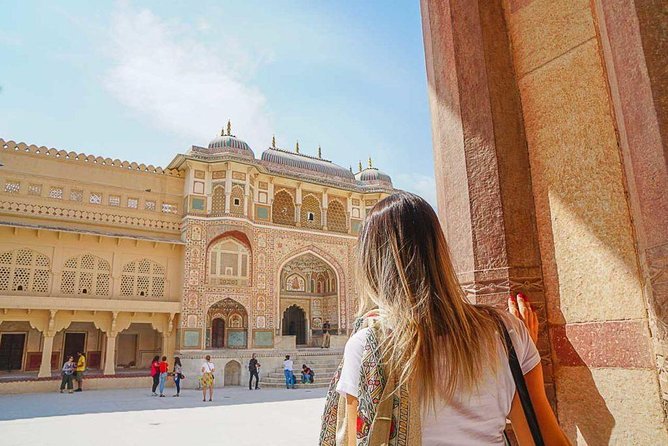
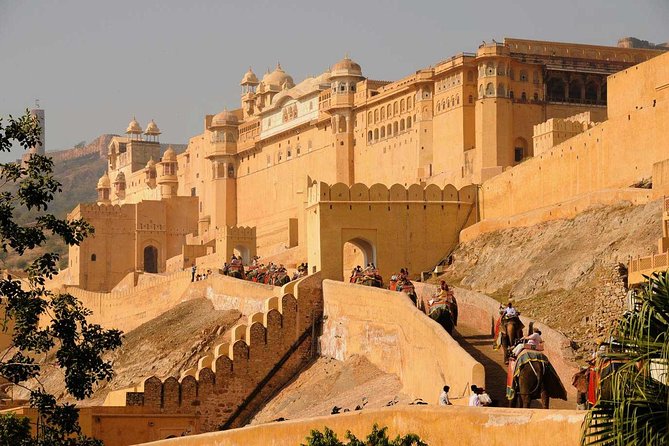
You start at Amber Palace (Amber Fort). This honey-hued fort rises from rocky terrain about 11 kilometers northeast of Jaipur. It’s a classic Rajput architecture example, and it’s dramatic even before you go inside.
Here’s a small cost detail worth knowing: there can be an optional jeep ride at Amber Palace for certain traveler groups (it’s listed as applicable for 5 and above travelers only). If you’re going with a smaller party, you may do the approach without that add-on. Either way, ask your guide what makes sense that day based on your pace.
Next is Jal Mahal, the Water Palace. It’s a photo stop near Man Sagar, a palace that sits dramatically over water. You don’t spend long here, but it’s a good visual break in the middle of all the stone-and-fort energy.
Then you get Hawa Mahal, the Palace of Breeze. This is famous for its honeycombed façade, five stories high, built in 1799. Expect it to be mostly about exterior views and photos rather than a deep interior visit. It still works because it’s one of the most recognizable Jaipur images.
You continue to City Palace, the royal residence complex. It’s not a single era building; it blends elements from different periods, including structures dating into the early 20th century. Your guide can help you read the layers instead of treating it like one more palace room tour.
After that comes Jantar Mantar, a UNESCO observatory made of geometric instruments. This is one of the best “smart” stops on the itinerary because it shows how people tracked sky movements with instruments you can actually see. It’s visual math you can walk through.
You close with Monkey Temple (Galtaji). It’s a 15th-century complex known for its pools and granite-cliff setting. Even if you’re not into temples specifically, it’s a very different atmosphere from the fort and palace day.
A practical note
If you’re concerned about animals, just be aware that this stop is called Monkey Temple for a reason. Keep small items zipped up and follow your guide’s instructions.
Day 5 Easy Exit from Delhi (and Why a 5-Hour Transfer Helps)
On the final day, you get “morning at leisure,” which is a nice relief after three busy days of sights. Then you drive back toward Delhi/Gurugram/Noida for an airport, hotel, or another onward location, taking about five hours.
This kind of end point is useful. You can plan your flight without guessing the transfer time too much. It’s also a better match for reality: in Northern India, road time can be the unpredictable part, and having the transfer timed into the tour saves you from last-minute stress.
Price and Value: What You’re Really Paying For at About $465
At $464.79 per person, the headline number only tells half the story. The value comes from what’s included.
You’re paying for:
- a private air-conditioned vehicle for sightseeing and transfers
- private local guides for the main sightseeing blocks
- monument entrance fees for the listed sights
- unlimited bottled water
- battery bus/golf cart return from Taj Mahal parking
- and, if you choose the hotel option, 4 nights of hotel accommodation plus daily breakfast
For first-timers, that combination is often cheaper than assembling it yourself when you add up entrance tickets, hired guides, and the cost of being inefficient with time. Private guiding isn’t just comfort—it’s interpretation. It turns a pile of monuments into a route you understand.
The upgrade option for 4-star or 5-star hotels also changes the feel of the trip. After long sight days, the room quality and breakfast timing can matter more than you expect.
Two small costs to keep in mind: the bicycle rickshaw ride in Old Delhi and the Amber Palace jeep ride (listed with conditions) are not included. Your guide can help you decide if those are worth it for your style.
Who This Tour Fits Best
This is a strong match if:
- you have limited time and want a clean route across Delhi, Agra, and Jaipur
- you want private guiding so you’re not just photographing, but understanding
- you prefer door-to-door transfers instead of trains and constant coordinating
- you like early starts and want the best light for the Taj Mahal
It’s not ideal if:
- you want lots of free wandering time in each city without a set plan
- you hate weather-dependent plans (sunrise Taj is subject to conditions)
- you want every lunch and dinner handled for you (meals aren’t included)
Also, dress code is listed as smart casual. Pack like you’ll be walking, but you don’t need formal wear.
Should You Book This Private Golden Triangle Tour?
I’d book it if you want the Golden Triangle to feel organized from the first pick-up to the final airport drop. The big value is practical: private guides, included entrance fees, AC transfers, and bottled water remove the daily friction that can sap your energy.
Skip it only if your priorities are totally different—like spending multiple extra days in one city, or traveling with a very loose schedule. And if you’re traveling on a Monday, ask your guide how they’ll handle Lotus Temple and Swaminarayan Akshardham, both marked closed. With that small caution in mind, this tour is a reliable way to see the core Northern India landmarks without turning your trip into logistics homework.
FAQ
What time is the pick-up?
The tour starts with pick-up at 9:00 am on Day 1.
Are hotel and breakfast included?
Hotel and daily breakfast are included only if you book the option that includes hotels. The tour offers a choice of 4-star or 5-star accommodation.
Do I need to pay entrance fees separately?
Entrance fees are included for the sights mentioned on the tour.
Is bottled water provided?
Yes. Unlimited bottled water is included throughout the tour.
Is the Taj Mahal visit definitely at sunrise?
The sunrise visit is subject to weather conditions.
Which stops have Monday closures?
Lotus Temple and Swaminarayan Akshardham are marked as Monday closed.
What extra costs might come up?
A bicycle rickshaw ride in Old Delhi is listed as extra. A jeep ride at Amber Palace is also listed as extra and is applicable for 5 and above travelers only.
Where does the tour end?
It ends in Delhi/Gurugram/Noida, with about a 5-hour drive to your chosen airport, hotel, or other desired location.